
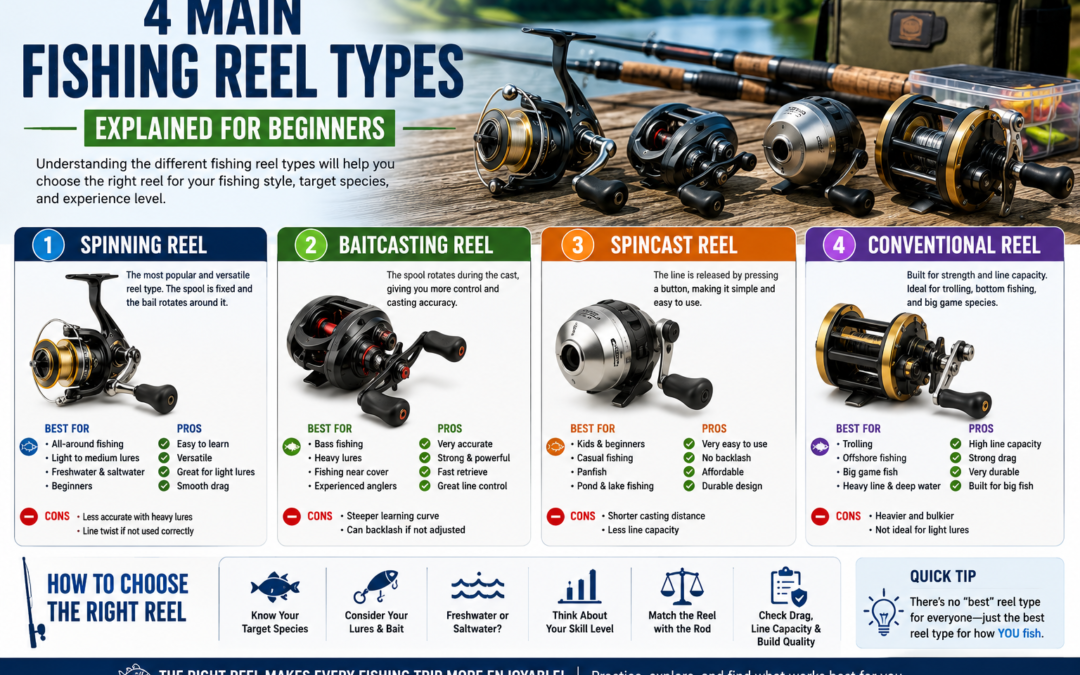
Understanding the main fishing reel types can make it much easier to choose the right equipment for your experience level, target species, and preferred fishing technique. Although fishing reels come in many sizes and designs, most recreational anglers use one of four main styles: spinning, baitcasting, spincast, or conventional reels.
Each reel type handles line differently and offers its own advantages. Some are simple enough for first-time anglers, while others provide the strength, precision, or line capacity required for advanced bass fishing, trolling, surf fishing, and offshore applications.
The Four Main Types of Fishing Reels
The four most common types of fishing reels are:
- Spinning reels
- Baitcasting reels
- Spincast reels
- Conventional reels
Choosing between these designs depends on how you fish, the lure weight you use, the species you target, and how much casting control you need.
1. Spinning Reels: The Most Versatile Choice
Spinning reels are among the most recognizable and widely used fishing reels. They sit beneath the rod and use a fixed spool with a rotating bail to guide the line during retrieval.
To cast, the angler opens the bail, holds the line with one finger, swings the rod forward, and releases the line. This straightforward casting process makes spinning reels suitable for beginners while still offering enough performance for experienced anglers.
Advantages of Spinning Reels
- Easy to learn and operate
- Works well with lightweight lures
- Suitable for freshwater and saltwater fishing
- Handles finesse techniques effectively
- Produces fewer severe backlashes than baitcasting reels
Disadvantages of Spinning Reels
- May provide less casting accuracy with heavy lures
- Line twist can develop when the reel is used incorrectly
- Very large models may feel heavy on lighter rods
Spinning reels are commonly used for bass, trout, crappie, walleye, redfish, snook, and many other species. Explore our spinning reels for freshwater, inshore, and general-purpose fishing.
2. Baitcasting Reels: Greater Accuracy and Control
Baitcasting reels sit above the fishing rod and use a rotating spool that releases line during the cast. They provide anglers with greater control over lure placement, retrieve speed, and line handling.
These reels are especially popular among bass anglers who fish around docks, grass, rocks, and submerged timber. They work well with heavier lures and techniques that require accurate casting.
Advantages of Baitcasting Reels
- Excellent casting accuracy
- Strong control with heavier lures
- Fast line retrieval options
- Compact and comfortable design
- Useful for fishing near heavy cover
Disadvantages of Baitcasting Reels
- Requires more casting practice
- Incorrect spool adjustment may cause backlash
- Usually less suitable for extremely light lures
Modern baitcasting reels include braking and spool-tension systems that help anglers control the rotating spool. Browse our casting reels for bass fishing and power techniques.
3. Spincast Reels: Simple Push-Button Operation
Spincast reels use an enclosed spool covered by a protective housing. The angler presses and holds a button during the casting motion, then releases the button to send the lure forward.
This simple design makes spincast reels popular with children, families, and first-time anglers. They require little adjustment and reduce many of the line-management problems associated with more advanced reel styles.
Advantages of Spincast Reels
- Very easy to use
- Simple push-button casting
- Protected internal spool
- Affordable beginner options
- Suitable for casual pond and lake fishing
Disadvantages of Spincast Reels
- Limited casting distance
- Lower line capacity than many spinning reels
- Less suitable for large or powerful fish
- Enclosed design can make maintenance harder
A spincast reel can be an excellent starting point, but many anglers eventually move to spinning or baitcasting equipment as their skills develop.
4. Conventional Reels: Strength for Trolling and Offshore Fishing
Conventional reels are designed for power, line capacity, and heavy-duty fishing. They are commonly mounted above the rod and use a rotating spool, but unlike baitcasting reels, many conventional models are intended primarily for trolling, bottom fishing, or dropping bait vertically.
Large conventional reels are frequently used for tuna, marlin, grouper, halibut, catfish, and other powerful species. Some models include level-wind systems, line counters, lever drags, or two-speed gearing.
Advantages of Conventional Reels
- High line capacity
- Strong drag systems
- Suitable for large fish
- Excellent for trolling and deep-water fishing
- Available with heavy-duty gearing
Disadvantages of Conventional Reels
- Heavier than many spinning reels
- Can be difficult to cast without experience
- Often designed for specialized applications
Explore our conventional reels for trolling, offshore fishing, and heavy freshwater applications.
Quick Comparison of Fishing Reel Types
| Reel Type | Best For | Skill Level | Main Advantage |
|---|---|---|---|
| Spinning reel | General freshwater and inshore fishing | Beginner to advanced | Easy casting and versatility |
| Baitcasting reel | Bass fishing and heavy lures | Intermediate to advanced | Accuracy and control |
| Spincast reel | Children and casual beginners | Beginner | Simple push-button casting |
| Conventional reel | Trolling, offshore, and large fish | Intermediate to advanced | Power and line capacity |
Which Fishing Reel Type Is Best for Beginners?
Most beginners should start with a spinning or spincast reel. A spincast reel offers the simplest casting system, while a spinning reel provides more versatility and allows the angler to develop skills that remain useful across many fishing styles.
Someone learning bass fishing may eventually prefer a baitcasting reel, but starting with spinning equipment can make it easier to understand casting, drag adjustment, and line management first.
Which Reel Is Best for Bass Fishing?
Bass anglers commonly use both spinning and baitcasting reels. Baitcasters are effective for heavier lures, accurate casting, frogs, jigs, spinnerbaits, and fishing around cover.
Spinning reels are often preferred for finesse techniques such as drop shots, Ned rigs, shaky heads, and lightweight soft plastics.
Many experienced bass anglers carry both reel types so they can change techniques according to water conditions and fish behavior.
Which Reel Type Works Best in Saltwater?
Saltwater anglers use spinning, baitcasting, and conventional reels depending on the application. Spinning reels are common for inshore and surf fishing, while conventional reels are frequently used for trolling and offshore fishing.
The most important consideration is not only the reel style but whether the reel includes suitable corrosion resistance, protected bearings, durable gearing, and a drag system designed for saltwater conditions.
How to Choose Between Different Fishing Reels
When comparing different fishing reel types, consider the following factors:
- Your fishing experience
- The species you want to catch
- The weight of your lures or bait
- The fishing line you intend to use
- Freshwater or saltwater conditions
- The amount of casting accuracy required
- The reel’s drag strength and line capacity
A reel should also balance properly with the fishing rod. An oversized reel can make the setup feel heavy, while a reel that is too small may lack sufficient line capacity or drag strength.
Other Specialized Fishing Reel Designs
Beyond the four main categories, anglers may also encounter electric reels, fly reels, centerpin reels, and line-counter reels. These designs serve more specialized purposes.
Electric reels assist with deep-water retrieval, fly reels manage fly line, centerpin reels allow natural bait presentation in flowing water, and line-counter reels help anglers monitor trolling depth and distance.
Browse our electric reels for powered deep-water and offshore applications.
```htmlWhy Understanding Fishing Reel Types Improves Every Fishing Setup
Learning the main fishing reel types helps anglers avoid buying equipment that does not match their rod, fishing line, lure weight, or target species. Each of the major fishing reel types is designed for a different purpose, which is why understanding their strengths can improve casting control, lure presentation, and fish-fighting performance.
Spinning, baitcasting, spincast, and conventional reels are the four primary fishing reel types used by recreational anglers. Spinning reels are versatile and beginner-friendly, while baitcasting reels provide greater accuracy with heavier lures. Spincast reels simplify casting for children and first-time anglers, whereas conventional reels deliver the strength and line capacity needed for trolling, deep-water fishing, and powerful species.
Comparing fishing reel types also makes it easier to select equipment for freshwater or saltwater conditions. Some fishing reel types are better suited to finesse fishing, while others perform best around heavy cover, offshore structure, or deep water. Reel size, drag strength, gear ratio, and line capacity should always be considered alongside the reel design.
There is no single option that is perfect for every angler. The best choice depends on experience, technique, location, and target fish. By studying the different fishing reel types, beginners can choose suitable equipment, experienced anglers can build specialized setups, and every fisherman can make more confident buying decisions. Understanding fishing reel types ultimately leads to better balance, improved control, and a more enjoyable fishing experience.
```Common Questions About Fishing Reel Types
What are the four main fishing reel types?
The four primary reel types are spinning, baitcasting, spincast, and conventional reels.
What is the easiest fishing reel to use?
Spincast reels are generally the easiest, while spinning reels provide greater versatility for beginners who want to develop their skills.
Is a baitcaster better than a spinning reel?
Neither is always better. Baitcasters offer accuracy and control with heavier lures, while spinning reels are easier to cast and perform well with lighter presentations.
Can one fishing reel handle every fishing style?
No single reel is ideal for every technique. Anglers often use different reels for finesse fishing, heavy cover, trolling, surf fishing, and offshore applications.
Learn More About Fishing Equipment
Visit Take Me Fishing for beginner fishing education, equipment guidance, and responsible angling information.
Additional sport-fishing and conservation resources are available from the International Game Fish Association.