
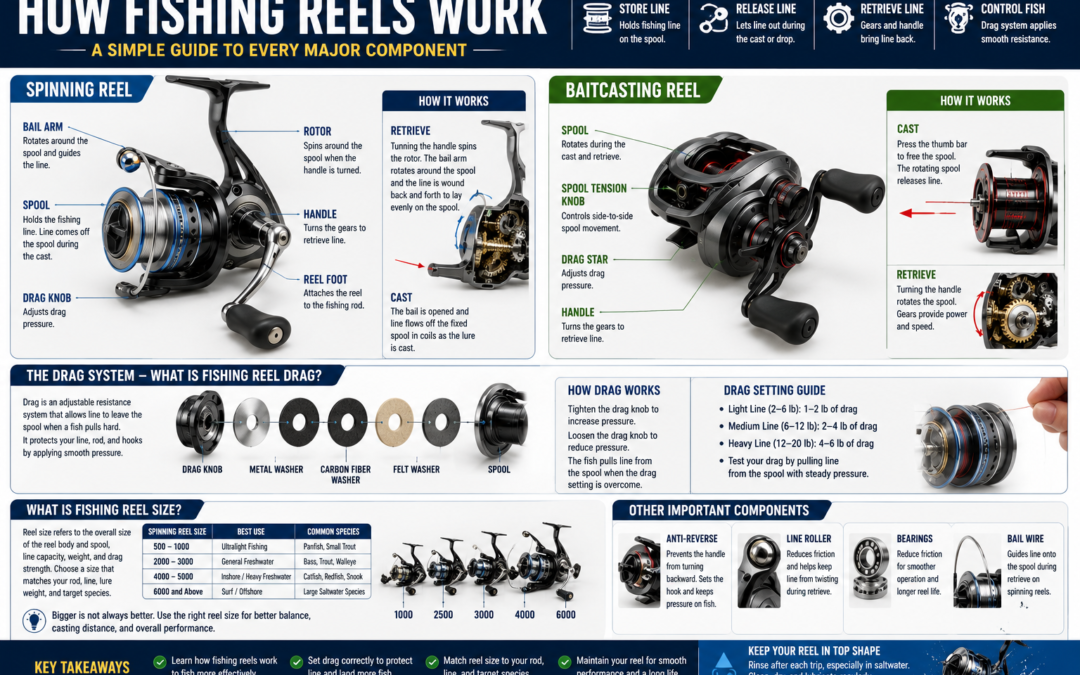
Understanding how fishing reels work can help anglers cast more effectively, select the correct reel size, adjust drag properly, and avoid common line problems. Although spinning, baitcasting, spincast, and conventional reels look different, they all perform the same basic job: storing fishing line, releasing it during a cast or drop, retrieving it through a gear system, and controlling fish with adjustable resistance.
A fishing reel is more than a spool with a handle. Inside the reel are gears, bearings, shafts, drag washers, anti-reverse components, and other moving parts that work together whenever the angler casts, retrieves a lure, or fights a fish.
The Basic Job of a Fishing Reel
Every fishing reel performs four essential functions:
- Stores fishing line on a spool
- Allows line to leave the reel during casting or dropping bait
- Retrieves line when the handle is turned
- Applies controlled resistance through the drag system
The exact mechanism depends on the reel design. A spinning reel uses a fixed spool and rotating bail, while a baitcaster and conventional reel use a spool that rotates. A spincast reel keeps the spool inside a protective housing and releases line through a front opening.
How the Handle and Gear System Retrieve Line
When an angler turns the reel handle, the handle transfers force into an internal gear system. These gears convert each handle rotation into movement that retrieves fishing line.
In a spinning reel, turning the handle causes the rotor and bail to rotate around the stationary spool. The bail guides line back onto the spool while the spool moves slightly forward and backward to distribute the line evenly.
In a baitcasting or conventional reel, turning the handle directly rotates the spool through the gear system. A level-wind mechanism may move from side to side to distribute the line evenly across the spool.
What Is Fishing Reel Gear Ratio?
Gear ratio describes how many times the spool or rotor turns during one complete rotation of the handle. A reel marked 6.2:1 completes approximately 6.2 spool or rotor rotations for every full handle turn.
A lower gear ratio generally provides slower retrieval and more cranking power. A higher gear ratio retrieves line faster and is useful when an angler needs to recover slack quickly.
- Low ratio: useful for deep crankbaits, trolling, and high-resistance lures
- Medium ratio: versatile for general fishing applications
- High ratio: useful for jigs, frogs, soft plastics, and rapid line recovery
Gear ratio alone does not determine actual retrieval speed. Spool diameter also matters. A larger spool may retrieve more line per handle turn than a smaller spool with the same gear ratio.
What Is Fishing Reel Drag?
Many beginners ask, what is fishing reel drag? Drag is an adjustable resistance system that allows line to leave the reel when a fish pulls with enough force. It protects the fishing line, rod, knots, and reel from excessive pressure.
Without drag, a strong fish could break the line during a sudden run. With properly adjusted drag, the spool releases line smoothly while maintaining enough tension to tire and control the fish.
How the Drag System Works
Most drag systems use a stack of washers positioned around or inside the spool. These washers may be made from carbon fiber, felt, metal, or other friction materials.
Tightening the drag compresses the washers, increasing resistance. Loosening the drag reduces pressure and allows line to leave the reel more easily.
On many spinning reels, the drag knob is located on top of the spool. Some models use a rear drag control. Baitcasting reels commonly use a star-shaped adjustment behind the handle, while many conventional reels use either a star drag or lever drag.
Why Smooth Drag Matters
A quality drag should release line gradually rather than sticking and suddenly slipping. Jerky drag pressure can cause thin line to break or hooks to pull free.
Smooth drag is especially important when using light fishing line, small hooks, or targeting fish that make powerful runs.
How Tight Should Fishing Reel Drag Be?
Drag should be strong enough to set the hook and control the fish but loose enough to release line before the fishing line reaches its breaking point.
A common guideline is to set drag at approximately 20% to 30% of the line’s rated breaking strength. However, knots, line age, rod action, water conditions, and target species can affect the safest setting.
Anglers can test drag by pulling line steadily from the reel. It should come off smoothly under firm pressure without locking completely.
What Is Fishing Reel Size?
The question what is fishing reel size usually refers to the reel’s body dimensions, spool capacity, weight, drag capability, and intended fishing application.
Spinning reels are often labeled with numbers such as 1000, 2500, 3000, 4000, or 6000. Smaller numbers generally indicate compact reels for lighter lines and smaller species. Larger numbers usually provide greater line capacity, stronger drag, and more weight.
These numbers are not completely standardized across manufacturers. A 3000-size reel from one brand may differ slightly from a 3000-size model made by another company.
General Spinning Reel Size Guide
| Reel Size | Typical Application | Common Target Species |
|---|---|---|
| 500–1000 | Ultralight fishing | Panfish, small trout and crappie |
| 2000–3000 | General freshwater and finesse fishing | Bass, trout and walleye |
| 4000–5000 | Heavy freshwater and inshore fishing | Catfish, redfish and snook |
| 6000 and above | Surf, offshore and heavy-duty fishing | Large saltwater species |
The correct reel size should match the fishing rod, line strength, lure weight, and target species. An oversized reel can make the setup heavy and unbalanced, while an undersized reel may not hold enough line or provide sufficient drag strength.
How a Spinning Reel Works
A spinning reel sits beneath the fishing rod. Its spool remains fixed during casting, while the fishing line flows from the spool in coils.
The angler opens the bail, holds the line with one finger, casts the rod, and releases the line. After the lure lands, the bail is closed and the handle is turned to retrieve line.
During retrieval, the bail rotates around the spool. The spool moves forward and backward so the line is laid evenly rather than collecting in one area.
Main Spinning Reel Components
- Spool
- Bail wire
- Line roller
- Rotor
- Drag knob
- Handle
- Reel foot
- Anti-reverse system
Browse our spinning reels to see models designed for freshwater, finesse, inshore, and saltwater fishing.
How a Baitcasting Reel Works
A baitcasting reel sits above the fishing rod and uses a spool that rotates during the cast. The weight of the lure pulls line from the rotating spool.
Because the spool can continue spinning after the lure slows down, baitcasting reels require braking, spool tension, and thumb control. When spool speed exceeds the rate at which line leaves the reel, loose line can collect and create a backlash.
Main Baitcasting Reel Controls
- Spool-tension knob: controls side-to-side spool movement and initial acceleration
- Braking system: slows the spool during the cast
- Thumb bar: disengages the spool for casting
- Star drag: adjusts fish-fighting resistance
- Handle and gears: retrieve line and transfer power
Explore our casting reels for bass fishing, heavier lures, and accurate presentations around cover.
How a Spincast Reel Works
A spincast reel uses a fixed spool enclosed inside a protective housing. The angler presses a button to disengage the line-holding mechanism, then releases the button during the casting motion.
When the handle turns, an internal pickup pin catches the line and winds it back onto the spool.
This enclosed, push-button design is easy to operate, making spincast reels popular with children, families, and first-time anglers.
How a Conventional Reel Works
A conventional reel uses a rotating spool and is commonly designed for trolling, bottom fishing, offshore fishing, or heavy freshwater applications.
The spool stores large amounts of line, while strong gears and drag systems help control powerful fish. Some models include level winds, line counters, two-speed gearing, or lever-drag controls.
Visit our conventional reels category for trolling, deep-water, and heavy-duty fishing options.
What Does the Spool Do?
The spool stores fishing line and affects line capacity, casting distance, retrieval speed, and reel balance.
A wide or large-diameter spool may release line more efficiently and retrieve more line per handle turn. A deep spool holds more line, while a shallow spool may reduce weight and suit lighter techniques.
Overfilling a spool can cause loose coils, tangles, and wind knots. Underfilling it can reduce casting distance. Always follow the manufacturer’s line-capacity markings where available.
What Does the Bail Do on a Spinning Reel?
The bail is the metal arm that guides line around a spinning reel spool. Opening the bail allows line to leave during casting. Closing it enables the line roller to guide line back onto the spool.
Many experienced anglers close the bail by hand instead of turning the handle. This can reduce loose loops and improve line placement.
What Is Anti-Reverse?
The anti-reverse system prevents the reel handle from turning backward. This allows the angler to set the hook and maintain pressure without the handle rotating in reverse.
Many modern reels use an instant anti-reverse bearing that engages with very little backward movement.
What Do Fishing Reel Bearings Do?
Bearings support rotating parts and reduce friction inside the reel. They can improve smoothness, spool movement, handle rotation, and gear alignment.
A larger bearing count does not always mean better quality. Bearing material, placement, protection, and manufacturing precision are often more important than the total number.
Why Line Capacity Matters
Line capacity indicates how much fishing line the spool can hold at a particular diameter or strength. It is often printed on the spool or listed in the reel specifications.
Light freshwater fishing may require less capacity, while surf fishing, trolling, and offshore applications may require enough line for long casts or extended fish runs.
Using line that is much thicker than recommended can reduce capacity and affect casting performance.
How Electric Fishing Reels Work
Electric reels combine traditional reel components with a powered motor. The motor retrieves line automatically or assists the angler during deep-water fishing.
Many electric reels include digital depth counters, programmable retrieval settings, speed controls, and manual handles for backup operation.
Browse our electric fishing reels for deep-water, offshore, and powered retrieval applications.
How Reel Design Affects Casting
Understanding how fishing reels work also explains why each reel type casts differently. Spinning reels release line from a fixed spool, making them effective with light lures. Baitcasters release line from a rotating spool, giving experienced anglers greater control and accuracy.
Spincast reels simplify casting through an enclosed push-button system, while conventional reels are often designed more for dropping, trolling, or heavy-duty fishing than repeated casting.
How to Prevent Common Reel Problems
- Do not overfill the spool
- Install fishing line in the correct direction
- Match line diameter to the reel specifications
- Adjust drag before fishing
- Set baitcaster tension and brakes for the lure weight
- Keep sand and salt away from internal components
- Follow the manufacturer’s cleaning and lubrication instructions
How to Choose a Reel Based on How It Works
Choose a spinning reel when you want easy casting, light-lure performance, and versatility. Choose a baitcaster when accuracy, heavier lures, and control around cover matter most.
A spincast reel suits casual beginners and children, while a conventional reel provides the strength and capacity required for trolling, deep water, and powerful fish.
Read our guide to the main fishing reel types for a broader comparison of each design.
Questions Anglers Ask About Reel Mechanics
How does a fishing reel retrieve line?
Turning the handle activates internal gears that rotate the spool, rotor, or bail assembly and wind line back onto the reel.
What is fishing reel drag used for?
Drag applies adjustable resistance and releases line when a fish pulls hard enough, helping prevent broken line and damaged tackle.
What is fishing reel size based on?
Reel size generally reflects body dimensions, spool capacity, weight, drag capability, and intended fishing use.
Does a higher gear ratio mean a stronger reel?
Not necessarily. Higher ratios retrieve line faster, while lower ratios may offer more cranking power. Construction and gear quality also affect strength.
Are more reel bearings always better?
No. Bearing quality, position, protection, and overall reel engineering matter more than bearing count alone.
Independent Fishing Education
Visit Take Me Fishing for beginner fishing instruction, equipment education, and responsible angling resources.
Sport-fishing and conservation information is also available through the International Game Fish Association.
```htmlUnderstanding how fishing reels work helps anglers choose the correct reel, adjust drag properly, select the right reel size, and retrieve fishing line more efficiently. Every fishing reel stores line, releases it during casting or dropping bait, retrieves it through a gear system, and applies resistance when a fish pulls.
Although spinning, baitcasting, spincast, and conventional reels operate differently, they share several important components. These include a spool, handle, gears, bearings, drag system, anti-reverse mechanism, and reel body. Learning how fishing reels work makes it easier to understand why certain reels perform better for specific fishing styles.
How Fishing Reels Work During Casting and Retrieval
The basic function of a fishing reel begins with the spool. The spool stores fishing line and allows it to leave the reel during casting. After the lure or bait enters the water, turning the handle activates internal gears that retrieve the line.
In a spinning reel, the spool remains fixed while the bail and rotor move around it. In a baitcasting or conventional reel, the spool rotates during casting and retrieval. Spincast reels use a fixed spool hidden beneath an enclosed cover.
This difference in spool movement is one of the most important parts of understanding how fishing reels work. It affects casting distance, lure control, line management, and the possibility of backlash.
The Main Parts of a Fishing Reel
Most reels contain the following major components:
- Spool: stores the fishing line.
- Handle: turns the internal gear system.
- Gears: transfer power from the handle to the spool or rotor.
- Drag system: controls how easily line leaves the reel under pressure.
- Bearings: reduce friction between moving parts.
- Anti-reverse system: prevents the handle from turning backward.
- Reel body: supports and protects the internal components.
These components work together every time an angler casts, retrieves a lure, or fights a fish. Knowing the main parts provides a clearer picture of how fishing reels work under real fishing conditions.
What Is Fishing Reel Drag?
Many beginners ask, what is fishing reel drag? Drag is an adjustable resistance system that allows fishing line to leave the spool when a fish pulls with enough force.
Without drag, a strong fish could break the line, damage the rod, or pull the hook free. Properly adjusted drag applies steady pressure while still allowing the fish to make controlled runs.
Most drag systems use friction washers made from carbon fiber, felt, metal, or other materials. Tightening the drag compresses the washers and increases resistance. Loosening the drag reduces pressure and allows line to leave more easily.
Understanding drag is essential when learning how fishing reels work because drag directly affects fish control and line protection.
How Tight Should Fishing Reel Drag Be?
A common guideline is to set drag at approximately 20% to 30% of the fishing line’s rated breaking strength. However, knot strength, rod action, line age, target species, and fishing conditions may require adjustments.
Drag should feel smooth when line is pulled from the reel. It should not lock completely or release in sudden jerks. Smooth drag pressure is particularly important when using light line or small hooks.
What Is Fishing Reel Size?
The question what is fishing reel size usually refers to the reel’s physical dimensions, line capacity, spool size, weight, drag strength, and intended use.
Spinning reels are commonly labeled with sizes such as 1000, 2500, 3000, 4000, or 6000. Smaller reel sizes are typically used for light fishing, while larger sizes provide increased line capacity and stronger drag systems.
| Reel Size | Typical Use | Common Species |
|---|---|---|
| 500–1000 | Ultralight fishing | Panfish, crappie, small trout |
| 2000–3000 | General freshwater fishing | Bass, trout, walleye |
| 4000–5000 | Heavy freshwater and inshore fishing | Catfish, redfish, snook |
| 6000 and above | Surf and offshore fishing | Large saltwater species |
Reel sizes are not perfectly standardized between manufacturers. A 3000-size reel from one brand may differ from another. Always compare line capacity, weight, and drag specifications instead of relying only on the model number.
How Spinning Reels Work
A spinning reel sits beneath the fishing rod and uses a fixed spool. During casting, line flows from the front of the spool in coils. The spool itself does not rotate.
To cast, the angler opens the bail, holds the line with one finger, swings the rod forward, and releases the line. After the lure lands, the bail closes and the handle retrieves the line.
Turning the handle rotates the rotor and bail around the spool. The spool moves forward and backward so the line is distributed evenly.
Spinning reels are one of the easiest designs for anglers learning how fishing reels work. Browse our spinning reels for freshwater, finesse, inshore, and saltwater applications.
How Baitcasting Reels Work
A baitcasting reel sits above the fishing rod and uses a spool that rotates during casting. The lure pulls line directly from the spinning spool.
Because the spool rotates, anglers must control spool speed with a braking system, spool-tension knob, and thumb pressure. If the spool spins faster than the lure pulls line, the loose line can collect and create a backlash.
Baitcasting reels offer strong accuracy, control, and performance with heavier lures. Explore our casting reels for bass fishing and power techniques.
How Spincast Reels Work
A spincast reel uses a fixed spool enclosed beneath a protective cover. The angler presses a button to release the line-holding mechanism and releases the button during the casting motion.
When the handle turns, an internal pickup pin catches the line and winds it back onto the spool. This push-button system makes spincast reels easy for children, families, and first-time anglers.
How Conventional Reels Work
Conventional reels use a rotating spool and are commonly designed for trolling, bottom fishing, deep-water fishing, and heavy offshore applications.
These reels usually provide high line capacity, powerful drag systems, and strong internal gears. Some include level-wind systems, line counters, lever drags, or two-speed gearing.
Visit our conventional reels category for trolling and heavy-duty fishing equipment.
What Fishing Reel Gear Ratio Means
Gear ratio explains how many times the spool or rotor turns during one complete handle rotation. A reel marked 6.2:1 completes approximately 6.2 rotations for each full turn of the handle.
Lower gear ratios generally retrieve line more slowly and can provide increased cranking power. Higher gear ratios retrieve line faster and help anglers recover slack quickly.
- Low gear ratio: useful for deep crankbaits and high-resistance lures.
- Medium gear ratio: suitable for general-purpose fishing.
- High gear ratio: useful for jigs, frogs, and fast line recovery.
Gear ratio is another major part of understanding how fishing reels work, but spool diameter also affects how much line is retrieved per handle turn.
What Fishing Reel Bearings Do
Bearings support rotating components and reduce friction inside the reel. They can improve handle smoothness, spool rotation, gear alignment, and casting performance.
A high bearing count does not automatically mean better quality. Bearing material, placement, protection, and manufacturing precision are more important than the number alone.
Why Line Capacity Matters
Line capacity shows how much fishing line the spool can hold at a particular diameter or strength. It is usually printed on the spool or listed in the reel specifications.
Light freshwater fishing may require limited capacity, while surf fishing, trolling, and offshore applications often require more line for long casts or powerful fish runs.
Using line that is much thicker than recommended reduces capacity and may affect casting performance.
How Fishing Reels Work with Different Fishing Lines
Monofilament, fluorocarbon, and braided line behave differently on a reel. Monofilament is flexible but stretches. Fluorocarbon is less visible underwater but can be stiffer. Braided line provides high strength with a smaller diameter but may require proper spool backing.
Understanding line behavior is important when learning how fishing reels work because the wrong line type or diameter can cause poor casting, loose loops, line twist, or reduced capacity.
Common Fishing Reel Problems
- Backlash on baitcasting reels
- Line twist on spinning reels
- Loose line loops
- Uneven line distribution
- Drag that sticks or slips
- Grinding gears
- Corrosion after saltwater exposure
Many reel problems can be reduced by installing line correctly, avoiding spool overfilling, adjusting drag properly, and following manufacturer cleaning instructions.
Why Understanding How Fishing Reels Work Matters
Learning how fishing reels work helps anglers select equipment that matches their fishing style. Spinning reels suit beginners and light lures, baitcasters provide accuracy with heavier lures, spincast reels offer simple push-button operation, and conventional reels provide power for trolling and large fish.
When anglers understand drag, reel size, gear ratio, line capacity, and spool design, they can make better buying decisions and avoid common equipment problems.
Frequently Asked Questions
How do fishing reels retrieve line?
Turning the handle activates internal gears that rotate the spool, rotor, or bail system and wind fishing line back onto the reel.
What is fishing reel drag?
Fishing reel drag is an adjustable resistance system that releases line when a fish applies enough pressure.
What is fishing reel size?
Fishing reel size describes the reel’s body dimensions, line capacity, weight, spool size, drag strength, and intended application.
Does a higher gear ratio make a reel stronger?
Not necessarily. Higher ratios retrieve line faster, while lower ratios may provide greater cranking power.
Learn More About Fishing Equipment
Visit Take Me Fishing for beginner fishing instruction, equipment guidance, and responsible angling information.
Additional sport-fishing and conservation resources are available through the International Game Fish Association.