
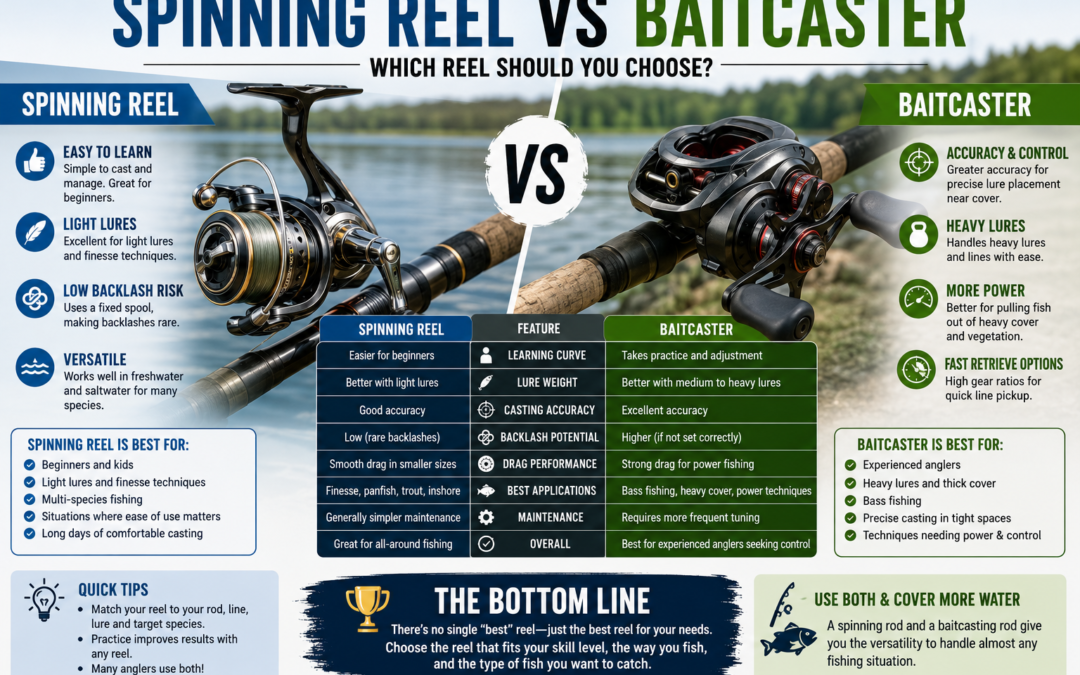
Choosing between a spinning reel vs baitcaster can feel confusing because both reel styles are widely used and capable of catching many of the same fish. The main difference is not simply which reel is better, but which one better matches your experience level, lure weight, casting technique, and fishing environment.
Spinning reels are generally easier to learn, handle lighter lures effectively, and work well for beginners and finesse fishing. Baitcasting reels provide greater casting control, stronger performance with heavier lures, and improved accuracy around docks, grass, rocks, and submerged timber.
Spinning Reel vs Baitcaster at a Glance
| Feature | Spinning Reel | Baitcaster |
|---|---|---|
| Learning curve | Easy for beginners | Requires more practice |
| Light lures | Excellent | More difficult with very light lures |
| Heavy lures | Capable, depending on size | Excellent |
| Casting accuracy | Good | Excellent with experience |
| Backlash risk | Low | Higher when poorly adjusted |
| Fishing near cover | Good for finesse techniques | Strong for power fishing |
| Best for | Beginners, light lures, versatility | Bass fishing, accuracy, heavy lures |
How a Spinning Reel Works
A spinning reel sits beneath the fishing rod and uses a fixed spool. The bail rotates around the spool during retrieval, guiding the line back onto the reel.
To cast, the angler opens the bail, holds the line with one finger, swings the rod forward, and releases the line. Because the spool does not rotate during the cast, spinning reels are less likely to produce severe backlashes.
This simple operation makes spinning equipment useful for beginners, children, casual anglers, and experienced fishermen who use lightweight lures or finesse presentations.
Browse our spinning reels for freshwater, bass, inshore, and general fishing applications.
How a Baitcaster Works
A baitcasting reel sits above the rod and uses a spool that rotates during the cast. As the lure pulls line from the reel, the angler must control spool speed using the braking system, spool-tension adjustment, and thumb pressure.
This rotating-spool design gives experienced anglers excellent control over casting distance and lure placement. However, if the spool rotates faster than the lure pulls line, loose line can collect inside the reel and create a backlash.
Modern baitcasters include adjustable magnetic, centrifugal, or combined braking systems that make spool control easier than it was on older models.
Explore our casting reels for bass fishing, heavy lures, and precision casting.
1. Learning Curve and Ease of Use
The most noticeable difference in the spinning reel vs baitcaster comparison is ease of use. Spinning reels usually require less adjustment and allow new anglers to begin casting quickly.
Baitcasters require more practice because spool tension and braking must be adjusted according to lure weight and casting style. New users may experience backlashes until they learn to control the spool properly.
For a first fishing setup, a spinning reel is usually the more forgiving choice. Anglers who want to develop advanced casting control may later add a baitcasting setup.
2. Casting Accuracy
Baitcasting reels provide greater control over lure speed and placement once the angler develops proper technique. Thumb pressure can slow the spool during flight, helping the lure land more quietly and accurately near cover.
This makes baitcasters especially useful when casting under docks, beside trees, around grass, or toward small openings in cover.
Spinning reels can still cast accurately, but baitcasters generally offer more control for anglers who frequently make short, targeted presentations.
3. Performance with Light and Heavy Lures
Spinning reels perform particularly well with lightweight lures, thin fishing line, and finesse techniques. Small soft plastics, drop-shot rigs, Ned rigs, light jigs, and tiny crankbaits are usually easier to cast with spinning equipment.
Baitcasters are often preferred for heavier lures such as frogs, spinnerbaits, large crankbaits, jigs, swimbaits, and weighted soft plastics. Their rotating spools and compact frames provide strong control during power fishing.
When comparing a baitcaster vs spinning reel, lure weight is one of the most important factors to consider.
4. Fishing Line and Line Management
Spinning reels work effectively with monofilament, fluorocarbon, and braided line, especially in lighter strengths. However, line twist may develop when line is installed incorrectly or when the drag spins excessively.
Baitcasters handle heavier fluorocarbon, monofilament, and braid well. They are often used for thick cover because heavier line helps anglers pull bass and other fish away from vegetation, wood, and rocks.
Neither reel eliminates line problems completely. Correct spooling, proper tension, and regular line inspection remain important for both designs.
5. Drag, Power, and Fish Control
Both reel types are available with strong drag systems, but baitcasters are commonly associated with power techniques and heavy cover. Their rigid frames and direct spool design can provide strong leverage when fighting fish close to structure.
Spinning reels often provide smooth drag performance, making them useful with lighter line. A smooth drag helps prevent thin line from breaking when a fish makes a sudden run.
The better choice depends on whether you need maximum power around cover or smooth pressure for finesse fishing.
6. Maintenance and Backlash
Spinning reels are generally easier for beginners to manage because they do not produce the severe spool overrun associated with baitcasters. They may still experience line twist, loose loops, or wind knots when used incorrectly.
Baitcasters require regular attention to spool tension, braking settings, bearings, and line condition. A backlash can usually be corrected, but severe tangles may require removing part of the fishing line.
Both reel styles should be cleaned and maintained according to the manufacturer’s instructions, especially after saltwater use.
7. Price and Long-Term Value
Affordable spinning reels are widely available and provide good value for beginners, family fishing, and general recreational use. Entry-level baitcasters are also available, although low-cost models may have less refined braking systems.
More expensive reels may offer lighter materials, smoother gearing, stronger drag systems, better sealing, and improved casting performance. However, the most expensive option is not automatically the best choice for every angler.
Proper rod balance, line selection, lure weight, and fishing technique often matter more than price alone.
Spinning Reel or Baitcaster for Beginners?
For most beginners, a spinning reel is the easier starting point. It allows new anglers to practice casting, drag adjustment, lure control, and fish fighting without constantly managing spool speed.
A baitcaster may suit a motivated beginner who wants to focus on bass fishing and is willing to practice. Starting with a heavier practice lure, increased braking, and short controlled casts can reduce frustration.
Our guide to the best fishing reels for beginners provides additional help for choosing a first setup.
Which Reel Is Better for Bass Fishing?
Many bass anglers use both. A baitcaster is often preferred for jigs, frogs, spinnerbaits, crankbaits, Texas rigs, and fishing near heavy cover. It provides the speed, power, and accuracy needed for many power-fishing techniques.
A spinning reel is valuable for drop shots, Ned rigs, shaky heads, small swimbaits, and other finesse presentations. It also works well when bass are pressured or feeding on smaller prey.
Rather than viewing the spinning reel vs baitcaster decision as an absolute choice, experienced bass anglers often use each reel for the techniques it handles best.
Which Reel Is Better for Saltwater?
Both reel types can be used in saltwater when specifically designed for marine conditions. Spinning reels are common for inshore fishing, surf casting, piers, and light offshore work.
Saltwater baitcasters are often used for inshore lure fishing, jigging, and species that require accurate casting. The reel should include corrosion-resistant materials, suitable sealing, and enough drag strength for the target species.
Always confirm that a reel is intended for saltwater use and follow the manufacturer’s maintenance instructions after each trip.
When a Spinning Reel Is the Better Choice
- You are new to fishing
- You frequently cast lightweight lures
- You use finesse fishing techniques
- You want simple operation
- You fish for trout, panfish, crappie, or similar species
- You prefer lower backlash risk
When a Baitcaster Is the Better Choice
- You need greater casting accuracy
- You use heavier lures
- You fish around grass, docks, rocks, or timber
- You want fast line-retrieval options
- You frequently target bass
- You are willing to practice spool control
Can You Use Both Reel Types?
Using both reel styles gives anglers more flexibility. A spinning setup can handle lighter lures and finesse techniques, while a baitcasting setup can manage heavier lures and accurate casting around cover.
Carrying both does not mean one reel is inadequate. It simply allows each design to be used where it performs best.
Final Verdict: Spinning Reel vs Baitcaster
Choose a spinning reel when ease of use, lightweight presentations, and versatility are the main priorities. Choose a baitcaster when you need casting accuracy, strong control, heavier lure performance, and better power around cover.
For beginners, spinning equipment is usually the safest first choice. For bass anglers and fishermen who want greater casting control, learning to use a baitcaster can provide valuable advantages.
The winner in the spinning reel vs baitcaster comparison ultimately depends on how, where, and what you fish.
```htmlSpinning Reel vs Baitcaster: Which Choice Fits Your Fishing Style?
The spinning reel vs baitcaster comparison becomes much easier when anglers consider lure weight, casting distance, fishing cover, experience level, and target species. A spinning reel is generally the better choice for lightweight lures, finesse techniques, beginners, and anglers who want simple casting with fewer backlashes. A baitcaster is often preferred for heavier lures, accurate casting, fast retrieval, and fishing around grass, docks, rocks, and submerged timber.
When comparing a spinning reel vs baitcaster, beginners usually find spinning equipment easier to control. The fixed spool reduces severe backlash, while the open design makes line handling more straightforward. In contrast, a baitcaster requires proper braking, spool tension, and thumb control, but it provides greater precision once the angler develops the correct technique.
The spinning reel vs baitcaster decision also depends on the type of fishing being performed. Spinning reels are excellent for trout, panfish, finesse bass fishing, and light inshore applications. Baitcasters are better suited to frogs, jigs, spinnerbaits, crankbaits, and power-fishing techniques around heavy cover.
There is no universal winner in the spinning reel vs baitcaster debate. Many experienced anglers use both reel styles because each design performs better in different situations. Understanding the spinning reel vs baitcaster differences helps anglers choose the right reel, improve casting performance, reduce line problems, and build a more effective fishing setup.
Frequently Asked Questions
Is a baitcaster better than a spinning reel?
Not in every situation. Baitcasters provide accuracy and control with heavier lures, while spinning reels are easier to use and perform well with lighter lures.
Why do professional bass anglers use baitcasters?
Baitcasters provide fast retrieval, accurate lure placement, and strong control when fishing near heavy cover.
Can beginners learn to use a baitcaster?
Yes. Beginners should use increased braking, proper spool tension, and heavier practice lures while learning.
Can spinning reels catch large fish?
Yes. Correctly sized spinning reels with suitable line and drag systems can handle many large freshwater and saltwater species.
Further Fishing Education
Visit Take Me Fishing for beginner equipment guidance, casting education, and responsible angling information.
Additional sport-fishing and conservation resources are available through the International Game Fish Association.
```