
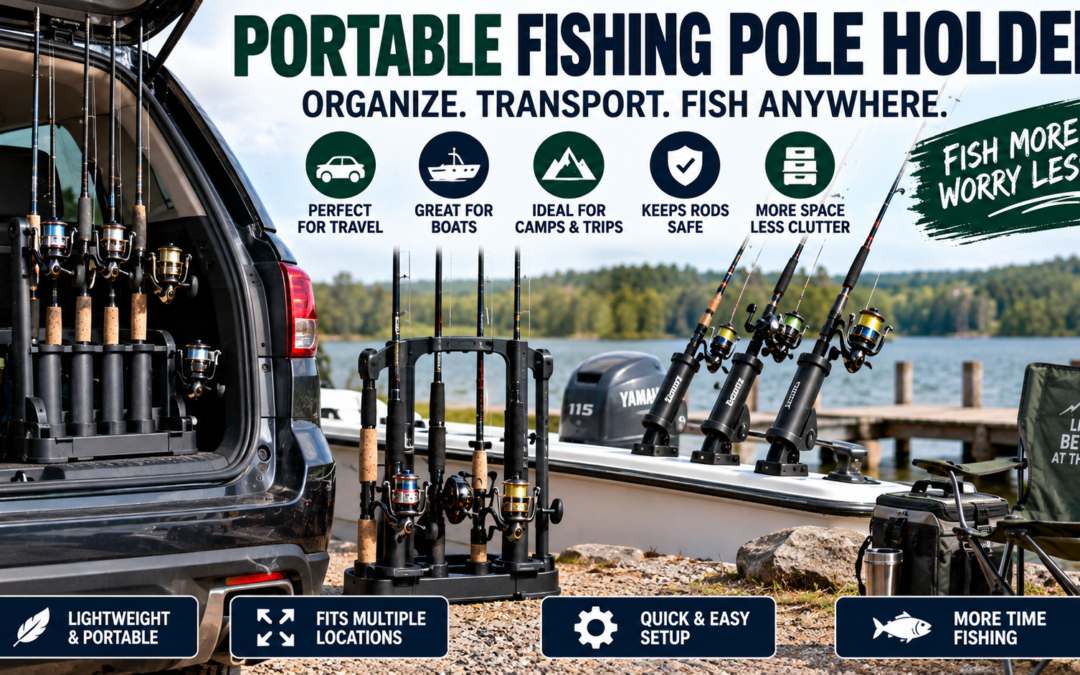
Portable Fishing Pole Holder: Smart Options for Fishing on the Go
A portable fishing pole holder can make transporting and storing fishing rods much easier when you move between vehicles, campsites, shorelines, docks, and different fishing locations. Instead of placing loose rods in the back of a vehicle or carrying several setups by hand, a dedicated holder gives your equipment a defined position and reduces unnecessary movement.
The right portable fishing pole holder should match the way you travel, the number of rods you carry, the size of your reels, and the environment where you fish. A compact setup may be ideal for one or two rods, while anglers carrying several complete outfits may need a larger portable rack or holder system.
This guide explains practical portable rod-holder options, how to choose one, how to transport rods safely, and what features matter before buying.
For general rod-holder information, visit the fishing rod holder guide.
What Is a Portable Fishing Pole Holder?
A portable fishing pole holder is a rod-storage or rod-support solution that can be moved, carried, or used in different fishing locations without requiring a permanent installation.
Portable holders can include freestanding racks, removable rod holders, compact transport systems, vehicle-friendly storage solutions, and temporary holders designed for campsites, docks, banks, or boats.
The main purpose is to keep rods together, separated, and accessible while reducing the risk of them being stepped on, crushed, tangled, or damaged during transportation.
Why Use a Portable Fishing Pole Holder?
Transporting several fishing rods without a storage system can quickly become inconvenient. Rods can slide around inside a vehicle, become tangled with line, or interfere with tackle boxes and other equipment.
A portable fishing pole holder creates a dedicated location for your rods and can provide several practical benefits:
- Keeps rods organized during transportation.
- Reduces contact between separate rod-and-reel setups.
- Makes equipment easier to carry between locations.
- Provides quick access when you arrive at the fishing spot.
- Helps keep rods away from areas where they can be stepped on or crushed.
- Can be moved between different fishing locations.
Portable Fishing Pole Holder Options
1. Compact Freestanding Rod Holder
A compact freestanding holder can be useful when you need temporary storage at a campsite, garage, dock, or fishing preparation area.
Because it does not need permanent installation, you can move it when changing locations. This makes it useful for anglers who fish in several environments instead of keeping all their equipment in one fixed fishing room.
When choosing this type of holder, stability matters. A lightweight rack may be convenient to transport, but it still needs a stable base when loaded with several rods.
Check how the holder behaves when one rod is removed. A good portable system should remain stable rather than tipping or shifting when the load changes.
2. Portable Holder for Vehicle Transport
Vehicle transport creates a specific storage challenge. Rods need to remain secure without taking up all the available space in the vehicle.
A portable holder can keep the rods grouped together while reducing movement during transport.
When transporting fishing rods in a vehicle, avoid placing heavy tackle boxes, coolers, tools, or other equipment directly on top of the rods.
Long rods also need enough clearance to prevent the tips from pressing against windows, doors, or other hard surfaces.
3. Removable Boat Rod Holder
Boat anglers may want a holder that can be installed temporarily or repositioned as fishing conditions change.
A removable system can provide a more flexible alternative to permanently installed equipment, especially for anglers who move between different boats or storage locations.
Hooked Beginner's catalog includes the Scotty 290 R-5 Rod Holder, the Cannon Rod Holder, and the Savage Gear MP Rodholder as rod-holder products to compare.
Always check the product's mounting and application requirements before using any holder on a boat.
4. Portable Vertical Rod Holder
A portable vertical holder keeps rods upright while allowing you to move the entire storage system as one unit.
This can be helpful at a fishing camp, workshop, garage, or temporary fishing station where you need organized storage but do not want to drill into walls.
Vertical storage also minimizes the amount of floor space used by long fishing rods.
Before choosing a vertical design, measure the longest rods you expect to carry and make sure there is sufficient overhead clearance.
5. Portable Horizontal Rod Storage
Horizontal storage can be useful when vertical clearance is limited.
A horizontal portable fishing pole holder can support rods along their length and keep them elevated from the ground.
This style can work particularly well during transport preparation because several rods can be placed together without being scattered across the floor or vehicle compartment.
Support spacing is important. Long rods should have adequate support so they are not placed under unnecessary pressure at a single point.
6. Multi-Rod Portable Rack
Anglers carrying a large collection of rods may need more than a single compact holder.
A multi-rod portable rack can keep several complete setups organized while allowing the entire collection to be moved together.
This can be useful for fishing trips involving multiple techniques. For example, you might carry separate spinning, casting, light-tackle, or specialized rods.
The main consideration is weight. A rack designed for many complete rod-and-reel setups may become difficult to carry once fully loaded.
Check the rack's weight, dimensions, carrying method, and capacity before choosing one for long-distance transport.
7. Portable Rod Holder for Camps and Shore Fishing
Bank anglers and campers sometimes need temporary rod organization after arriving at the fishing location.
A portable holder can create a dedicated place for rods while you set up tackle, prepare bait, or move between fishing spots.
Choose a location where the holder will not be knocked over by foot traffic, waves, wind, or other equipment.
Soft ground can also affect stability, so check the base before placing several rods into the holder.
How to Choose a Portable Fishing Pole Holder
Consider How Many Rods You Carry
Start by counting the complete setups you normally transport.
If you usually carry two or three rods, a large rack may be unnecessary. If you routinely travel with several setups, look for a system with adequate capacity and spacing.
Do not judge capacity only by the number printed on the product. Reel size and handle dimensions can affect how many complete setups comfortably fit together.
Check Portability
The whole purpose of a portable holder is movement, so consider how easy it is to carry.
Look at total weight, dimensions, handles, folding mechanisms, removable components, and storage requirements.
A large rack may offer excellent storage but become inconvenient if it is difficult to fit into your vehicle or carry to the fishing location.
Measure Your Rods and Reels
Measure complete rod-and-reel setups before choosing a holder.
| Measurement | Why It Matters |
|---|---|
| Rod length | Determines overall storage and transport clearance. |
| Reel width | Determines spacing between neighboring setups. |
| Reel depth | Affects how compact the holder can be. |
| Handle length | Determines clearance around grips and reels. |
| Rod quantity | Determines required holder capacity. |
This is particularly important if you use larger reels or carry rods in their fully assembled configuration.
Think About Your Fishing Environment
A holder used in a garage may not be appropriate for a boat or shoreline.
Consider where the holder will be used most often. A vehicle-focused solution should fit your transport setup, while a boat holder needs to match the boat and intended installation.
Check Stability
Portability should not come at the expense of stability.
A holder should stay upright when rods are inserted or removed. Wider bases, appropriate weight distribution, and secure mounting methods can help improve stability depending on the design.
Test the system with your normal equipment before relying on it during a fishing trip.
Portable Fishing Pole Holder for Cars and Trucks
Vehicle transport requires careful planning because rods are usually longer than the available storage space.
Keep the rod tips away from hard surfaces and avoid placing heavy objects on top of the blanks.
When rods remain assembled, ensure reel handles cannot catch against other equipment. Loose hooks should also be secured so they cannot snag line, clothing, or vehicle upholstery.
A portable holder can help create a repeatable transport arrangement. Instead of placing rods wherever space happens to be available, each setup has a defined location.
Portable Fishing Pole Holder for Boats
Boat environments require additional attention to movement and access.
The holder should be positioned so rods do not obstruct seating, casting, navigation controls, or walking areas.
Keep frequently used rods within easy reach and store backup equipment in less accessible areas.
Hooked Beginner's Scotty 290 R-5 Rod Holder is one catalog option to examine when comparing rod-holder designs.
Portable Fishing Pole Holder for Shore Fishing
Shore anglers can benefit from a holder that is easy to carry from the vehicle to the fishing position.
The holder should be stable on the type of ground you expect to encounter. Sand, gravel, grass, mud, and rocky banks can all behave differently.
Keep the holder away from the edge of the water unless the design is specifically intended for that environment.
Wind can also affect lightweight portable racks, especially when they are loaded with long rods. Check stability before leaving equipment unattended.
How to Organize Rods Inside a Portable Holder
A portable storage system works best when the rods are arranged consistently.
Group Similar Rods Together
Keep spinning rods together and separate casting or specialized setups where practical.
Put Frequently Used Rods in Accessible Positions
The rods you use most often should be easiest to remove.
Leave Space Between Setups
Do not pack the holder so tightly that reels and guides constantly touch each other.
Secure Loose Hooks and Lures
Hooks and lures should be secured before transporting rods. Loose tackle can damage equipment or create a snag hazard.
Portable Holder vs. Fishing Pole Storage Rack
A portable holder and a permanent fishing pole storage rack serve different purposes.
| Feature | Portable Holder | Permanent Storage Rack |
|---|---|---|
| Movement | Designed to move between locations | Usually fixed in one location |
| Installation | Often minimal or temporary | May require wall or floor installation |
| Best use | Travel, boats, camps, temporary fishing areas | Garages, workshops, homes |
| Capacity | Often focused on practical transport | Can accommodate larger permanent collections |
Some anglers benefit from having both. A permanent rack can organize the main collection at home, while a smaller portable holder can be used during trips.
For permanent storage ideas, see the fishing pole storage rack guide.
How to Protect Rods During Transport
Rod protection starts before the equipment enters the vehicle.
Check that guides are intact and remove dirt or debris that could scratch other equipment.
If rods are transported assembled, keep hooks and lures secured. Separate rods so blanks and guides do not repeatedly rub against each other.
Do not place heavy tackle boxes, coolers, or tools over the rod sections.
Take Me Fishing provides general guidance on maintaining fishing equipment and preparing it for storage: fishing gear maintenance guide.
DIY Portable Fishing Pole Holder
A DIY holder can be useful when you need a customized transport system.
Lightweight PVC and plywood can be configured into a holder with individual positions for rods. The advantage is that you can determine the exact spacing and dimensions.
Take Me Fishing provides a step-by-step resource for making a DIY fishing rod holder: DIY Fishing Rod Holder Guide.
Before building a portable design, consider how the finished system will be carried. Extra material can increase durability but also increase weight.
Portable Fishing Pole Holder Buying Checklist
| Check | What to Look For |
|---|---|
| Portability | Reasonable weight and dimensions for your travel method. |
| Capacity | Enough positions for the rods you normally carry. |
| Rod clearance | Adequate space for blanks, guides, handles, and reels. |
| Stability | A base or mounting method appropriate for the intended environment. |
| Transport | Fits comfortably in your vehicle or other transport method. |
| Durability | Materials appropriate for repeated use and the fishing environment. |
| Accessibility | Rods can be removed without disturbing other setups. |
Frequently Asked Questions
What is the best portable fishing pole holder?
The right portable fishing pole holder depends on how many rods you carry, where you fish, how you transport them, and whether the holder will be used primarily for travel, storage, or on-water access.
Can I use a portable rod holder in a car?
Yes, provided the holder fits securely and does not interfere with passengers, controls, doors, or visibility. Protect rod tips and avoid placing heavy objects on top of the equipment.
Can a portable fishing pole holder hold rods with reels attached?
Some can. Check the holder's dimensions and spacing before using complete rod-and-reel setups. Reel size can significantly affect the required clearance.
Are portable fishing rod holders good for boats?
Some are appropriate for boat use, but the holder must match the mounting method and intended application. Always follow the manufacturer's instructions.
How many fishing rods should a portable holder carry?
Carry enough rods for your intended fishing without making the system unnecessarily heavy or difficult to transport. The right capacity depends on the fishing techniques and locations involved.
Can I make a portable fishing pole holder myself?
Yes. PVC and plywood are examples of materials that can be used for a custom holder. The design should account for rod dimensions, reel clearance, stability, and transport weight.
How do I keep fishing rods from getting damaged while traveling?
Keep rods separated, secure hooks and lures, avoid placing heavy equipment on top of them, and use a holder or other storage solution that prevents excessive movement.
Final Thoughts
A portable fishing pole holder can make fishing trips more organized by giving your rods a secure and predictable place during transportation and setup.
The right design depends on the number of rods you carry, the size of your reels, the way you travel, and the fishing environments you visit.
Compact holders can work well for smaller collections, while multi-rod systems can make sense for anglers carrying several complete setups. Boat anglers should pay particular attention to stability, mounting, access, and interference with normal boat movement.
For permanent home storage, compare the fishing rod rack guide and fishing rod storage rack guide. For broader rod-holder information, return to the fishing rod holder guide.
Finally, check the actual dimensions and specifications of any holder before purchasing. A storage solution that fits your rods, reels, vehicle, and fishing routine will be easier to use consistently and better suited to protecting your equipment.
Trackbacks/Pingbacks