
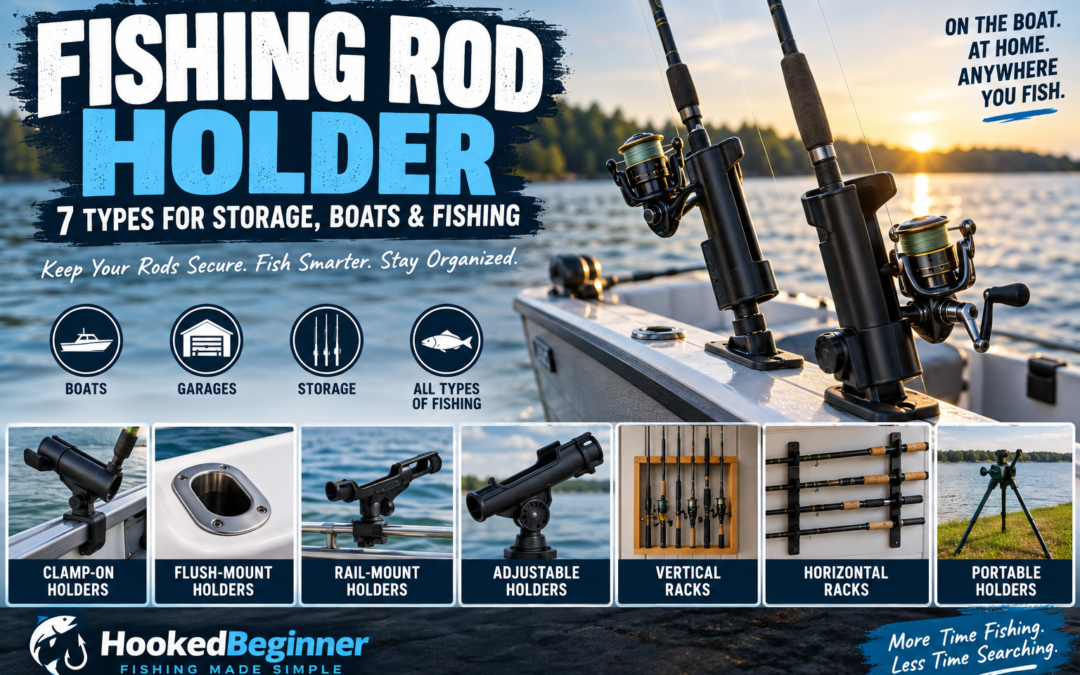
Fishing Rod Holder: 7 Types for Storage, Boats & Fishing
A fishing rod holder gives anglers a practical place to secure, organize, transport, or position a fishing rod when it is not being held. The right holder can help keep fishing equipment organized at home, reduce clutter on a boat, and provide a stable position for techniques that require the rod to remain supported while you fish.
However, not every rod holder serves the same purpose. Some are designed for boat fishing, while others are intended for rod storage in a garage or fishing room. Some attach with clamps, some require permanent mounting, and rod racks can hold several fishing rods at once.
This complete guide explains the main types of fishing rod holders, where they are used, what to check before buying one, and how to match a holder to your fishing setup.
Table of Contents
- What Is a Fishing Rod Holder?
- 7 Types of Fishing Rod Holders
- Fishing Rod Holders for Boats
- Fishing Rod Storage and Rod Racks
- How to Choose a Fishing Rod Holder
- Fishing Rod Holder Materials
- Mounting and Installation
- How to Match a Holder to Your Fishing Rod
- Fishing Rod Holder Care and Maintenance
- Rod Holder Products at HookedBeginner
- Common Rod Holder Buying Mistakes
- Fishing Rod Holder FAQs
What Is a Fishing Rod Holder?
A fishing rod holder is a support designed to keep a fishing rod in a stable position. Depending on its design, it can be used for storage, transportation, boat fishing, trolling, bait fishing, or keeping multiple rods organized.
A holder is different from the rod itself. Your fishing rod is responsible for casting, lure presentation, bite detection, hook setting, and fighting fish. The holder provides a separate support system for the rod when you need to put it down or keep it positioned.
For example, a clamp-on holder can attach to a suitable boat edge without requiring a permanent hole. A rack can organize several rods in a garage or fishing area. A flush-mount holder can be installed into a boat's gunwale for a more permanent setup.
The most important point is simple: choose the holder according to where you will use it, how you will use it, how many rods you need to support, and what type of mounting surface you have.
7 Types of Fishing Rod Holders
Fishing rod holders are available in several designs. The following seven categories cover the most useful options for anglers looking to organize or support their fishing equipment.
1. Clamp-On Fishing Rod Holders
Clamp-on fishing rod holders attach to a suitable rail, gunwale, edge, or other mounting surface using a clamp. They are useful when you want a removable setup or do not want to make a permanent modification.
One example available at HookedBeginner is the Savage Gear MP Rodholder. Its product information describes a wide G-clamp mounting system, adjustable support arms, aluminum construction, and use for trolling and live-bait fishing.
Before buying a clamp-on fishing rod holder, measure the mounting surface. A clamp that is too small will not fit, while one that is too large may not secure the holder properly.
2. Flush-Mount Fishing Rod Holders
Flush-mount holders are installed into a boat's mounting surface so that the holder sits within the surrounding surface. They provide a relatively clean installation and are commonly associated with boat fishing.
Because flush-mount installation can require drilling or cutting, placement should be planned carefully. Check the manufacturer's dimensions, mounting depth, drainage requirements, and the space underneath the installation point before making modifications.
A flush-mount design can be useful when the holder is intended to remain in one location rather than being moved regularly.
3. Rail-Mount Fishing Rod Holders
Rail-mount holders attach to compatible boat rails or tubular structures. They can provide flexibility because the holder may be repositioned depending on the design and mounting system.
Measure the rail diameter before purchasing. Round rails, square tubing, and other mounting structures may require different hardware or clamps.
4. Adjustable Fishing Rod Holders
An adjustable fishing rod holder allows the rod position or angle to be changed. This can be useful when fishing techniques require different rod positions.
Adjustment systems vary considerably. Some holders use rotating arms, while others use pivoting mechanisms or adjustable mounting points.
The Savage Gear MP Rodholder, for example, uses rotating support arms that can be positioned for different boat-fishing situations.
5. Vertical Fishing Rod Racks
A vertical fishing rod rack is designed primarily for organized storage. Instead of supporting one rod during active fishing, a rack can keep several rods standing vertically in one location.
Vertical storage can be useful in a garage, fishing room, workshop, boat storage area, or other location where floor space and rod organization matter.
If you own several fishing rods for different techniques, a rack can make it easier to separate spinning rods, casting rods, light tackle rods, and heavier setups.
6. Horizontal Fishing Rod Racks
Horizontal fishing rod racks store rods parallel to a wall, ceiling, cabinet, or other suitable surface. They can be useful when vertical wall space is limited or when you want rods stored above the floor.
When installing a horizontal rack, consider the complete length of the rod. Make sure the rack provides enough support points and that the rod will not sag excessively or interfere with doors, walkways, vehicles, or other equipment.
7. Portable Fishing Rod Holders
Portable holders are designed to be moved between locations. They can be useful for anglers who fish from different boats, docks, banks, or temporary fishing stations.
The main advantage is flexibility. Instead of permanently installing a holder, you can take the equipment with you and position it where appropriate.
Fishing Rod Holders for Boats
Boat fishing creates different rod-holder requirements from home storage. A boat holder must work with the available mounting surface and the way you fish.
Before choosing a fishing rod holder for a boat, identify the intended location. It might be a gunwale, rail, transom, deck, T-top structure, or another suitable mounting point.
Boat rod-holder guides commonly distinguish between flush-mount, clamp-on, rail-mounted, adjustable, and storage designs. The correct choice depends on the mounting surface and whether the holder is intended primarily for active fishing or storage.
Boat Fishing and Active Rod Support
Active fishing is different from simply storing a rod. During trolling, drifting, or bait fishing, the rod may need to remain accessible while the angler performs another task.
That makes the holder's retention, mounting security, rod compatibility, and intended use especially important.
Never assume that every fishing rod holder is suitable for every fishing technique. Check the manufacturer's intended application and specifications before relying on a holder during active fishing.
Measure the Mounting Area First
One of the easiest ways to avoid buying the wrong holder is to measure the mounting location before ordering.
- Measure the rail diameter if using a rail mount.
- Measure the edge thickness if using a clamp.
- Check the available clearance around the holder.
- Check whether the rod and reel can move freely.
- Check whether installation requires drilling.
- Check the mounting hardware required.
For a clamp-on model such as the Savage Gear MP Rodholder, the mounting surface should be measured before ordering because boat edges and rails vary.
Fishing Rod Storage and Rod Racks
Fishing rod storage has a different purpose from an active fishing holder. The goal is usually to keep rods organized, protected, accessible, and separated from other equipment.
A fishing rod rack can be particularly useful for anglers who own multiple rods. Instead of leaving rods against a wall or on the floor, a rack gives them a dedicated storage position.
Fishing Rod Storage at Home
For home storage, consider the available wall and floor space. A vertical rack can make use of wall height, while a horizontal rack can work where vertical clearance is limited.
Keep stored rods away from areas where they can be stepped on, struck by equipment, or exposed to unnecessary moisture and heat.
Fishing Rod Storage in a Garage
A garage can provide useful storage space, but rods should not be positioned where vehicles, bicycles, tools, doors, or other equipment can damage them.
Measure the longest rods you own before installing a rack. Leave enough room to remove each rod without hitting another rod or nearby equipment.
Fishing Pole Storage
The phrase fishing pole storage is often used interchangeably with fishing rod storage. Regardless of terminology, the storage principle is the same: provide stable support while protecting the rod from unnecessary bending, impact, moisture, and clutter.
For more information about choosing fishing equipment, see the HookedBeginner complete fishing pole guide.
How to Choose a Fishing Rod Holder
Choosing a fishing rod holder becomes easier when you work through a few practical questions before purchasing.
1. Where Will You Use It?
First identify the location.
- Boat
- Dock
- Garage
- Fishing room
- Workshop
- Vehicle
- Bank-fishing station
A holder designed for a boat may not be the right solution for home storage, while a garage rack is not automatically suitable for active fishing.
2. How Many Rods Do You Need to Hold?
Single-rod holders are useful when you need one supported rod. Multi-rod racks make more sense when the primary goal is organization.
Count the rods you currently own and consider whether your collection is likely to grow. Avoid choosing a rack based only on today's inventory if you regularly add fishing equipment.
3. What Type of Fishing Do You Do?
Your fishing technique affects the holder you need.
Someone who primarily stores rods at home has different requirements from an angler who trolls from a boat. Likewise, a bank angler may need a portable solution rather than a permanent boat mount.
Understanding rod characteristics also helps. If you are still deciding what rod to use, explore HookedBeginner's types of fishing rods guide and fishing rod buying guide.
4. What Mounting Surface Do You Have?
The mounting surface is one of the most important compatibility factors.
Measure before ordering rather than assuming a holder will fit. Pay attention to rail diameter, edge thickness, available depth, mounting holes, and clearance.
5. Does the Holder Fit Your Rod?
Check the opening and support design against the rod handle and butt section. Also consider the reel and whether it can sit naturally without hitting the holder.
A holder that technically fits the rod but interferes with the reel can still create a poor setup.
Fishing Rod Holder Materials
Fishing rod holders can be made from plastics, aluminum, stainless steel, and other materials. The appropriate material depends on where and how the holder will be used.
Aluminum
Aluminum can provide a useful combination of strength and relatively low weight. The HookedBeginner Savage Gear MP Rodholder uses high-grade aluminum support components along with rubber-coated rod-contact areas.
Plastic and Polymer
Plastic and polymer holders can be lightweight and practical for many storage applications. Their suitability depends on the specific material, design, mounting system, and intended load.
Stainless Steel
Stainless steel is commonly used in marine fishing equipment because of its strength and resistance to corrosion. However, the exact grade and construction matter, especially when equipment is exposed to saltwater.
Do not select a holder based only on the material name. Look at the complete product specifications and intended application.
Mounting and Installation
Installation requirements depend on the holder design.
Clamp-On Installation
Clamp-on holders generally require you to position the clamp over a compatible surface and tighten the mounting mechanism.
Before use, verify that the clamp is secure and that the mounting surface can support the setup. Avoid excessive tightening that could damage a softer surface.
Permanent Installation
Permanent holders require more planning. Before drilling or cutting, confirm the manufacturer's measurements and inspect the space behind the mounting surface.
Do not assume that an apparently empty mounting location is clear behind the surface. Wiring, structural components, plumbing, or other equipment can be hidden behind panels or gunwales.
Installation Checklist
- Measure the mounting location.
- Confirm the holder dimensions.
- Confirm the required hardware.
- Check clearance around the rod and reel.
- Check the strength of the mounting surface.
- Follow the manufacturer's installation instructions.
- Test the holder before relying on it during fishing.
How to Match a Holder to Your Fishing Rod
The holder should work with the rod rather than simply hold it loosely.
Consider the rod's handle, butt diameter, reel configuration, overall length, and intended fishing technique.
For example, a lightweight spinning setup may have different support requirements from a heavy offshore rod. Likewise, a long surf rod needs sufficient clearance and storage support.
If you're still comparing rod designs, HookedBeginner's fishing rod guide explains rod construction and the features that influence fishing performance.
You can also use the fishing rod length guide, fishing rod power guide, and fishing rod action guide when matching equipment to a particular fishing style.
Fishing Rod Holder Care and Maintenance
Regular maintenance helps keep a fishing rod holder working properly, particularly when it is exposed to water, dirt, sand, and salt.
After Saltwater Fishing
Rinse the holder with fresh water after saltwater exposure when the manufacturer's instructions permit it. Pay attention to clamps, screws, hinges, joints, and areas where salt or sand can accumulate.
Inspect Before Fishing
- Check clamps for looseness.
- Inspect screws and mounting hardware.
- Look for cracks or structural damage.
- Check rubber contact surfaces.
- Confirm the holder remains firmly attached.
- Make sure the rod can be removed quickly when needed.
If a holder shows structural damage, replace it rather than continuing to rely on it.
For broader equipment-care information, you can also review HookedBeginner's fishing reel maintenance guide.
Fishing Rod Holder Products at HookedBeginner
HookedBeginner currently has rod-holder products that can be incorporated into this topic cluster. These products allow the guide to connect readers directly with relevant equipment rather than discussing rod holders only in theory.
Scotty 290 R-5 Rod Holder
The Scotty 290 R-5 Rod Holder is one of the rod-holder products available on HookedBeginner.
Use the product page to review the current product information, specifications, availability, and purchasing details before ordering.
Cannon Rod Holder
The Cannon Rod Holder is another rod-holder product available in the HookedBeginner catalog.
Check the individual product listing for its current specifications and compatibility information.
Savage Gear MP Rodholder
The Savage Gear MP Rodholder is a clamp-on boat rod holder designed around a wide G-clamp, adjustable support arms, and aluminum construction. Its product information identifies applications including trolling, live-bait fishing, and drifting.
The product page also recommends measuring the intended mounting area before ordering because boat gunwales and rails vary.
Common Fishing Rod Holder Buying Mistakes
Choosing Without Measuring
One of the most common mistakes is purchasing a holder before measuring the mounting location.
Measure first. Then compare those measurements with the manufacturer's specifications.
Confusing Storage With Active Fishing
A rack designed to organize rods at home is not automatically a substitute for a holder designed for active boat fishing.
Determine whether the holder is primarily for storage or whether the rod will remain positioned in it while fishing.
Ignoring the Reel
Do not check only the rod shaft. The reel and handle also need enough clearance to sit naturally in the holder.
Buying More Capacity Than Necessary
A larger rack is not always better. Consider the number of rods you actually need to store and the amount of available space.
Ignoring the Environment
Freshwater, saltwater, garage storage, boat storage, and outdoor use can expose equipment to different conditions. Choose materials and maintenance practices appropriate for the environment.
Fishing Rod Holder Buying Checklist
Before purchasing a fishing rod holder, run through this checklist:
- What will I use the holder for?
- Where will I install or use it?
- How many rods need support?
- What is the mounting surface?
- Have I measured the mounting surface?
- Does the holder fit my rod handle?
- Does the reel have enough clearance?
- Is the holder removable or permanent?
- Is the material appropriate for my environment?
- Does the manufacturer specify a particular application?
- Do I need a rack or a single rod holder?
- How will I clean and maintain it?
Fishing Rod Holder FAQs
What is a fishing rod holder used for?
A fishing rod holder supports a fishing rod when it is not being held. Depending on its design, it can be used for storage, transportation, boat fishing, trolling, bait fishing, or keeping a rod positioned while the angler performs another task.
What is the difference between a fishing rod holder and a fishing rod rack?
A fishing rod holder generally supports one rod or a small number of rods in a specific position, while a fishing rod rack is commonly designed to organize and store multiple rods.
What is a fishing pole holder?
A fishing pole holder is another common term for equipment designed to support or store a fishing pole or fishing rod. The exact design determines whether it is intended for active fishing, transportation, or storage.
Are clamp-on fishing rod holders good for boats?
Clamp-on holders can be useful when the boat has a compatible mounting surface and you want a removable setup. Always check the clamp dimensions and intended application before installation.
Do fishing rod holders require drilling?
Not all fishing rod holders require drilling. Clamp-on models can attach to compatible surfaces without permanent drilling, while many flush-mount holders require a more permanent installation.
How do I choose a fishing rod holder?
Start by identifying where you will use it, what fishing technique you use, how many rods you need to support, what mounting surface is available, and whether the holder fits your rod and reel.
Can I use a rod rack for active fishing?
A storage rack should not automatically be treated as an active fishing holder. Check the specific product's intended use before relying on it while fishing.
How many rod holders do I need?
The number depends on your fishing style, the number of rods you use simultaneously, and your storage requirements. A single-rod setup may require only one holder, while anglers managing several rods may need multiple holders or a multi-rod rack.
How do I maintain a fishing rod holder?
Inspect the mounting system regularly, remove dirt and debris, rinse equipment appropriately after saltwater exposure, check screws and clamps, and replace damaged components.
Should I use a rod holder for saltwater fishing?
Rod holders can be useful for saltwater fishing, but the holder should be appropriate for the marine environment and maintained according to the manufacturer's instructions. Pay particular attention to corrosion, mounting security, and salt buildup.
Final Thoughts on Choosing a Fishing Rod Holder
The right fishing rod holder depends less on choosing a particular style and more on matching the holder to the job.
For home organization, a fishing rod rack can keep multiple rods separated and accessible. For boat fishing, a clamp-on, rail-mounted, adjustable, or flush-mount design may be appropriate depending on the boat and fishing technique. For anglers who want flexibility, a removable holder can provide a practical solution without permanent modification.
Before buying, measure the mounting area, check rod and reel compatibility, determine how many rods you need to support, and confirm the product's intended use.
When you're ready to compare fishing equipment, explore the HookedBeginner fishing rods guide, learn more about types of fishing rods, or review the available fishing accessories.
For responsible angling education and conservation information, anglers can also explore the International Game Fish Association's Learn to Fish resources and NOAA Fisheries recreational fishing resources. IGFA provides educational resources covering fishing techniques, ethical angling, and environmental stewardship, while NOAA provides information on recreational fisheries and responsible fishing practices.
Trackbacks/Pingbacks