
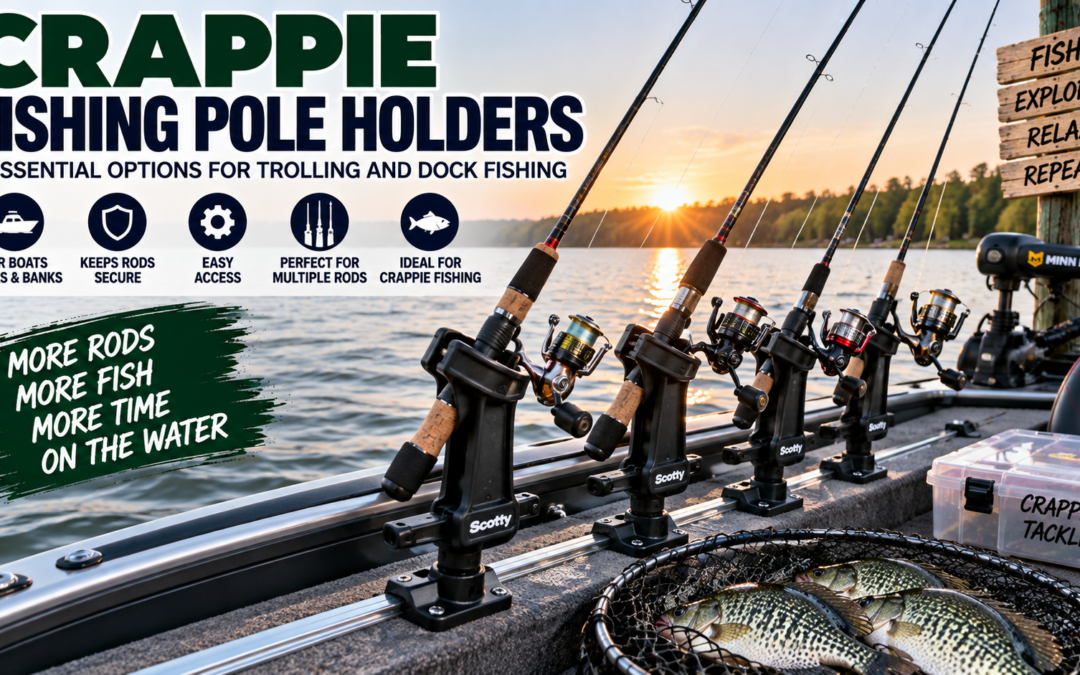
Crappie fishing pole holders can make a major difference when you are managing several rods from a boat, dock, shoreline, or dedicated fishing setup. Crappie anglers often work with multiple rods, different depths, and several presentations, so keeping each pole secure and easy to reach can make the entire fishing setup more organized.
The right holder should do more than simply keep a fishing pole upright. It should provide stable support, keep rods separated, allow quick access, and fit the space where you fish. A holder used for boat trolling may need a different arrangement from one used while fishing from a dock or bank.
This guide covers six practical crappie fishing pole holders setups and explains how to choose the right option for rod position, storage, trolling, accessibility, and stability.
For broader rod-holder information, see the fishing rod holder guide.
Why Crappie Anglers Use Pole Holders
Crappie fishing can involve several rods positioned at different angles or depths. Keeping every rod in your hands at the same time is not practical, particularly when you are fishing from a boat or managing several lines.
A properly positioned holder lets you keep a rod secure while remaining ready to reach it when a fish bites.
A good holder can help with:
- Keeping multiple rods organized.
- Maintaining consistent rod positions.
- Reducing clutter around the boat or dock.
- Keeping reels and handles accessible.
- Reducing the chance of rods being knocked onto the floor.
- Making multi-rod fishing easier to manage.
The main goal is simple: every rod should have a secure position that makes sense for the way you fish.
6 Crappie Fishing Pole Holder Options
1. Multi-Rod Boat Holder
A multi-rod boat holder is one of the most useful solutions for anglers who fish several crappie rods at the same time.
Instead of leaving rods across seats or on the deck, a dedicated holder keeps the setups separated and positioned where they can be monitored.
This arrangement can be especially useful when several rods need to remain ready while you move around the boat, adjust tackle, or manage other equipment.
When selecting a boat holder, consider the number of rods you normally use and whether each reel will have enough clearance.
The holder also needs to be positioned so it does not interfere with seating, boat controls, or normal movement.
2. Trolling Rod Holder Setup
Trolling creates a specific need for stable rod positioning. Rather than holding each rod manually, anglers can use holders to maintain consistent placement while the boat moves.
A good trolling arrangement keeps the rod secure while allowing the angler to quickly remove it when needed.
Spacing matters. Rods positioned too closely can create line-management problems, especially when several lines are being worked at different angles.
Arrange the holders so the rod tips and lines have enough separation for the fishing technique you are using.
For boat anglers, the Scotty 290 R-5 Rod Holder is one catalog product worth comparing when evaluating rod-holder options.
3. Side-Mounted Crappie Pole Holder
A side-mounted system can be useful when you want the rods positioned along the edge of a boat or fishing platform.
The advantage is that the rods can remain outside the primary working area, leaving more room for the angler, tackle boxes, seats, and other equipment.
Side positioning can also make it easier to monitor multiple rods at once because the handles remain arranged along the boat rather than stacked across the floor.
Before mounting a side holder, check the structure where it will be attached and follow the manufacturer's mounting requirements.
4. Vertical Crappie Pole Holder
A vertical holder keeps fishing poles standing upright and can work well on boats, docks, garages, or fishing preparation areas.
Vertical storage is particularly useful when the goal is to keep rods organized between trips or while preparing tackle.
For active fishing, make sure the vertical arrangement does not place the rods where they can interfere with casting or movement.
A vertical holder can also be helpful when you carry several crappie rods to and from your fishing location because the setups can remain together rather than being scattered around the vehicle or dock.
5. Dock and Bank Fishing Pole Holder
Not every crappie angler fishes from a boat. A dock or shoreline setup may require a simple holder that keeps a rod secure while the angler watches the line.
The key consideration is stability. A holder sitting on or near a dock should not be positioned where foot traffic can easily knock it over.
For shoreline fishing, check the ground or mounting surface carefully. Grass, mud, gravel, and uneven surfaces can affect how stable a freestanding holder remains.
The holder should also keep reels and rod handles away from areas where they can be stepped on.
6. Portable Multi-Rod Holder
A portable holder is useful when you fish different crappie waters and do not want a permanent installation.
You can move the holder between a boat, dock, campsite, garage, or other fishing location depending on the setup required.
The main trade-off is stability versus portability. A very lightweight holder may be easy to transport but less stable with several rods loaded into it.
Look for a design that is easy to carry while still providing enough support for your complete rod-and-reel setups.
For additional transport-focused ideas, see the portable fishing pole holder guide.
How to Choose Crappie Fishing Pole Holders
Start With the Number of Rods
Count the rods you normally use during a crappie trip.
Some anglers fish with only one or two poles, while others use several rods positioned around the boat or dock.
Do not choose a holder based only on the number of slots. The complete rod-and-reel setup needs enough room for the handle, reel body, and line-management area.
Consider the Reel Size
Reel clearance is easy to overlook.
Two rod slots may look wide enough for bare rod blanks but become crowded once spinning reels are attached.
Before purchasing, measure the complete equipment rather than only the rod diameter.
| Measurement | Why It Matters |
|---|---|
| Rod diameter | Determines how the blank fits into the holder. |
| Reel width | Determines side-to-side clearance. |
| Reel depth | Important for compact storage areas. |
| Handle length | Affects how much room is required behind the holder. |
| Rod length | Determines overall clearance and storage position. |
Think About Your Fishing Location
A holder for a boat does not necessarily make sense for a dock or garage.
Boat holders should account for movement, mounting, splash exposure, and accessibility. Dock holders need good stability and should not obstruct walking areas. Home storage holders can prioritize capacity and organization.
Choose the holder around the environment rather than trying to force one design into every situation.
Check Accessibility
A holder should keep the rods secure without making them difficult to remove.
When a fish bites, you should be able to reach the rod quickly.
A holder that stores rods tightly together may save space but make removal slower. Leave enough separation for your hands to reach the rod grip and reel.
Crappie Fishing Pole Holders for Trolling
Trolling is one situation where rod-holder placement becomes especially important.
The rods should remain stable while the boat moves, and the angles should allow you to monitor lines without unnecessary interference between setups.
If several rods are being used, think about their positions as a complete system instead of selecting holder locations individually.
Try to keep adjacent lines and rod tips separated enough to reduce tangles.
Also consider where you will stand when removing a rod. A holder that works on paper may become awkward if another rod blocks your reach.
Crappie Fishing Pole Holders for Dock Fishing
Dock fishing often calls for simpler equipment than boat trolling.
A secure holder can allow you to keep the rod in position while watching the line, preparing bait, or managing another setup.
Make sure the holder is positioned away from the edge where a knocked-over rod could fall into the water.
Keep the walking path clear. Fishing rods can become a trip hazard when too many complete setups are placed across a narrow dock.
Crappie Rod Holder Arrangement for Multiple Rods
When several rods are involved, organization can make a bigger difference than simply adding more holder slots.
Separate Rods by Technique
Keep rods designed for different presentations in clearly separated positions where practical.
Keep Frequently Used Rods Accessible
Place the rods you monitor most frequently in the easiest positions to reach.
Use Consistent Rod Angles
Consistent positioning can make it easier to see the rods and maintain line separation.
Leave Room for the Reels
Do not place holders so close together that reel handles or bodies constantly touch.
How Stable Should a Crappie Pole Holder Be?
Stability depends on the environment.
A holder mounted directly to a suitable surface can remain very stable, while a freestanding design depends on its base and weight distribution.
Boat movement adds another consideration. If you fish from a moving boat, the holder needs to be appropriate for that application and installed according to the manufacturer's instructions.
Before using a holder with several rods, test the system with the equipment installed. Remove one rod and make sure the remaining setup stays secure.
Rod Holder Materials
Crappie rod holders can be made from different materials, each with different practical characteristics.
| Material | Common Benefit | Consideration |
|---|---|---|
| Plastic | Lightweight and often easy to handle | Check durability and mounting strength |
| Metal | Can provide rigid support | Weight and corrosion resistance matter |
| Composite | Can balance weight and durability | Check construction quality |
For outdoor or boat use, pay attention to the manufacturer's intended application and material specifications.
Boat Mounting Considerations
Before installing crappie fishing pole holders on a boat, determine exactly where the holder will sit.
The mounting position should not obstruct controls, seats, storage compartments, walkways, or casting areas.
Follow the product's installation instructions and use mounting hardware appropriate for the mounting surface.
For anglers comparing different holder designs, Hooked Beginner's fishing pole holder guide covers broader holder and storage considerations.
Crappie Fishing Pole Holders vs. General Rod Holders
A general fishing rod holder can work perfectly well for crappie fishing, but your particular technique may call for different positioning.
| Use | Important Consideration |
|---|---|
| Crappie trolling | Stable positioning and separation between multiple rods |
| Dock fishing | Simple access and secure placement |
| Boat storage | Capacity and reel clearance |
| Bank fishing | Ground stability and portability |
| Garage storage | Organization and space efficiency |
The important thing is to match the holder to the fishing situation.
How to Protect Crappie Rods in Holders
Rod holders should reduce the risk of damage rather than create new contact points.
Make sure the rod is supported without excessive pressure on the blank.
Keep reel handles and sensitive components away from surfaces that can knock against them during movement.
When storing rods between trips, clean dirt and debris from the equipment and allow it to dry before placing it into an enclosed storage area.
For broader maintenance guidance, see the Take Me Fishing fishing gear maintenance guide.
How to Store Multiple Crappie Rods After Fishing
After a trip, take a few minutes to reset the equipment.
Remove loose tackle, check the line, inspect the rod guides, and wipe away dirt or moisture.
Return each rod to its designated position.
A consistent storage system makes it easier to identify the equipment you want before the next trip.
For a broader storage approach, see the fishing rod storage rack guide.
Can a Regular Fishing Rod Holder Be Used for Crappie?
Yes. A general rod holder can be appropriate for crappie fishing when its size, mounting method, and rod clearance suit your equipment.
The important issue is not the word “crappie” on the packaging. It is whether the holder keeps your rod secure and accessible for the way you fish.
A general-purpose holder can therefore be useful for anglers who want one storage solution that works for several fishing styles.
The Scotty 290 R-5 Rod Holder is one example of a rod-holder product available in the Hooked Beginner catalog.
DIY Crappie Fishing Pole Holder
Some anglers prefer to build a custom holder around the exact dimensions of their boat or fishing space.
PVC, plywood, and other materials can be used to create simple rod-support systems for temporary or permanent storage.
A custom holder allows you to control the number of positions, spacing, and orientation.
Take Me Fishing provides a DIY fishing rod holder guide using PVC and plywood that can serve as a general reference for a custom storage project: DIY Fishing Rod Holder Guide.
When designing your own holder, measure the complete rod-and-reel setups first and build around the actual equipment.
Crappie Fishing Pole Holder Buying Checklist
| Check | Question to Ask |
|---|---|
| Capacity | How many rods do I normally fish? |
| Reel clearance | Will complete rod-and-reel setups fit comfortably? |
| Location | Will the holder be used on a boat, dock, bank, or at home? |
| Stability | Will the holder remain secure when loaded? |
| Access | Can I remove a rod quickly? |
| Mounting | Is the installation method appropriate for my surface? |
| Spacing | Will the rods and lines remain separated? |
| Portability | Does the holder need to move between locations? |
Frequently Asked Questions
What are the best crappie fishing pole holders?
The right crappie fishing pole holders depend on how many rods you use and where you fish. Boat trolling, dock fishing, bank fishing, and storage each have different priorities.
Can I use a normal rod holder for crappie fishing?
Yes. A general rod holder can work as long as the rod fits securely and the holder is suitable for your fishing environment.
How many crappie rods should a holder accommodate?
Choose capacity based on the number of rods you normally use. Leave enough space between complete rod-and-reel setups to remove a rod without disturbing neighboring equipment.
Are rod holders useful for crappie trolling?
Yes. Holders can keep multiple rods positioned around a boat while leaving the angler free to monitor lines and manage other equipment.
Can crappie fishing pole holders be used from a dock?
Yes. A stable holder can keep a rod secure while you monitor the line, provided it is positioned safely and does not obstruct the dock walkway.
Should crappie rod holders be mounted or portable?
Choose based on your fishing routine. Permanent mounting can provide stable, repeatable positioning, while portable holders offer flexibility when you fish from different locations.
How should multiple crappie rods be arranged?
Arrange them so the rods and lines have adequate separation. Keeping frequently monitored rods within easy reach can also make the setup more efficient.
What should I check before buying a crappie rod holder?
Check capacity, reel clearance, stability, mounting method, spacing, accessibility, and whether the holder is designed for the environment where you intend to use it.
Final Thoughts
Crappie fishing pole holders are most useful when they are selected around the way you actually fish. Boat trolling, dock fishing, shoreline fishing, and rod storage all place different demands on a holder.
Start by counting your rods, measuring the complete rod-and-reel setup, and identifying where the holder will be used. Then consider capacity, stability, spacing, mounting, and access.
For multi-rod boat fishing, a dedicated rod-holder system can make the setup easier to manage. For dock and bank fishing, a stable portable design may be enough. For storage between trips, a vertical or horizontal rack can keep the entire collection organized.
Hooked Beginner's fishing pole holder guide and fishing rod rack guide provide additional storage information, while the portable fishing pole holder guide covers transport-oriented solutions.
For product comparison, the Scotty 290 R-5 Rod Holder is one verified catalog option to examine.
The best holder is ultimately the one that keeps your rods secure, leaves enough room for your reels and lines, and allows you to reach the right pole quickly when the action starts.