
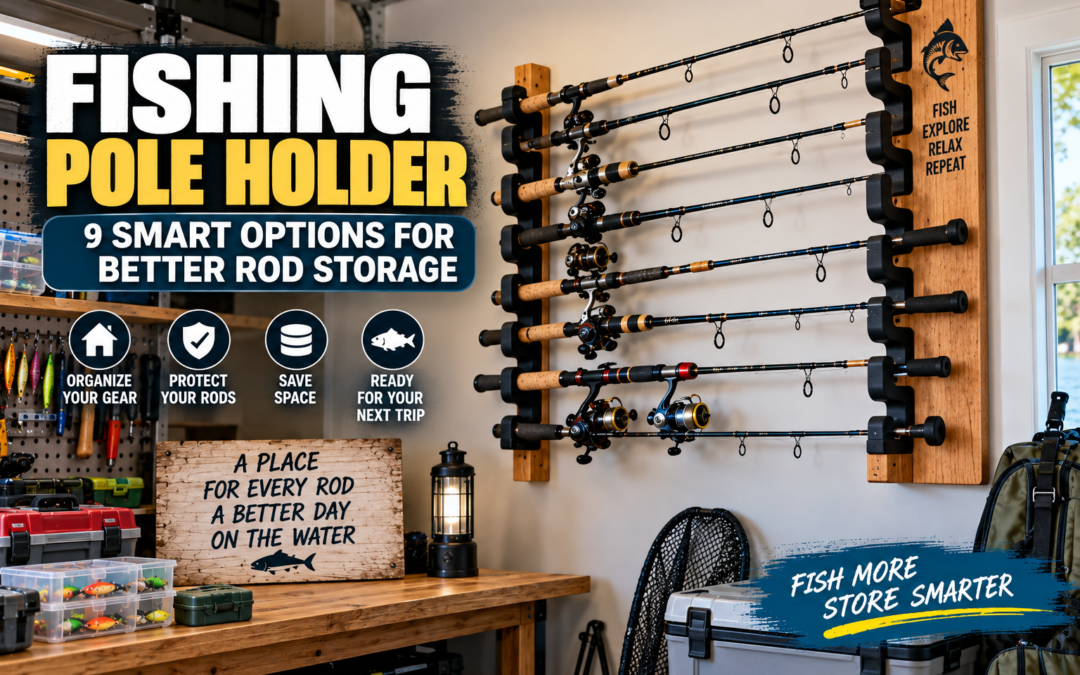
A fishing pole holder gives your rods a dedicated place to rest when you are not on the water. Instead of leaning fishing poles against a wall, stacking them in a corner, or leaving them where they can be knocked over, a properly selected holder keeps your equipment organized and easier to access.
Rod storage becomes especially important when you own several setups. A light spinning rod, a heavier casting rod, and a boat setup all have different dimensions and reel clearances. The right fishing pole holder can help separate these setups while making better use of your garage, workshop, boat, shed, or fishing room.
This guide covers nine practical holder options, how to choose between them, where each type works best, and what to consider before installing or buying one. For broader information on rods, start with the fishing rods guide.
What Is a Fishing Pole Holder?
A fishing pole holder is a storage or support device designed to keep a fishing rod in a controlled position. Depending on its construction, it may be mounted to a wall, attached to a boat, installed vertically, positioned horizontally, or designed as a freestanding system.
The basic purpose is simple: support the fishing pole while reducing unnecessary contact with floors, walls, other rods, and equipment.
A holder can be used for a rod by itself or, depending on the design, for a complete rod-and-reel setup. This is important because the reel adds width and changes how much clearance the storage system needs.
Why Use a Fishing Pole Holder?
Proper storage is more than an organization preference. Take Me Fishing recommends keeping rods properly supported and warns against leaning rods together or storing them upright in a garage corner because blanks, guides, tips, and reels can be more exposed to damage.
A dedicated holder can help you:
- Keep multiple fishing rods separated and easier to identify.
- Reduce the chance of rods being stepped on, knocked over, or tangled together.
- Make use of vertical or otherwise unused storage space.
- Keep frequently used setups within easy reach.
- Create a more organized fishing equipment area.
Organization also makes routine maintenance easier. When each rod has a defined place, it is easier to notice damaged guides, dirty blanks, tangled line, or equipment that needs attention before the next trip.
9 Fishing Pole Holder Options
1. Wall-Mounted Fishing Pole Holder
A wall-mounted fishing pole holder is one of the most practical choices for a garage, workshop, shed, or dedicated fishing room. It keeps rods off the floor and uses wall space that might otherwise go unused.
Wall systems can be configured to hold several rods at once. Depending on the design, rods may be positioned vertically or horizontally.
This type is especially useful when floor space is limited. Instead of occupying a corner with a large freestanding rack, the rods remain attached to the wall and out of the way of normal foot traffic.
Before installing one, measure the rods, reels, available wall space, and the distance needed to remove each setup comfortably.
2. Vertical Fishing Pole Holder
A vertical holder keeps rods standing upright in a controlled position. It can be a good fit for a narrow wall where there is plenty of height but limited horizontal space.
Vertical storage also makes it easy to see the top sections and handles of your rods at a glance. For anglers with several similar setups, labeling or grouping them by use can make this arrangement even more practical.
When using vertical storage, the holder should support the rod securely instead of relying on the rod tip or another fragile point as the main support.
3. Horizontal Fishing Pole Holder
A horizontal fishing pole holder supports rods along a wall or other surface. This approach is useful when you have a long open wall, such as the area above a workbench.
Horizontal storage can be particularly convenient for longer rods because it keeps the entire setup visible and accessible. It also lets you organize rods by type, size, or fishing style.
The key consideration is support spacing. A long rod should not be forced into a position where too much pressure is concentrated on one small section.
4. Multi-Rod Fishing Pole Holder
A multi-rod holder is designed for anglers who have more than one or two fishing setups. Instead of installing individual supports for every rod, one system handles several rods in the same area.
This can be useful for anglers who own separate setups for freshwater, bass, saltwater, light tackle, or heavier applications.
Do not judge capacity by the advertised number alone. A holder that says it stores ten rods may become difficult to use if ten fully rigged setups are packed too closely together. Reel size and handle length matter just as much as rod count.
5. Fishing Pole Holder for a Garage
The garage is a popular storage location because it provides space, but it can also expose fishing equipment to accidental impacts from vehicles, bicycles, ladders, tools, boxes, and doors.
A garage fishing pole holder should be positioned away from high-traffic areas. A side wall, storage wall, or area above an existing workbench can often be more practical than placing rods beside a frequently opened garage door.
Keep the rods far enough away from other equipment that they cannot easily be struck or snagged.
6. Ceiling-Mounted Fishing Pole Holder
Ceiling-mounted systems use overhead space rather than wall or floor space. They can be useful when the garage or workshop walls are already occupied.
Because the storage system is overhead, installation strength becomes especially important. The mounting point and hardware need to be appropriate for the weight and configuration of the stored equipment.
Ceiling storage can be convenient for rods that are used less frequently, while everyday setups may be easier to access from a wall-mounted holder.
7. Boat Fishing Pole Holder
Boat storage has different requirements from garage storage. Movement, vibration, water exposure, and restricted space all affect the type of holder that makes sense.
Take Me Fishing recommends keeping rods straight and side by side on a boat and using rod holders or rod lockers to reduce scratching, impacts, and movement caused by vibration.
For this type of application, a marine-oriented holder should provide secure support without unnecessarily interfering with the reel or line.
Hooked Beginner currently lists the Scotty 290 R-5 Rod Holder, which is a relevant product to consider when evaluating rod-holder solutions.
8. Portable Fishing Pole Holder
A portable holder is useful when the fishing gear needs to move between storage locations. Instead of permanently mounting the system, you can keep the holder wherever it is needed.
Portable designs can work well for temporary storage at a fishing camp, workshop, storage area, or other location where permanent installation is not practical.
The tradeoff is that a portable holder needs enough stability to prevent the rods from tipping when equipment is added or removed.
9. Freestanding Fishing Pole Holder
A freestanding holder can be useful when wall mounting is not possible or when you want to move the entire rod collection as one unit.
This type can work particularly well in larger garages or workshops where floor space is available. It can also make it easier to rearrange your fishing equipment without drilling into walls.
Look for a wide and stable base, adequate spacing, and enough clearance for reels. The structure should remain stable when rods are removed from one side.
Fishing Pole Holder vs. Fishing Rod Rack
Although the terms are often used interchangeably, a fishing pole holder and a fishing rod rack can serve slightly different roles.
| Feature | Fishing Pole Holder | Fishing Rod Rack |
|---|---|---|
| Main purpose | Supports one or more rods | Organizes a larger rod collection |
| Typical installation | Wall, boat, ceiling, or portable | Wall, floor, or freestanding |
| Space usage | Often compact | Can require more space |
| Best use | Specific rod support | Collection organization |
| Mobility | Depends on design | Some models are portable |
A holder is often the better choice when the priority is securing a specific setup. A larger rack may make more sense when the goal is to organize an entire collection.
How to Choose the Right Fishing Pole Holder
1. Count Your Rods
Start with the number of rods you actually need to store. If you have three rods today but regularly add equipment, leave some additional capacity rather than filling the system immediately.
At the same time, avoid buying excessive capacity that makes the holder unnecessarily large for your space.
2. Measure Rod Length
Rod length determines how much space your storage system needs. A short spinning setup and a long surf rod cannot always share the same storage arrangement.
Measure the rods before choosing the holder, particularly when installing horizontal storage.
3. Measure Reel Clearance
A rod with a reel attached takes up more space than a bare rod. Large spinning reels, baitcasting reels, and conventional reels can require significantly different clearances.
Make sure the reel does not press against a wall or another stored setup.
4. Check the Contact Points
The points where the holder touches the rod should be smooth and appropriate for the type of equipment being stored.
Excessive rubbing, pressure, or movement can eventually make storage less protective. The objective is to hold the setup securely without creating unnecessary stress.
5. Check Mounting Strength
For a mounted system, the installation surface matters. Drywall, wood, masonry, and other surfaces may require different hardware and mounting methods.
A holder that is securely fastened is much more useful than one that shifts every time you remove a rod.
6. Think About Access
Consider how often each rod is used. Frequently used setups should be placed where they can be reached quickly without moving boxes or other fishing equipment.
Less frequently used rods can occupy positions farther back in the storage area.
What Makes a Good Fishing Pole Holder?
A good holder does not need to be complicated. Its most important qualities are stability, appropriate spacing, compatibility with your rods, and convenient access.
For a multi-rod setup, the best design is one that lets you remove one rod without knocking into the others. For boat use, secure support and resistance to movement become especially important.
The holder should also fit your storage environment. A large floor rack may be unnecessary in a small room, while a tiny two-rod holder may not be enough for a large collection.
How to Store a Fishing Rod in a Holder
Before storing a rod, remove hooks, lures, and other loose terminal tackle that could catch on the rod or line. Take Me Fishing recommends removing hooks and lures after use and rinsing fishing equipment with fresh water to remove dirt, sand, and saltwater residue.
After the equipment is clean and dry:
- Check the rod blank and guides for visible damage.
- Make sure loose line is secured.
- Place the rod into the designated holder position.
- Confirm that the reel has adequate clearance.
- Check that neighboring rods are not rubbing against one another.
- Keep the storage area free of objects that can fall onto the rods.
For longer-term storage, organization matters just as much as the holder itself. IGFA recommends maintaining a disciplined storage system so fishing equipment remains organized, easy to find, and ready for the next trip.
Common Fishing Pole Holder Mistakes
Overloading the Holder
Putting more rods into a holder than it was designed to handle can make every setup harder to access. Extra capacity only helps when there is enough physical room to use it properly.
Ignoring Reel Size
A storage system designed around bare rods may not work well when every rod has a large reel attached.
Installing in a High-Traffic Area
A fishing pole holder next to a garage door, vehicle path, or frequently used work area can expose rods to unnecessary impacts.
Storing Dirty or Wet Equipment
Salt, sand, dirt, and moisture should not simply be locked away with the equipment. Cleaning and drying gear before storage is part of maintaining it.
Placing Rods Too Close Together
If handles, reels, or guides constantly touch, removing one setup can disturb the entire group. Give each rod enough space to be used independently.
DIY Fishing Pole Holder vs. Ready-Made Holder
A DIY holder can be useful for anglers who want a simple storage solution. Take Me Fishing has published a step-by-step DIY rod-holder design intended to keep rods from being leaned against a wall or stuck in a corner, while also reducing tangles and protecting guides and tips.
A ready-made fishing pole holder, on the other hand, can provide a more finished solution without requiring cutting, drilling, or fabrication.
| Option | Advantages | Considerations |
|---|---|---|
| DIY holder | Custom dimensions and potentially low material cost | Requires tools, measurements, and installation |
| Ready-made holder | Convenient and purpose-built | Dimensions and capacity are predetermined |
The better choice depends on whether customization or convenience matters more for your particular storage area.
Fishing Pole Holder for Beginners
Beginners often do not need a complicated storage system. A simple holder for the first few rods may be enough, particularly when the angler is still learning which fishing styles and setups they enjoy most.
As the collection grows, the storage system can grow with it. Organizing rods early also reduces the habit of leaving equipment scattered across a garage or room.
For beginners who are still building a complete setup, the fishing pole guide and fishing reels guide provide additional information on the equipment itself.
Best Placement Ideas for a Fishing Pole Holder
The ideal location depends on the type of holder and how often you fish.
- Garage wall: Good for larger collections and everyday access.
- Workshop: Useful when fishing equipment is stored alongside tools and tackle.
- Fishing room: Convenient for dedicated gear organization.
- Boat: Appropriate for rods that need to remain secured during transport and fishing.
- Shed: Useful when indoor space is limited, provided the environment is appropriate for storing the equipment.
Wherever you install the holder, avoid locations where rods can be struck by doors, vehicles, ladders, or other heavy equipment.
How to Organize Multiple Fishing Poles
Once you have several rods, organization becomes easier when you group similar setups together. For example, you can separate spinning rods from casting rods or divide equipment by fishing environment.
IGFA's tackle-organization guidance emphasizes dividing equipment into logical categories and maintaining a consistent system so gear can be located and returned to its proper place after a trip.
The same principle works for rod storage. A rod holder is most useful when every position has a clear purpose.
Frequently Asked Questions About Fishing Pole Holders
What is the best way to store fishing poles?
A dedicated holder or rack that supports rods securely and prevents unnecessary contact between equipment is generally more organized than leaning rods together in a corner. Take Me Fishing specifically recommends proper rod storage instead of leaving rods leaning against one another.
Can a fishing pole holder hold a rod with the reel attached?
Many designs can, but you should confirm the holder's dimensions and intended configuration. Reel size can significantly change the amount of clearance required.
How many fishing poles can one holder store?
Capacity varies by model. Some holders support only a few rods, while multi-rod systems are designed for larger collections. The practical capacity depends on both the advertised number and the spacing between setups.
Are fishing pole holders suitable for garages?
Yes. Garages are common storage locations, but the holder should be installed away from vehicles, doors, ladders, and other sources of impact.
Should fishing poles be stored vertically or horizontally?
Either orientation can work when the rods are properly supported. Choose based on available space, rod length, holder design, and ease of access.
Do I need a fishing pole holder for only two rods?
Not necessarily, but even a small collection benefits from having a defined storage location. A compact holder can keep two setups organized without requiring a large storage system.
Final Thoughts
The right fishing pole holder can make your fishing equipment easier to store, protect, and access. Wall-mounted, vertical, horizontal, multi-rod, garage, ceiling, boat, portable, and freestanding options each solve different storage problems.
The key is matching the holder to the equipment and the space. Consider rod length, reel size, storage capacity, mounting method, spacing, stability, and how frequently you use each setup.
For anglers building a more organized system, the fishing rods section and fishing accessories category provide additional ways to build out and organize a complete fishing setup.
A well-planned storage system means less clutter, easier access, and less unnecessary handling of your fishing gear. Whether you have two rods or a growing collection, a properly chosen holder gives every setup a clear place when the fishing day is over.