
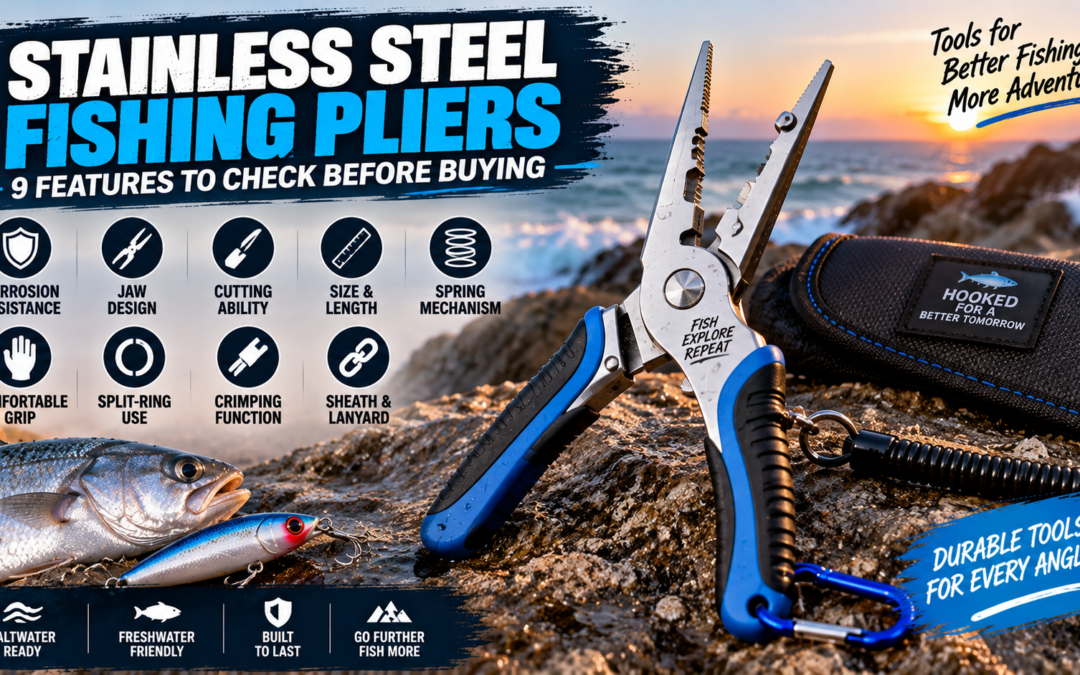
Stainless Steel Fishing Pliers: 9 Features to Check Before Buying
Stainless steel fishing pliers are one of those fishing tools that become useful in far more situations than many beginners expect. A quality pair can help remove hooks, grip leaders, cut fishing line, crimp connections, work split rings, tighten knots, and handle small tackle adjustments without forcing you to reach for several different tools.
The material matters because fishing pliers are frequently exposed to water, fish slime, salt, sand, and moisture. For anglers who fish saltwater, corrosion resistance becomes especially important. Take Me Fishing recommends stainless steel or titanium for saltwater pliers and notes that pliers can serve several functions, including cutting wire, tightening knots, and removing hooks. See the Take Me Fishing guide to saltwater fishing tools.
However, stainless steel is only one part of the decision. The best pair for your setup also depends on jaw design, cutter quality, length, grip, spring mechanism, locking system, split-ring capability, sheath, lanyard, and the type of fishing you do.
This guide breaks down the nine features that deserve attention before buying stainless steel fishing pliers, explains how they differ from other fishing pliers, and shows how to choose a pair for freshwater, saltwater, shore fishing, boat fishing, and everyday tackle work.
- Why Stainless Steel Fishing Pliers?
- 9 Features That Matter
- Choosing the Right Pliers Length
- Stainless Steel for Saltwater Fishing
- Using Pliers in Freshwater
- What Fishing Pliers Can Do
- Choosing Line Cutters
- Split-Ring Pliers
- Grip and Ergonomics
- Sheaths, Lanyards and Storage
- Cleaning and Maintenance
- Common Buying Mistakes
- Frequently Asked Questions
Why Stainless Steel Fishing Pliers?
Fishing pliers need to survive a difficult combination of moisture, pressure, sharp hooks, abrasive line, and repeated handling. A tool that works well in a dry workshop may not perform the same way after repeated exposure to saltwater.
Stainless steel is popular because it provides corrosion resistance while retaining the strength needed for gripping and cutting. The exact grade, finish, coating, cutter material, and construction still matter, so the words “stainless steel” should not be treated as a complete specification.
Take Me Fishing specifically recommends corrosion-resistant materials such as stainless steel or titanium for anglers who fish in saltwater. It also recommends cleaning and drying pliers after use. Read its fishing tackle tool guidance.
IGFA product coverage also shows that modern fishing pliers can combine corrosion-resistant construction with replaceable cutters, spring-loaded jaws, specialized coatings, ergonomic grips, and other features intended for repeated use. See IGFA's coverage of high-strength stainless steel fishing pliers.
9 Features That Matter When Buying Stainless Steel Fishing Pliers
1. Stainless Steel Construction
The first feature to examine is the construction of the pliers themselves.
Stainless steel provides resistance to corrosion, but not all stainless steel fishing pliers are identical. The alloy, manufacturing process, surface treatment, and exposure to saltwater all affect long-term performance.
For freshwater anglers, basic corrosion-resistant construction may be more than adequate. Saltwater anglers should pay closer attention to corrosion protection because salt residue can remain on the tool after every trip.
Do not assume that stainless steel means you can leave the tool wet. Proper cleaning and drying remain important.
2. Jaw Design
The jaws determine how effectively the tool can grip hooks, leaders, split rings, sleeves, and other fishing components.
A narrow needle-nose design provides access to small spaces and can be particularly helpful when removing hooks from difficult positions. A wider jaw can provide more gripping power for heavier tackle.
Consider your normal fishing style:
- Light tackle: narrower jaws can provide better access around small hooks.
- General fishing: medium jaws offer a useful combination of reach and strength.
- Heavy tackle: stronger, wider jaws can provide more leverage.
- Toothy fish: longer jaws can help keep your hands farther from the mouth and hooks.
The length of the jaws and the overall shape should match the type of work you actually perform.
3. Cutting Ability
Many anglers use fishing pliers primarily because they want cutting capability in the same tool.
Good cutters should handle the line types you actually use. Depending on the model, cutters may be designed for monofilament, fluorocarbon, braided line, or light wire.
Replaceable cutters are especially useful for anglers who fish frequently because the cutting edges eventually wear.
IGFA's coverage of modern fishing pliers highlights replaceable carbide or tungsten-carbide cutters on several designs, illustrating the importance of cutter construction when choosing a multi-purpose fishing tool. See IGFA's fishing plier product coverage.
4. Pliers Length
Pliers length affects leverage, reach, weight, and safety.
Compact pliers are convenient for everyday tackle work and are easy to carry in a vest, bag, or small tackle box. Longer pliers can provide additional reach when removing hooks from fish with sharp teeth or when working around deeper hook placements.
Take Me Fishing's saltwater tool guidance specifically distinguishes between shorter compact pliers for power and longer needle-nose pliers for reaching tight areas. Compare the different saltwater plier applications.
For many anglers, medium-length pliers provide a practical balance between portability and reach.
5. Spring-Loaded Opening
Spring-loaded jaws can make repeated tackle work faster because the handles return toward their open position after you release pressure.
This is useful when cutting line, removing hooks, changing terminal tackle, or performing several adjustments during a trip.
The spring should feel controlled rather than excessively stiff. A spring that is too weak may not open the jaws effectively, while one that is too strong can make the tool uncomfortable for extended use.
Some high-end fishing pliers also use specialized spring or magnetic opening mechanisms. The exact design matters less than whether it makes the tool easier to control.
6. Ergonomic Non-Slip Grip
Fishing pliers can become difficult to use when your hands are wet, cold, slimy, or covered with sunscreen.
An ergonomic handle can make a significant difference. Look for a grip that provides enough texture and surface area to maintain control without requiring excessive squeezing force.
A comfortable grip is particularly important when working with stiff leaders, heavy wire, hooks, crimps, or stubborn split rings.
IGFA's product coverage includes fishing pliers with molded or textured grips designed to improve control during demanding fishing applications. See the examples documented by IGFA.
7. Split-Ring Capability
Anglers who use plugs, hard baits, jigs, and other artificial lures often need to change hooks or hardware.
Split-ring pliers have specialized jaw shapes that help separate the ring so a hook or accessory can be inserted.
A general pair of fishing pliers may not perform this task as efficiently as a dedicated split-ring tool. If you frequently modify lures, check whether the pliers specifically include a split-ring section.
This feature can be especially valuable for anglers who carry fewer tools and want one pair of stainless steel fishing pliers to handle multiple tackle tasks.
8. Crimping Function
Crimping capability is useful when building leaders, making wire connections, or working with sleeves and crimps.
Not every pair of fishing pliers is designed for heavy crimping. The crimping section should match the type and size of components you use.
Heavy saltwater anglers who work with wire or larger terminal tackle may want a purpose-built crimping tool rather than relying exclusively on general-purpose pliers.
For lighter tackle work, an integrated crimping area can save space in the tackle box.
9. Sheath, Lanyard and Storage System
A good pair of pliers is not very useful if you constantly lose it at the bottom of a tackle bag.
A belt sheath, protective case, coiled lanyard, or tether can keep the tool accessible during fishing.
This becomes particularly important when fishing from a boat, kayak, surf beach, or wading environment where dropping equipment can mean losing it completely.
Some modern designs include both a sheath and lanyard so the angler can carry the tool securely while keeping it within immediate reach.
Choosing the Right Fishing Pliers Length
Pliers length should be determined by your fishing environment and the work you expect to perform.
Short Pliers
Short pliers are compact and easy to carry. They work well for everyday tackle work, lure changes, line cutting, and smaller hooks.
Medium Pliers
Medium-length pliers provide a useful compromise between compactness and reach. They are often the most versatile choice for an angler who wants one pair of pliers for several fishing situations.
Long Pliers
Long pliers offer additional reach and can be useful when handling fish with teeth or deeply positioned hooks. They also provide more distance between the angler's hand and the hook.
For saltwater anglers, especially those targeting toothy fish, reach can be an important part of tool selection.
Stainless Steel Fishing Pliers for Saltwater
Saltwater is particularly demanding on fishing tools.
Salt residue can collect around hinges, cutters, jaws, springs, and other moving components. Sand can also work into the hinge and reduce smooth operation.
Take Me Fishing recommends stainless steel or titanium pliers for saltwater use because of their corrosion resistance. It also points out that pliers are frequently used for cutting wire, tightening knots, and removing hooks. Review the saltwater tools guide.
Take Me Fishing also identifies a practical warning sign: pliers that become difficult to open can indicate corrosion and may be a reason to replace them with a corrosion-resistant model. See its guide to signs that fishing gear needs replacement.
For saltwater use, look for:
- Corrosion-resistant construction.
- Protected or replaceable cutters.
- A hinge that remains smooth after cleaning.
- A non-slip grip.
- Secure storage or tethering.
- A design that can be thoroughly cleaned.
Stainless Steel Fishing Pliers for Freshwater
Freshwater anglers still benefit from corrosion-resistant pliers. Moisture, fish slime, rain, humidity, and wet tackle can all affect metal tools.
The corrosion requirements are usually less demanding than repeated saltwater exposure, but basic maintenance still matters.
A compact pair can be particularly useful for bass, trout, panfish, and general freshwater fishing where hooks and line need to be removed or adjusted regularly.
If your fishing includes both freshwater and saltwater, investing in a more corrosion-resistant tool can simplify your tackle system because you do not need completely separate tools for each environment.
What Can Stainless Steel Fishing Pliers Do?
A quality pair can perform several jobs during a fishing trip.
Hook Removal
Pliers can help remove hooks while keeping your fingers away from sharp points. The longer the jaws, the more reach you have when working around difficult hook positions.
For toothy saltwater fish, a dedicated hook-removal tool may still be preferable. Take Me Fishing specifically notes that long-handled hook removers can provide additional separation from dangerous mouths and hooks. See the saltwater tool recommendations.
Line Cutting
Cutters allow you to trim excess line after tying knots, remove damaged sections, or change rigs without reaching for a separate knife.
Crimping
Crimping sections can help with terminal tackle and leader construction when the pliers are designed for that purpose.
Split-Ring Work
Split-ring sections can make hook replacement and lure modifications faster.
Leader Handling
The jaws can help grip leader material while making adjustments or securing connections.
Tackle Adjustments
A pair of pliers can also help with small mechanical jobs that arise during a fishing trip, such as tightening components or manipulating hardware.
Choosing Line Cutters
Do not judge cutters simply by how sharp they feel when new. Think about the line materials you normally use.
Different cutter designs are intended for different materials. Some are designed for monofilament and fluorocarbon, while specialized cutters can also handle braided line or light wire.
Replaceable cutters are valuable for serious anglers because they allow the cutting component to be replaced instead of replacing the entire tool.
Before buying, check the manufacturer's specifications for the materials the cutters are designed to handle.
Do You Need Split-Ring Pliers?
Not every angler does.
If you mostly fish bait with simple terminal tackle, a standard pair of fishing pliers may be enough. If you frequently replace treble hooks, rings, hooks, or other lure hardware, split-ring functionality can become extremely useful.
A split-ring section should open the ring cleanly without requiring excessive force.
Anglers who work on many lures may choose dedicated split-ring pliers in addition to standard fishing pliers, while anglers who prioritize portability may prefer a multi-function design.
Why Grip and Ergonomics Matter
Fishing tools are often used under less-than-ideal conditions.
Your hands may be wet. The fish may be moving. The line may be slippery. The hook may be difficult to reach. A poor grip can make a simple job unnecessarily difficult.
Look for handles that sit comfortably in your hand and offer enough traction to maintain control without requiring excessive squeezing.
Some designs use rubberized or polymerized surfaces while others rely on textured metal or molded grips.
There is no single handle material that works for everyone. The important consideration is secure control in the conditions where you fish.
Stainless Steel vs. Titanium Fishing Pliers
Both stainless steel and titanium are used in fishing pliers designed for corrosion resistance.
Stainless steel can provide a strong combination of durability and corrosion resistance. Titanium is also widely used in saltwater tools and can offer high corrosion resistance with a relatively low weight.
The choice depends on your budget, fishing environment, and desired combination of weight and durability.
Take Me Fishing notes that titanium pliers can be a larger initial investment for anglers who fish both freshwater and saltwater, while also highlighting their long-term resistance when cared for correctly. Compare its stainless steel and titanium guidance.
For most anglers, choosing a well-made tool with the correct features is more important than choosing a material based on marketing language alone.
Stainless Steel vs. Aluminum Fishing Pliers
Aluminum fishing pliers can be attractive to anglers who want a lightweight corrosion-resistant tool.
Stainless steel tends to provide a different balance of strength, weight, and durability.
The correct material depends on the tasks you expect the tool to perform. If heavy gripping, cutting, crimping, and repeated saltwater use are central to your fishing, construction quality should receive particular attention.
Sheaths, Lanyards and Storage
A fishing tool should be accessible without becoming a piece of loose tackle.
A sheath attached to a belt, tackle bag, vest, or boat storage point lets you reach the pliers quickly. A lanyard reduces the chance of losing them overboard or in the water.
When storing your pliers in a tackle box, keep them away from standing water and wet lures. Allow them to dry before putting them into enclosed storage.
Take Me Fishing's maintenance guidance recommends drying tackle thoroughly and replacing worn or rusted tools such as pliers, forceps, and cutters when necessary. Review the fishing tackle maintenance guidance.
How to Clean Stainless Steel Fishing Pliers
Even corrosion-resistant pliers should be cleaned after fishing, especially after saltwater use.
Step 1: Remove Debris
Wipe away fish slime, sand, bait residue, salt deposits, and other visible debris.
Step 2: Rinse as Appropriate
Follow the manufacturer's instructions for rinsing the tool. The goal is to remove salt and debris without forcing contaminants deeper into the hinge.
Step 3: Dry Completely
Dry the jaws, cutters, hinge, and handles before storing the pliers.
Step 4: Inspect the Cutters
Check the cutting edges for chips, dull spots, or corrosion.
Step 5: Check the Hinge
Open and close the pliers to make sure movement remains smooth.
Step 6: Lubricate if Recommended
Use only lubrication recommended by the manufacturer and apply it appropriately to moving components.
Never assume stainless steel means maintenance-free. Regular cleaning is what keeps the tool functioning properly.
When Should You Replace Fishing Pliers?
Fishing pliers should be replaced when they can no longer perform their intended jobs safely or reliably.
Warning signs include:
- Severe corrosion.
- Jaws that no longer align correctly.
- Cutters that remain dull after sharpening or replacement is unavailable.
- A hinge that binds or will not open smoothly.
- Cracked or damaged handles.
- A broken spring mechanism.
- Excessive play between the jaws.
- Loss of grip caused by damaged handle material.
Take Me Fishing specifically identifies pliers that no longer open properly as a sign that corrosion may have compromised the tool. Read the full gear-replacement checklist.
How Many Pairs of Fishing Pliers Do You Need?
Most casual anglers can operate with one good general-purpose pair.
However, specialized anglers may benefit from more than one:
- General-purpose pliers: hooks, line and everyday tackle.
- Long-reach pliers: toothy fish and deeper hook removal.
- Split-ring pliers: lure and hook changes.
- Heavy crimping pliers: leaders, sleeves and heavy tackle.
The right number depends on how specialized your fishing has become.
Choosing Fishing Pliers for Different Fishing Styles
Freshwater Bass Fishing
A medium-size pair with sharp cutters, comfortable jaws, and a secure grip can cover most common bass-fishing tool requirements.
Trout Fishing
Smaller, lighter pliers are often more convenient when working with smaller hooks and lightweight terminal tackle.
Surf Fishing
Saltwater-resistant construction becomes more important. Longer jaws can also be useful for additional reach.
Offshore Fishing
Offshore anglers may need stronger jaws, corrosion-resistant construction, heavy-duty cutters, crimping capability, and a secure lanyard or sheath.
Kayak Fishing
Compact pliers with a tether can be especially useful because there is limited space and dropped equipment can be difficult or impossible to recover.
Stainless Steel Fishing Pliers Buying Checklist
Before purchasing a pair, check these specifications:
| Feature | What to Check |
|---|---|
| Material | Stainless steel construction and corrosion protection |
| Length | Enough reach without excessive weight |
| Jaws | Grip and access for your typical hooks and tackle |
| Cutters | Line types supported and whether cutters are replaceable |
| Spring | Smooth opening and closing |
| Grip | Secure handling with wet hands |
| Split-ring feature | Useful for lure and hook changes |
| Crimper | Important for leader and terminal tackle work |
| Storage | Sheath, belt clip, lanyard or tether |
Common Fishing Pliers Buying Mistakes
Buying by Appearance
A pair can look tough without having useful cutters, reliable jaws, or suitable corrosion protection. Check the specifications instead.
Choosing Pliers That Are Too Short
Compact tools are convenient, but they can leave your hand unnecessarily close to hooks and fish mouths.
Choosing Pliers That Are Too Large
Heavy-duty pliers can become uncomfortable to carry when you rarely need their additional strength.
Ignoring Cutter Compatibility
Make sure the cutters are designed for the lines and materials you use.
Skipping a Lanyard
For boats, kayaks, and wading, losing a pair of pliers can be expensive and inconvenient.
Leaving Pliers Wet
Even corrosion-resistant materials benefit from cleaning and drying.
Using General Pliers for Every Task
A general-purpose pair may not replace specialized split-ring, crimping, or long-reach tools for advanced fishing.
Build a Better Fishing Tool Kit
Stainless steel fishing pliers are only one part of a useful fishing tool kit.
Depending on your fishing style, you may also carry:
- Line scissors.
- Hook removers.
- Split-ring tools.
- Crimping tools.
- Line clippers.
- Fishing knife.
- Measuring tool.
- Small screwdriver or multi-tool.
- Replacement hooks and split rings.
- Leader material.
Take Me Fishing identifies pliers, scissors, knives, hook removers, nets, and other tools as important components of a saltwater fishing toolkit. Review its complete saltwater tool list.
You can also browse the verified fishing accessories section on Hooked Beginner when organizing the accessory side of your fishing setup.
How Pliers Fit Into a Complete Fishing Setup
Good fishing tools save time. Instead of stopping to search for a separate cutter every time a rig needs changing, a multi-function pair of pliers can handle several routine tasks in one tool.
That makes them particularly useful when you are fishing from a boat, beach, kayak, or remote shoreline where carrying a large collection of separate tools is inconvenient.
The tool should complement the rest of your equipment rather than duplicate everything else in your tackle box.
For broader fishing equipment information, see the fishing rods section and fishing reels section.
Frequently Asked Questions
Are stainless steel fishing pliers good for saltwater?
Yes. Stainless steel is commonly used for saltwater fishing pliers because of its corrosion resistance. However, they should still be cleaned and dried after saltwater exposure.
Are stainless steel or titanium fishing pliers better?
Both materials can work well. Stainless steel can provide a strong combination of durability and corrosion resistance, while titanium is valued for corrosion resistance and low weight. Your fishing environment and budget should determine the choice.
What size fishing pliers should I buy?
A medium-sized pair is a versatile starting point for many anglers. Smaller pliers are easier to carry, while longer pliers provide additional reach for difficult hook-removal situations.
Can fishing pliers cut braided line?
Some can. Check the manufacturer's specifications because cutter designs vary. Models with specialized carbide or tungsten-carbide cutters may be specifically designed for braid.
Do I need split-ring pliers?
You need them most when you regularly replace treble hooks, split rings, or lure hardware. Standard fishing pliers may be sufficient for anglers who mostly fish bait with simple terminal tackle.
Can fishing pliers be used to remove hooks?
Yes. They are commonly used for hook removal, but longer hook-removal tools can provide additional distance when dealing with toothy species or deeply positioned hooks.
How do I clean stainless steel fishing pliers?
Remove fish slime, salt, sand, and debris, rinse according to the manufacturer's recommendations, dry the pliers completely, inspect the hinge and cutters, and lubricate moving parts only when recommended by the manufacturer.
Why are my fishing pliers getting rusty?
Possible causes include saltwater exposure, trapped moisture, poor drying, damaged surface protection, or corrosion around the hinge and cutters. Regular cleaning and drying can reduce the problem.
Should fishing pliers have a lanyard?
A lanyard is particularly useful when fishing from a boat, kayak, pier, or while wading because it reduces the chance of dropping the tool and losing it.
Are expensive fishing pliers worth it?
They can be worthwhile for anglers who fish frequently or require specialized cutters, corrosion resistance, replaceable components, or heavy-duty construction. Occasional anglers may not need premium features.
Conclusion
The right stainless steel fishing pliers should do more than simply look durable. They should match the kind of fishing you actually do.
Start with construction and corrosion resistance, then evaluate jaw design, length, cutters, grip, spring action, split-ring capability, crimping function, and storage. Saltwater anglers should place particular emphasis on corrosion resistance and maintenance, while freshwater anglers may prioritize compactness and versatility.
Do not overlook the small details. A reliable cutting edge, comfortable handle, secure sheath, useful jaw shape, and properly maintained hinge can make a major difference when you are changing tackle or removing a hook with a fish still moving.
For anglers building a complete gear system, combine your pliers with the right rods, reels, line, hooks, tackle, and accessories. The Hooked Beginner fishing accessories section provides a starting point for organizing the supporting equipment around your main fishing setup.
Ultimately, the best pair is the one that performs the jobs you regularly encounter, remains comfortable in your hand, survives the environment where you fish, and stays reliable after proper care.