
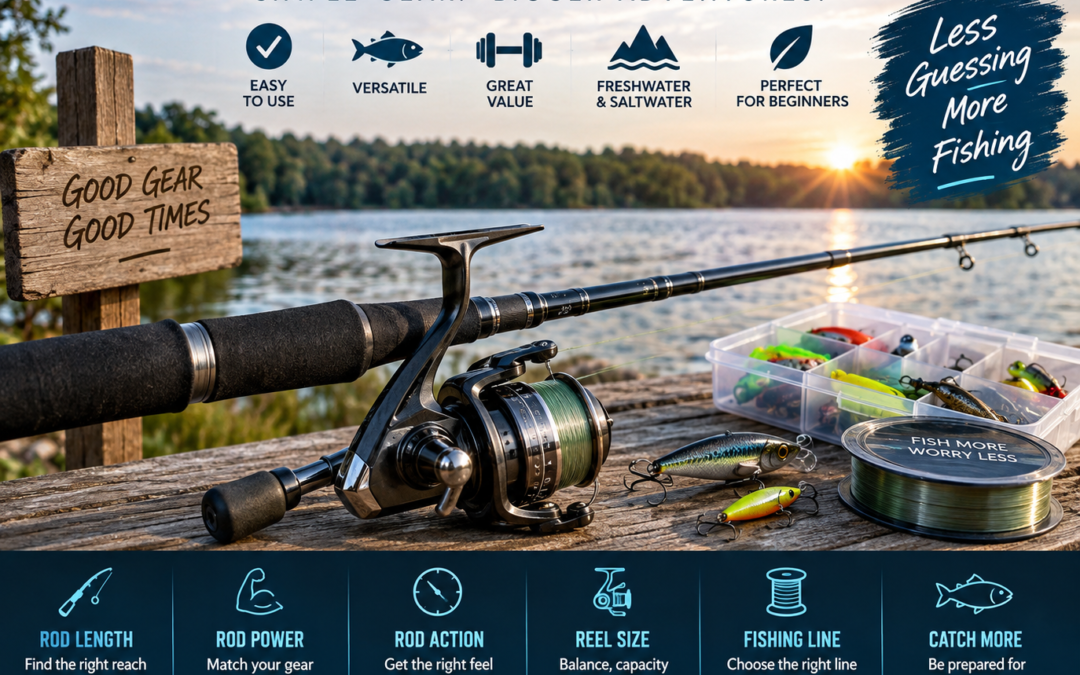
8 Best Beginner Rod and Reel Combos: Complete Buying Guide
Choosing your first beginner rod and reel becomes much easier when you understand how the rod, reel, line, lure, and fishing environment work together. New anglers often see dozens of rod powers, actions, lengths, reel sizes, and fishing techniques and assume they need to understand everything before making a purchase.
You do not. You need to understand the specifications that directly affect your own fishing.
This complete guide explains how to choose a beginner rod and reel, how to match a rod with a reel, when to choose spinning equipment, when baitcasting makes sense, how rod length affects casting, how power and action work, how to select reel size, how to choose fishing line, and how to build a setup that fits your target fish and fishing environment.
For a broader look at rod construction and selection, start with the Hooked Beginner fishing rods guide. The page covers rod anatomy, materials, power, action, length, balance, and buying considerations.
Table of Contents
- What Is a Beginner Rod and Reel?
- Rod and Reel Combo vs. Buying Separately
- 8 Common Beginner Rod and Reel Setups
- Why Spinning Setups Are Popular With Beginners
- Should Beginners Use Baitcasting?
- How to Choose Rod Length
- How to Choose Rod Power
- How to Choose Rod Action
- How to Choose Reel Size
- How to Choose Fishing Line
- Matching the Setup to Your Target Fish
- Matching the Setup to Your Fishing Location
- How Much Should Beginners Spend?
- Common Beginner Mistakes
- How to Set Up Your First Combo
- How to Maintain a Beginner Rod and Reel
- Where to Find Rod and Reel Combos
- Beginner Buying Checklist
- Frequently Asked Questions
What Is a Beginner Rod and Reel?
A beginner rod and reel is a fishing setup that gives a new angler a practical combination of casting control, line management, fish-fighting ability, and ease of use.
The rod controls much of the casting feel and determines how the setup behaves when a fish is hooked. The reel stores and retrieves the fishing line and uses a drag system to control how much line can leave the spool when a fish pulls.
These components should be selected as a system. A rod that is too powerful for lightweight lures can make casting difficult. A rod that is too light for the target fish may not provide enough control. A reel that is too large can make a lightweight rod uncomfortable, while a reel that is too small may not offer enough line capacity or drag capability.
That is why choosing a beginner rod and reel starts with your fishing plans rather than with the product itself.
What should a good beginner setup offer?
- Comfortable handling
- Good rod-and-reel balance
- Appropriate line capacity
- A suitable drag system
- Correct rod power
- Appropriate rod action
- A useful rod length
- Compatible lure and line ratings
- Simple operation
- Enough versatility for your fishing needs
Rod and Reel Combo vs. Buying Separately
Many beginners choose a complete rod and reel combo because it removes part of the compatibility problem. Instead of researching two completely separate products, you start with a package designed to function as a complete outfit.
Buying separately gives you greater control. Experienced anglers can select a particular reel size, drag system, gear ratio, rod action, rod power, blank material, handle design, or line capacity.
Benefits of a complete combo
- Rod and reel are already paired
- Less research is required
- Easy starting point for new anglers
- Simple way to build a complete setup
- Useful for learning how different specifications work together
Benefits of buying separately
- More control over specifications
- Greater customization
- More choices for specialized fishing
- Easier to fine-tune balance
- Useful for experienced anglers who already know what they need
For many first-time anglers, a complete combo provides a practical starting point. Once you understand rod length, power, action, reel size, and line ratings, it becomes much easier to build custom setups.
8 Common Beginner Rod and Reel Setups
There is no single setup that works perfectly for every fishing technique. The right beginner rod and reel depends on the species, water, lure weight, and fishing method.
1. General-purpose spinning setup
A general-purpose spinning setup is one of the most flexible starting points for freshwater fishing. It can handle bait, small lures, soft plastics, jigs, spinners, and other common presentations.
2. Light spinning setup
Light equipment is useful for smaller fish and lighter presentations. It provides a responsive feel without requiring heavy tackle.
3. Medium spinning setup
Medium power offers a broad range of applications and can be useful for anglers who want one setup that can handle several freshwater species.
4. Medium-heavy spinning setup
Medium-heavy equipment gives the angler additional backbone for heavier lures, stronger fish, and fishing around structure.
5. Baitcasting setup
Baitcasting equipment uses a rotating spool and provides a different casting experience. It can offer excellent lure control but generally has a steeper learning curve.
6. Saltwater spinning setup
Saltwater setups place additional demands on corrosion resistance, line capacity, drag performance, and overall durability.
7. Bank-fishing setup
Bank anglers often need a useful balance between casting distance and maneuverability. The right rod length depends on the amount of open space available and the distance required.
8. Boat-fishing setup
Boat anglers can often position themselves closer to their target, so rod handling, lure control, and compact maneuverability can be especially important.
Hooked Beginner's current fishing rod collection can be explored through the verified fishing rods section.
Why Spinning Setups Are Popular With Beginners
Spinning equipment is popular among beginners because the operating system is relatively straightforward and the setup can accommodate many common fishing applications.
With a spinning reel, the spool stays fixed while the bail controls line release and retrieval. This differs from baitcasting, where the spool rotates during the cast.
A spinning beginner rod and reel can be useful for:
- Panfish
- Trout
- Crappie
- Perch
- Bass
- General freshwater fishing
- Pond fishing
- Lake fishing
- River fishing
- Many bank-fishing situations
The exact capability depends on rod power, rod action, line rating, reel size, lure weight, and target fish.
The International Game Fish Association's beginner fishing guidance also emphasizes starting with simple equipment when introducing someone to fishing. Their guidance discusses simple rod-and-reel setups and basic tackle for new anglers.
Should Beginners Use Baitcasting?
Beginners can absolutely learn baitcasting, but they should expect to spend more time practicing.
A baitcasting reel uses a rotating spool during the cast. If the spool spins faster than the lure pulls line away, excess line can build up and create a backlash.
That does not make baitcasting equipment unsuitable for beginners. It simply means that spool control, brake settings, thumb control, and casting technique require practice.
Baitcasting setups can be useful for heavier lure presentations, precise casting, and techniques where baitcasting equipment is commonly used.
For someone who wants the simplest learning experience for broad freshwater fishing, spinning equipment is often an easier place to begin.
How to Choose Rod Length
Rod length affects casting distance, leverage, line control, lure presentation, and maneuverability.
Shorter rods are often easier to manage around tight cover, vegetation, docks, trees, and confined fishing spaces.
Longer rods can provide more casting leverage and reach, making them useful for longer casts and some bank-fishing situations.
| Rod Length | General Characteristic | Potential Application |
|---|---|---|
| Shorter | Easy maneuverability | Tight spaces and close-range fishing |
| Medium | Balanced handling and casting | General-purpose fishing |
| Longer | More reach and casting leverage | Bank fishing and longer casts |
Your own height, fishing location, lure weight, target species, and casting needs should influence the final decision.
For more information, read the verified fishing rod length guide.
How to Choose Rod Power
Rod power refers to the force required to bend a fishing rod. Common ratings include ultralight, light, medium-light, medium, medium-heavy, heavy, and extra-heavy.
Power and action are different. Power describes the rod's overall resistance to bending, while action describes where the bending occurs.
Ultralight
Ultralight rods are designed for very light tackle and smaller fish. They can be ideal when sensitivity and light presentations are priorities.
Light
Light rods offer a little more strength while remaining focused on lighter presentations.
Medium-light
Medium-light rods provide more backbone while retaining useful sensitivity for light and finesse applications.
Medium
Medium power is one of the most versatile starting points for general freshwater fishing.
Medium-heavy
Medium-heavy rods provide additional strength for heavier lures, larger fish, and fishing around structure.
Heavy
Heavy rods are intended for applications requiring considerable strength and are generally unnecessary for basic light-tackle fishing.
For a detailed breakdown, visit the verified fishing rod power guide.
How to Choose Rod Action
Rod action describes where along the blank the rod bends under pressure.
Fast action
Fast-action rods bend primarily toward the tip and provide a responsive feel for many lure presentations.
Moderate-fast action
Moderate-fast rods provide a blend of tip response and deeper loading, making them useful for a range of techniques.
Moderate action
Moderate-action rods bend farther down the blank and provide a more progressive loading characteristic.
Slow action
Slow-action rods bend through more of the blank and are used for more specialized applications.
Action affects casting feel, lure presentation, hook-setting behavior, and how the rod cushions a fish's movement.
See the verified fishing rod action guide for a deeper explanation.
How to Choose Reel Size
Reel size should be matched to the rod, target species, line, lure weight, and fishing environment.
A reel that is too large may make a lightweight rod feel unbalanced. A reel that is too small may lack the line capacity or drag capability needed for the application.
Important reel-size considerations
- Rod length
- Rod power
- Line diameter
- Line strength
- Spool capacity
- Target species
- Lure weight
- Fishing location
- Required casting distance
Do not choose reel size by number alone. Look at the entire setup.
For a dedicated explanation of reel sizing, use the verified fishing reel size guide.
You can also explore the site's fishing reels collection when comparing reel options.
How to Choose Fishing Line
Fishing line is the connection between your reel, rod, terminal tackle, and fish. Choosing the right line is therefore an important part of building a complete beginner rod and reel.
Monofilament
Monofilament is a familiar option for beginners because it is relatively easy to handle and tie.
Fluorocarbon
Fluorocarbon is commonly used as leader material and is also used as main line for selected applications.
Braided line
Braided line offers high strength relative to diameter and low stretch, but it requires attention to spool management and leader connections.
Always check the line range recommended for the rod. The strongest line you can fit onto the reel is not automatically the correct line for the rod.
Take Me Fishing's verified fishing gear and tackle resource covers rods, reels, fishing line, tackle, and equipment-selection basics for anglers learning how to build a suitable fishing setup.
Matching the Setup to Your Target Fish
Panfish
Panfish can often be targeted effectively with light tackle and small lures. A lighter setup can also make these smaller fish more enjoyable to fight.
Trout
Trout fishing often involves relatively light presentations. Light or medium-light equipment may suit the application depending on the water and fish being targeted.
Bass
Bass fishing includes many techniques. A versatile spinning outfit can provide a useful starting point, while specialized bass tactics can eventually justify additional setups.
Catfish
Catfish vary considerably in size, so the correct rod power and reel capacity should be based on the fish you expect to encounter.
Saltwater fish
Saltwater fishing can require more line capacity, greater drag capability, stronger tackle, and additional corrosion protection.
Matching the Setup to Your Fishing Location
Ponds
Pond fishing is often a good environment for a versatile beginner setup because the angler can usually cover multiple fishing situations without specialized equipment.
Lakes
Lakes may require longer casts, different lure weights, and different levels of rod power depending on target species and structure.
Rivers
Rivers introduce current, rocks, changing water depth, submerged structure, and shoreline obstacles that should be considered when selecting tackle.
Bank fishing
Bank anglers may benefit from additional casting distance, but excessive rod length can become inconvenient in tight shoreline environments.
Boat fishing
Boat anglers can reposition themselves, so handling, lure control, and maneuverability may become more important than maximum casting distance.
Saltwater
Saltwater environments place extra demands on reels, guides, line, and other components. Equipment should be cleaned and maintained after exposure.
How Much Should Beginners Spend?
There is no universal price for a beginner rod and reel. The right budget depends on how often you will fish, what species you want to target, where you fish, and how much equipment you already own.
Entry-level equipment
Entry-level equipment can be suitable for occasional fishing, family trips, beginners who are still learning, or anglers who want a simple first setup.
Mid-range equipment
Mid-range equipment can provide a useful balance between durability, features, comfort, and performance for someone who expects to fish regularly.
Higher-priced equipment
Premium equipment may offer specialized materials, refined components, lighter construction, or more specialized performance characteristics.
The most expensive option is not automatically the correct choice. Matching the equipment to the intended use matters more than simply increasing the price.
Common Beginner Mistakes
1. Choosing equipment before deciding how you will fish
Start with the species and fishing environment. Then select the equipment.
2. Choosing the wrong rod power
A rod that is too powerful can make light presentations difficult. A rod that is too light may lack enough backbone for stronger fish.
3. Ignoring rod action
Action changes how the rod loads, casts, presents lures, and behaves during a fight.
4. Choosing reel size by number alone
Reel size should be evaluated with rod length, power, line rating, capacity, and target species.
5. Ignoring lure ratings
Always check the lure or casting-weight range printed on the rod.
6. Ignoring line ratings
Rod line ratings are part of the equipment's intended operating range.
7. Buying highly specialized gear immediately
Most beginners do not need a separate setup for every technique. Start with the fishing you expect to do most often.
8. Forgetting balance
The rod and reel should feel comfortable together. Good individual components can still create an awkward setup if they are poorly matched.
How to Set Up Your First Combo
Step 1: Assemble the rod
Connect the rod sections according to the manufacturer's instructions and align the guides.
Step 2: Attach the reel
Secure the reel inside the reel seat and tighten it firmly without forcing it.
Step 3: Thread the line
For a spinning reel, open the bail and guide the line through the rod guides from the largest guide toward the tip.
Step 4: Check the spool
Make sure the line is evenly loaded and that the spool is not excessively overfilled.
Step 5: Attach terminal tackle
Add the hook, lure, swivel, sinker, leader, or other terminal component required for your fishing technique.
Step 6: Adjust the drag
Set the drag according to your line, target fish, and tackle. Learn how the drag operates before fishing.
Step 7: Practice casting
Practice in an open area and learn the timing and loading characteristics of the rod before fishing around people, vehicles, boats, or other obstacles.
How to Maintain a Beginner Rod and Reel
Maintenance is part of owning fishing equipment. A properly maintained beginner rod and reel can remain useful for years.
Clean after fishing
Remove dirt, sand, mud, vegetation, and other debris from the equipment.
Rinse after saltwater exposure
Saltwater can contribute to corrosion, so equipment exposed to salt should be cleaned according to the manufacturer's guidance.
Inspect the line
Check for fraying, cuts, abrasion, and unusual wear.
Inspect rod guides
Damaged guides can increase friction and contribute to line problems.
Protect the rod
Avoid impacts and do not place heavy objects on top of the blank.
Maintain the reel correctly
Follow the manufacturer's cleaning and lubrication instructions for the specific reel.
For additional information, use the verified fishing reel maintenance guide.
External Beginner Resources
New anglers can supplement their Hooked Beginner learning with established fishing-education resources.
The International Game Fish Association provides a free Intro to Fishing course designed for young and novice anglers and covering angling basics, safety, fish knowledge, and responsible fishing.
Take Me Fishing provides a comprehensive beginner fishing checklist covering essential equipment and the basics needed to start fishing with a spinning rod and reel.
Its broader how-to-fish resource also covers fishing basics, gear, techniques, safety, and different fishing environments.
Where to Find Rod and Reel Combos
Hooked Beginner has a dedicated spinning rod and reel combo collection.
Verified combo products currently present in the Hooked Beginner product sitemap include:
- Carbon X R1 Spinning Combo
- Carbon X and Carbon R1 Spinning Combo
- Carbon X II and Carbon R1 Spinning Combo
- SG4 Medium Game Combo
- Fox Horizon X4 Combo
The Carbon X R1 Spinning Combo is a configurable spinning outfit with multiple reel sizes and rod configurations, while the Carbon X and Carbon R1 Spinning Combo combines a Carbon X spinning reel with a Carbon R1 spinning rod. Review the exact product variation before ordering.
Hooked Beginner also maintains dedicated categories for different reel and combo types, allowing you to compare equipment according to how you actually fish.
How to Compare a Beginner Rod and Reel
| Component | What to Check | Why It Matters |
|---|---|---|
| Rod length | Overall length | Affects casting, leverage, reach, and handling |
| Rod power | Ultralight through heavy | Controls overall rod strength |
| Rod action | Fast, moderate-fast, moderate, slow | Controls where the blank bends |
| Lure rating | Recommended lure weight | Helps match the rod to the presentation |
| Line rating | Recommended line range | Helps match line to the rod |
| Reel size | Size and capacity | Affects balance and line storage |
| Drag | Adjustment and capacity | Controls line release under pressure |
| Environment | Freshwater or saltwater | Affects durability and maintenance |
Beginner Buying Checklist
- ☐ I know what fish I want to target.
- ☐ I know where I will fish.
- ☐ I know whether I need freshwater or saltwater equipment.
- ☐ I have selected the right rod type.
- ☐ I have checked rod length.
- ☐ I have checked rod power.
- ☐ I have checked rod action.
- ☐ I have checked lure weight.
- ☐ I have checked the line rating.
- ☐ I have selected an appropriate reel size.
- ☐ I have checked reel capacity.
- ☐ I understand the drag.
- ☐ The complete outfit feels balanced.
- ☐ The setup fits my budget.
- ☐ I have the necessary line and terminal tackle.
Beginner Rod and Reel Setup by Fishing Situation
| Fishing Situation | Starting Direction | Main Factors |
|---|---|---|
| General freshwater | Versatile spinning setup | Balance, power, action, manageable length |
| Small fish | Light tackle | Light line, small lures, lighter power |
| Bass | Spinning or baitcasting | Power, action, lure weight, structure |
| Bank fishing | Versatile spinning setup | Reach, casting distance, handling |
| Boat fishing | Compact or versatile setup | Control, maneuverability, lure presentation |
| Saltwater | Saltwater-rated setup | Corrosion resistance, drag, capacity, strength |
Frequently Asked Questions
What is the best beginner rod and reel?
The right setup depends on your target species, fishing location, lure weight, line requirements, and fishing technique. For many general freshwater situations, a versatile spinning setup can be a practical starting point.
Should beginners buy a rod and reel combo?
A combo can simplify the initial purchase because the rod and reel are already selected as a pair.
Is a spinning reel easier for beginners?
Spinning reels are commonly used by beginners because they provide a straightforward casting system and can handle many common fishing applications.
What rod length should a beginner use?
A medium-length rod can provide a useful balance for general fishing, but the ideal length depends on the angler, water, target fish, casting distance, and technique.
What rod power should beginners choose?
Medium and medium-light power can cover many freshwater situations, but the correct power should match the fish and tackle being used.
What rod action should beginners choose?
Fast and moderate-fast actions can be useful for many techniques, but the correct action depends on the lure and presentation.
What reel size is good for a beginner?
Choose a reel size that balances the rod and provides appropriate line capacity and drag for the target fish.
Can beginners use baitcasting reels?
Yes. Beginners can learn baitcasting, although they should expect a greater learning curve because spool control is part of the casting process.
Should I buy the most expensive setup I can afford?
No single price guarantees the right setup. Matching the equipment to your actual fishing requirements is more important than simply spending more.
Can one beginner rod and reel handle multiple fishing styles?
A versatile outfit can handle several related freshwater applications, but specialized techniques eventually benefit from specialized equipment.
How do I know if a rod and reel are balanced?
Assemble the outfit and hold it naturally. The setup should feel comfortable without being noticeably heavy toward the tip or reel.
Final Beginner Rod and Reel Buying Guide
Choosing the right beginner rod and reel is primarily about matching equipment to the fishing you actually intend to do.
Start with your target species and fishing environment. Decide whether you need spinning or baitcasting equipment. Then match rod length, power, action, line rating, and lure rating with an appropriate reel size, line capacity, and drag system.
For many new freshwater anglers, a versatile spinning setup can be a practical starting point. As your experience grows, you can add more specialized equipment based on the techniques and species you actually enjoy.
The goal of your first setup is not to own every possible fishing product. The goal is to have equipment that is comfortable, balanced, appropriate for your target fish, and simple enough to let you focus on learning.
Use this guide together with the verified Hooked Beginner resources above, compare the specifications carefully, and choose the setup that fits your fishing rather than simply choosing the biggest or most expensive option.