
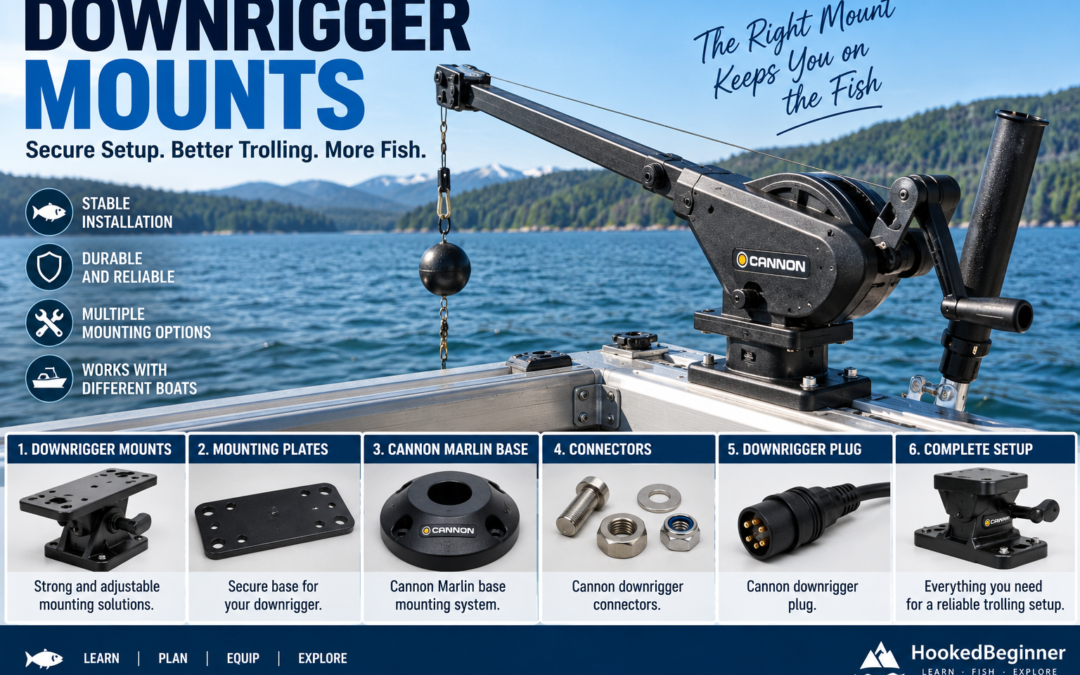
Downrigger Mounts: 8 Powerful Options for Better Boat Setup
Choosing the right downrigger mounts is one of the most important parts of building a reliable trolling setup. A downrigger needs a secure connection to the boat because the mounting system must support the equipment while the cable, weight, release clip, and fishing line are working together below the surface.
That makes the mount more than a simple piece of hardware. The location, base style, mounting plate, bolt pattern, clearance, and boat construction can all affect whether a downrigger installation works properly.
Different boats also require different mounting solutions. A permanent installation on a reinforced deck is not the same as a removable mounting system. Likewise, a mounting plate designed for one Cannon setup may not be appropriate for another model without checking compatibility.
This guide explains what downrigger mounts are, why they matter, the main mounting options to consider, how Cannon-style bases and plates fit into a trolling system, how to choose a mount for your boat, common installation mistakes, and what to check before drilling into the deck.
For manufacturer information and current Cannon downrigger products, visit the official Cannon Downriggers website.
What Are Downrigger Mounts?
Downrigger mounts are the hardware systems used to attach a downrigger securely to a boat. Depending on the design, a mounting system may include a base, mounting plate, bracket, bolts, washers, locking hardware, connectors, or other components needed to secure the downrigger.
The mount is the connection between the boat and the downrigger. Because the downrigger operates under load while trolling, that connection needs to be matched to the boat and the equipment.
A mounting system can be permanent or removable. Permanent systems are designed to remain installed, while removable systems allow the angler to take the downrigger off the boat when it is not needed.
The exact hardware varies by manufacturer and model. That is why the correct approach is to identify the downrigger model first, then confirm the compatible mounting hardware rather than buying a plate simply because it looks similar.
Why Downrigger Mounts Matter
A good mount affects the stability, positioning, accessibility, and usability of the entire trolling setup.
Secure Downrigger Position
The first job of a mounting system is keeping the downrigger securely attached to the boat. Movement at the mounting point can make the equipment harder to operate and may place additional stress on the hardware.
Correct Cable and Weight Position
Where the downrigger sits on the boat affects how the cable and weight move relative to the hull. Mounting location should therefore be considered together with the fishing layout and the boat's available workspace.
Improved Access
A well-positioned downrigger should be easy to reach when lowering or raising the weight, adjusting depth, releasing line, or clearing equipment.
Better Use of Boat Space
Boat decks are limited spaces. The mounting position needs to leave enough room for anglers, rods, controls, seats, cleats, electronics, and other equipment.
Removal and Storage
A removable mount can be useful when you do not want the downrigger attached to the boat during transportation, storage, or non-trolling fishing trips.
8 Downrigger Mounting Options to Consider
1. Permanent Downrigger Mounts
Permanent downrigger mounts are designed to remain attached to the boat. They are a practical choice for anglers who troll regularly and have a dedicated location for their downrigger.
The major advantage is simplicity. Once correctly installed, the downrigger stays in its designated position instead of requiring installation before every trip.
The disadvantage is that the mounting location becomes more permanent. Before drilling, make sure the position works for the current setup and is not likely to interfere with future equipment changes.
2. Quick-Release Downrigger Mounts
A quick-release system allows the downrigger to be removed while leaving part of the mounting hardware attached to the boat.
This can be useful for anglers who use the boat for several types of fishing. The downrigger can be removed when it is not required, reducing clutter on the deck.
Quick-release systems vary considerably, so always verify that the upper and lower components are designed to work together.
3. Downrigger Mounting Plates
A mounting plate provides a defined attachment surface between the downrigger and the boat or its base system.
Plates may be designed around a particular bolt pattern or downrigger model. They can also make installation easier by creating a predictable interface between components.
Do not assume that any rectangular plate will fit any downrigger. Hole spacing, plate dimensions, hardware size, and model compatibility all matter.
4. Cannon Downrigger Mounts
Cannon downrigger mount systems are designed around Cannon's range of controlled-depth fishing equipment and related accessories.
Cannon is part of Johnson Outdoors Fishing, which identifies Cannon as a brand focused on controlled-depth fishing and downrigger products and accessories.
When choosing a Cannon mounting system, start with the exact downrigger model and then identify compatible bases, plates, brackets, and replacement hardware.
5. Cannon Downrigger Mounting Plates and Bases
Cannon downrigger mounting plates and bases are useful when the downrigger needs a stable interface with the boat deck or a removable mounting system.
The key consideration is compatibility. A base or plate needs to match the downrigger and provide an appropriate attachment point for the boat.
When drilling into the deck, inspect the underside of the mounting location before starting. You need to know whether you can safely access the bolts, nuts, washers, backing structure, fuel components, wiring, or other equipment beneath the deck.
6. Downrigger Connector Hardware
Cannon downrigger connectors and similar hardware can be part of systems designed to join or secure compatible mounting components.
Connector hardware should be treated as a system component rather than a universal spare. Thread type, dimensions, load requirements, and model compatibility all matter.
7. Downrigger Plugs and Electrical Connections
Cannon downrigger plug searches can refer to electrical connection hardware used with electric downrigger setups rather than the physical mounting base itself.
This is why it helps to separate the mounting system into two categories: mechanical mounting hardware and electrical equipment.
The mechanical mount secures the downrigger to the boat. Electrical connections supply or route power and may require different installation considerations.
8. Cannon Marlin Base Mounting Systems
A Cannon Marlin base mounting system is another example of why anglers should identify the exact product before ordering replacement hardware.
Specialized bases can provide a particular mounting pattern, orientation, or attachment method intended for a specific downrigger setup. Always compare the manufacturer's compatibility information with the model already installed on your boat.
Downrigger Mounts Comparison Table
| Mounting Option | Best For | Main Advantage | Main Consideration |
|---|---|---|---|
| Permanent mount | Dedicated trolling boats | Always ready to use | Permanent deck installation |
| Quick-release mount | Multi-purpose boats | Easy equipment removal | Compatibility between parts |
| Mounting plate | Defined attachment patterns | Creates a stable mounting interface | Hole pattern must match |
| Cannon downrigger mount | Cannon equipment | Designed around Cannon systems | Model compatibility |
| Base system | Dedicated mounting locations | Stable connection to deck hardware | Deck access and reinforcement |
| Connector hardware | Compatible mounting assemblies | Joins system components | Thread and model compatibility |
| Electrical plug | Electric downriggers | Provides power connection | Electrical compatibility |
| Specialized base | Specific Cannon systems | Purpose-built fit | Exact model identification required |
How to Choose Downrigger Mounts
Choosing the right downrigger mounts starts with the boat and downrigger you already have.
Start With the Downrigger Model
Write down the exact model name and model number before ordering mounting hardware. This is the easiest way to avoid buying incompatible components.
Check the Mounting Pattern
Compare the mounting holes on the downrigger or base with the mounting pattern of the plate or bracket.
Do not assume that similar-looking hardware uses the same hole spacing.
Measure the Available Deck Space
Measure the space where the downrigger will be installed. Check not only the footprint of the mount but also the space required for the downrigger arm, cable, weight, controls, and nearby fishing equipment.
Inspect Under the Deck
Before drilling, inspect the area beneath the deck. You need to know what is located below the mounting point and whether the proposed bolts can be installed and secured safely.
Manufacturer mounting instructions for comparable marine mounting hardware emphasize checking clearance before drilling and using appropriate backing washers and locking hardware.
Think About Removal
Ask whether you want the downrigger permanently installed or removable.
If you fish without downriggers during some trips, a removable system may make more sense than a permanent installation.
Consider Boat Construction
Fiberglass, aluminum, wood, and composite decks can require different approaches to drilling, sealing, backing, and hardware installation.
The boat manufacturer's recommendations should take priority over generic mounting advice.
Consider Your Trolling Position
The mount should place the downrigger where it is accessible while keeping the cable and weight clear of obstacles.
Think about where you will stand when operating the downrigger and where the rod holder or fishing rod will sit.
Downrigger Mounts for Different Use Cases
Freshwater Trolling
Freshwater trolling is one of the most common situations where a downrigger mount becomes useful. The mount needs to provide a stable base while keeping the downrigger within reach.
For anglers using multiple fishing rods, layout becomes especially important because the downrigger, rod holders, and other equipment need to work together without becoming crowded.
Our trolling rods guide can help when building the rest of the trolling setup.
Great Lakes and Large-Lake Trolling
Large-water trolling often involves extended use of downriggers and several pieces of equipment operating at the same time.
This makes a stable mounting location especially important. Consider how the mount interacts with rod holders, electronics, seating, and other equipment before drilling.
Coastal and Saltwater Trolling
Saltwater puts additional demands on marine hardware because corrosion can affect metal components, fasteners, and electrical connections.
For saltwater applications, verify that the mounting hardware is appropriate for the marine environment and follow the equipment manufacturer's maintenance recommendations.
See our saltwater fishing rods guide when selecting the rest of a saltwater trolling setup.
Small Fishing Boats
Small boats have less available deck space, making the mounting position particularly important.
A removable or compact mounting system may be useful where the same deck area is used for multiple fishing techniques.
Multi-Purpose Boats
If the boat is used for casting, trolling, cruising, and other activities, consider how easily the downrigger can be removed or repositioned.
Quick-release systems can provide flexibility when compatible with the equipment and boat.
Materials and Setup for Installing Downrigger Mounts
A proper installation requires more than the mount itself. You also need the correct fasteners, tools, access to the mounting area, and a clear understanding of where the hardware will sit.
1. Downrigger Mount or Base
Start with the exact mounting component recommended for your downrigger model.
2. Mounting Hardware
Use the hardware specified by the manufacturer whenever possible. Washers, locking nuts, bolts, and backing hardware should be selected for the actual installation rather than substituted randomly.
Comparable marine mounting instructions specify combinations of bolts, washers, and locking nuts and emphasize firm, secure attachment.
3. Measuring Tools
Measure the deck carefully before marking holes. Double-check the position before drilling.
4. Drill and Correct Bit
Use the drill size specified by the mounting hardware instructions. The required bit size should never be guessed.
5. Backing Support
Depending on the boat construction and load, backing washers or structural reinforcement may be necessary. Follow the boat and equipment manufacturer's instructions.
6. Sealant Where Required
Drilling through a boat deck can create a pathway for water intrusion. Use an appropriate marine sealant where the boat manufacturer and mounting instructions call for it.
7. Final Alignment
Before fully tightening everything, confirm that the downrigger is oriented correctly and that the arm and operating controls have enough clearance.
Common Downrigger Mounting Mistakes
Drilling Before Measuring
The most avoidable mistake is drilling holes before confirming the complete footprint and bolt pattern.
Place the mount where you intend to use it, measure twice, and verify the underside of the deck before drilling.
Ignoring Under-Deck Clearance
A mounting location can look perfect from above while being unusable underneath because of wiring, fuel components, reinforcement, or other obstructions.
Always inspect both sides of the mounting surface before committing to the location.
Using the Wrong Mounting Hardware
Do not assume a different bolt, washer, or nut is an acceptable substitute simply because it physically fits.
Marine equipment is exposed to vibration, moisture, and repeated loading, so hardware selection matters.
Choosing the Wrong Hole Pattern
Similar-looking bases and plates may have different hole patterns. Confirm measurements and model compatibility before purchase.
Mounting Too Close to Other Equipment
Leave enough room for the downrigger arm, cable, weight, rod, and operator.
Forgetting Removal Requirements
Some anglers install a permanent system and later discover that it interferes with another fishing technique or makes transportation more difficult.
Decide whether you want permanent or removable equipment before installation.
Failing to Check Corrosion
Inspect mounting hardware periodically, particularly when fishing in saltwater or storing the boat in a damp environment.
Overlooking the Rest of the Trolling System
The mount is only one piece of the setup. Rod holders, rods, reels, cable routing, weights, and controls all need to work together.
Downrigger Mounting Buying Checklist
| Check | Question to Ask |
|---|---|
| Downrigger model | Is the mount compatible with the exact model? |
| Mount type | Do you need permanent or removable mounting? |
| Hole pattern | Does the mounting plate match the equipment? |
| Deck space | Is there enough room for the complete downrigger? |
| Under-deck access | Can the bolts and backing hardware be installed safely? |
| Boat material | Is the mounting method appropriate for the deck construction? |
| Hardware | Are the bolts, washers, nuts, and backing components correct? |
| Clearance | Can the arm and cable operate without obstruction? |
| Corrosion resistance | Is the hardware suitable for your fishing environment? |
| Removal | Will you need to remove the downrigger between trips? |
| Future equipment | Will the mounting position still work if the boat layout changes? |
Related Fishing Guides
Once you have selected your downrigger mounts, the rest of the trolling setup should be planned around the same fishing environment.
- Trolling Rods Guide — choose rods designed for trolling applications.
- Saltwater Fishing Rods — useful for coastal trolling equipment.
- Fishing Rod Buying Guide — review rod length, power, action, and line specifications.
- Fishing Rod Length Guide — compare lengths for different fishing applications.
- Fishing Reel Size Guide — match reel size with the fishing system you are building.
- Types of Fishing Rods — compare major rod categories.
Downrigger Mounts FAQs
What are downrigger mounts?
Downrigger mounts are the mechanical hardware systems used to attach a downrigger to a boat. They can include bases, plates, brackets, bolts, washers, locking hardware, and related components.
What is the best type of downrigger mount?
There is no single mount that works for every boat. The appropriate choice depends on the downrigger model, boat construction, available deck space, desired permanence, and compatibility of the mounting hardware.
Can I use the same mounting plate for every Cannon downrigger?
You should not assume that. Check the exact Cannon model and the manufacturer's compatibility information before purchasing a mounting plate or base.
What are Cannon downrigger mounting plates and bases used for?
They provide the mechanical interface between the downrigger and the boat or mounting system. Depending on the product, they may support permanent or removable installation.
What is a Cannon downrigger mount?
A Cannon downrigger mount is hardware designed to secure a compatible Cannon downrigger system to a boat. The exact design and compatibility depend on the downrigger and mounting component.
What are Cannon downrigger connectors?
Cannon downrigger connectors are related hardware components used with compatible downrigger or mounting systems. Because connector dimensions and applications can differ, identify the exact model before ordering replacement hardware.
What is a Cannon downrigger plug?
A Cannon downrigger plug generally refers to an electrical connection component associated with an electric downrigger setup. It is different from the mechanical base or mounting plate.
What is a Cannon Marlin base mounting system?
It is a specialized mounting system associated with Cannon equipment. Compatibility should be checked against the exact downrigger and base model before installation.
Should downrigger mounts be permanently installed?
Not necessarily. Permanent mounts are useful for dedicated trolling boats, while removable systems can be more convenient for multi-purpose boats.
Do I need to inspect underneath the boat deck before drilling?
Yes. You should verify clearance and identify any wiring, fuel components, structural members, or other equipment underneath the proposed mounting point before drilling.
Can I install a downrigger mount myself?
Some anglers can install mounting hardware themselves when they have the correct tools, access, measurements, and manufacturer instructions. Complex installations or boats requiring structural modification may warrant professional installation.
Final Thoughts
Downrigger mounts are a foundational part of a reliable trolling system. The correct mount should match the exact downrigger, fit the boat's deck and structure, provide appropriate clearance, and position the equipment where it can be operated safely.
Before buying, identify the exact downrigger model, confirm the mounting pattern, measure the available space, inspect the underside of the deck, and decide whether you want a permanent or removable setup.
Most mounting problems can be prevented before installation. Measure carefully, verify compatibility, use the specified hardware, and make sure the finished system leaves enough room for the downrigger, cable, weight, rod, and operator.
A well-planned mounting system gives the rest of your trolling equipment a stable foundation and makes it easier to focus on fishing rather than fighting your boat layout.
For model-specific product and compatibility information, consult the official Cannon Downriggers site before purchasing or modifying mounting hardware.