
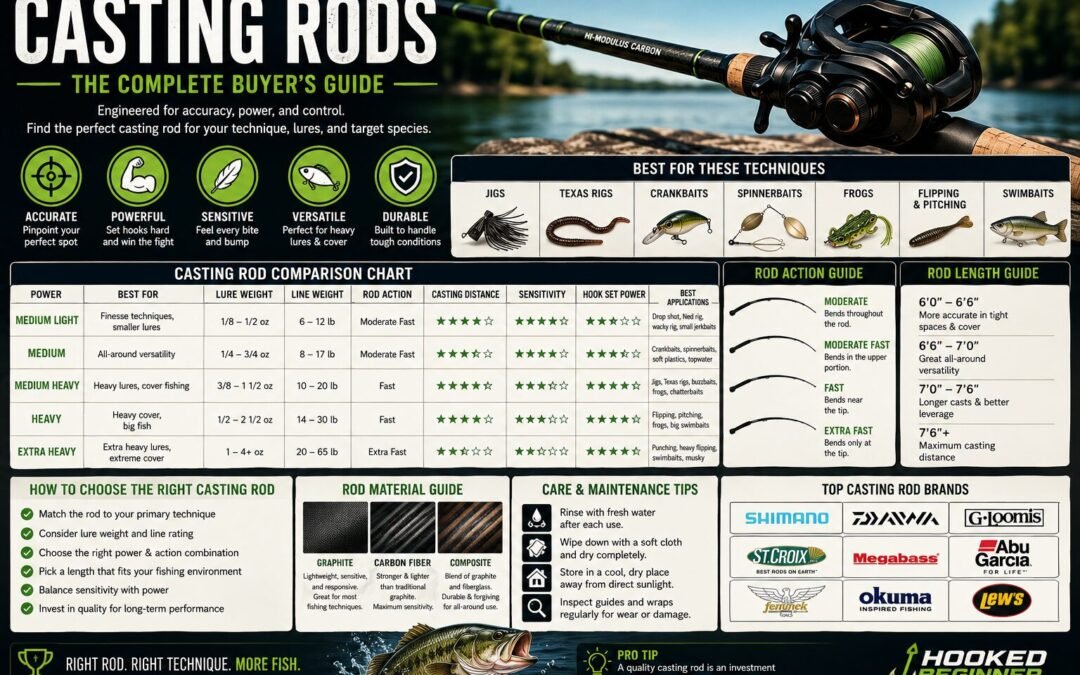

Casting Rods: The Complete Buyer's Guide
Casting Rods are engineered to provide exceptional casting accuracy, greater hook-setting power, and improved lure control. They are a favorite among anglers targeting bass and other freshwater species because they perform exceptionally well with heavier lures, stronger fishing lines, and precision presentations around heavy cover.
Unlike spinning equipment, Casting Rods are designed with the reel mounted on top of the rod, allowing better control during powerful casts and improved leverage when fighting fish. Modern rod technology has made today's casting rods lighter, stronger, and more sensitive than ever before, making them suitable for both experienced anglers and beginners looking to improve their fishing skills.
Whether you fish shallow vegetation, rocky shorelines, timber, docks, or open reservoirs, choosing the right Casting Rods can significantly improve your casting distance, lure presentation, and overall success on the water.
Hooked Beginner offers a premium selection of Fishing Rods, including specialized Casting Rods and versatile Spinning Rods for anglers of every experience level.
Table of Contents
- Why Choose Casting Rods
- Benefits of Casting Rods
- Casting Rod Construction
- Power and Action
- Choosing the Right Length
- Best Fishing Techniques
- Buying Guide
Why Choose Casting Rods?
Casting Rods are designed for anglers who require precision, strength, and superior lure control. Their design allows more accurate casting around structure such as fallen trees, docks, weed beds, and shoreline cover where fish often hide.
Many tournament anglers prefer Casting Rods because they offer excellent sensitivity, allowing them to detect subtle bites while maintaining enough backbone to drive hooks securely into larger fish.
Benefits of Casting Rods
Excellent Casting Accuracy
One of the biggest advantages of Casting Rods is their ability to place lures exactly where anglers want them. Accurate lure placement often leads to more strikes, especially when fishing around heavy cover.
Greater Hook-Setting Power
The stronger backbone found in many casting rods allows anglers to set hooks quickly and confidently, especially when using single-hook lures or fishing around thick vegetation.
Improved Lure Control
Whether working jigs, spinnerbaits, crankbaits, frogs, or soft plastics, casting equipment provides excellent lure control throughout the retrieve.
Better Performance with Heavy Lures
Heavier lures perform exceptionally well on casting equipment because the rod transfers power efficiently while maintaining smooth casting performance.
Understanding Casting Rod Construction
Modern Casting Rods are available in several construction materials that influence overall performance.
Graphite Blanks
Graphite provides lightweight performance and exceptional sensitivity, making it easier to detect subtle bites while reducing fatigue throughout long fishing trips.
Carbon Fiber Technology
Premium carbon fiber blanks increase strength while maintaining lightweight performance, helping anglers cast farther with greater accuracy.
Composite Construction
Composite rods combine graphite and fiberglass to balance flexibility, durability, and lifting power for multiple fishing techniques.
Understanding Power and Action
Choosing the correct combination of power and action is essential when selecting Casting Rods. These characteristics determine how the rod performs with different lure weights, fishing techniques, and target species.
Power Ratings
- Medium Light
- Medium
- Medium Heavy
- Heavy
- Extra Heavy
Rod Actions
- Moderate
- Moderate Fast
- Fast
- Extra Fast
Fast and extra-fast actions provide quicker hooksets, while moderate actions perform well with moving lures that require more forgiveness during the fight.
Choosing the Right Casting Rod Length
Rod length influences casting distance, leverage, lure presentation, and fish control.
- Shorter rods improve casting accuracy in tight spaces.
- Medium-length rods provide excellent all-around versatility.
- Longer rods increase casting distance and hook-setting leverage.
Choosing the proper length depends on your preferred fishing techniques, target species, and the environments you fish most often.
Best Fishing Techniques for Casting Rods
Casting Rods excel across numerous freshwater fishing techniques.
- Texas rigs.
- Jig fishing.
- Spinnerbaits.
- Crankbaits.
- Buzzbaits.
- Topwater lures.
- Frogs.
- Flipping and pitching.
- Swimbaits.
- Heavy-cover fishing.
The versatility of casting equipment allows anglers to transition between techniques while maintaining excellent lure control and casting precision.
Casting Rods Buying Guide
Before purchasing Casting Rods, evaluate the types of water you fish, the lures you use most frequently, and the species you target. Selecting equipment that matches your fishing style improves comfort, confidence, and long-term performance.
Hooked Beginner offers premium options including the Carbon R1 Casting Rod, Shimano Curado Spinning Rods, and Okuma Serrano Spinning Rods, providing dependable equipment for anglers of all skill levels.
For additional educational resources on recreational fishing and conservation, visit the International Game Fish Association, Take Me Fishing, and NOAA Fisheries.
Matching Your Reel to Your Rod
Selecting the right reel is just as important as choosing the rod itself. When both pieces of equipment work together, casting becomes smoother, retrieves feel more controlled, and the overall fishing experience becomes far more comfortable. A properly balanced setup reduces fatigue during long days on the water and allows anglers to fish with greater confidence.
The size of the reel should complement the rod rather than overpower it. An oversized reel adds unnecessary weight and affects balance, while a reel that is too small may struggle when handling heavier lures or larger fish. A balanced setup feels comfortable in your hand and allows better control throughout every cast and retrieve.
Gear ratio is another factor worth considering. Faster gear ratios help anglers quickly pick up slack line after a fish strikes or when working fast-moving lures. Slower gear ratios provide additional cranking power for larger lures and deeper presentations. Matching the reel to your preferred fishing techniques creates a more efficient and enjoyable experience on the water.
Understanding Lure Selection
Different fishing techniques require different lure styles, and each performs best when paired with equipment designed to handle its weight and presentation. Understanding these relationships helps improve casting performance and overall fishing success.
Lightweight soft plastics require greater control during casting, allowing anglers to present lures naturally without disturbing the water. Medium-weight hard baits offer versatility and perform well in many different fishing environments. Larger lures designed for heavier cover demand stronger equipment capable of delivering accurate casts while maintaining complete control throughout the retrieve.
Matching lure weight to your equipment also improves casting efficiency. Equipment that is overloaded may reduce casting accuracy, while gear that is too powerful for lightweight lures often struggles to load properly during the cast.
Fishing Different Types of Water
Fishing conditions vary significantly depending on the body of water. Small ponds, rivers, reservoirs, and large lakes each present unique challenges that influence equipment selection and fishing techniques.
Shallow ponds often require accurate casting around shoreline vegetation, fallen trees, and submerged brush. Precision becomes more valuable than maximum casting distance because fish frequently remain close to visible cover.
Reservoirs typically contain a mixture of shallow flats, rocky points, standing timber, and deeper channels. Versatile equipment allows anglers to adapt quickly as fish move throughout the day.
River fishing introduces current, changing water levels, and constantly moving fish. Controlling lure speed becomes especially important in flowing water where natural presentations often trigger more strikes.
Large natural lakes frequently require longer casts and broader search patterns. Equipment capable of covering more water efficiently helps anglers locate active fish more quickly.
Fishing Around Heavy Cover
Many game fish spend much of their time near structure because it provides protection, shade, and easy access to food. Fallen trees, vegetation, docks, rocks, bridge pilings, and submerged brush all create productive fishing locations.
Fishing close to heavy cover demands confidence and careful lure placement. Accurate casting increases the likelihood of placing the lure where fish are actively feeding while reducing the chances of snagging underwater obstacles.
After a fish strikes near heavy cover, maintaining steady pressure becomes essential. Allowing fish too much freedom often gives them opportunities to wrap the fishing line around branches or vegetation. Strong, balanced equipment helps anglers guide fish into open water more efficiently.
Developing Better Casting Accuracy
Accuracy improves with consistent practice rather than equipment alone. Spending time practicing different casting angles, distances, and targets helps anglers develop greater confidence before heading onto the water.
Many experienced anglers begin by practicing in open spaces using targets placed at varying distances. As confidence improves, more advanced casts around obstacles become easier to execute. Small improvements in accuracy often produce significant improvements in fishing success because lures spend more time in productive strike zones.
Learning to control casting speed, release timing, and lure trajectory also helps reduce backlashes while improving overall efficiency.
Maintaining Your Equipment
Routine maintenance helps preserve performance while extending the lifespan of your fishing equipment. After every trip, inspect guides for damage, clean away dirt and debris, and wipe down exposed surfaces using a soft cloth.
If equipment has been used in saltwater, rinse thoroughly with fresh water before storage. Salt deposits can accelerate corrosion and reduce the lifespan of guides, reel seats, and other components.
Store rods in a cool, dry location away from prolonged direct sunlight. Rod racks or protective sleeves help prevent accidental damage during transportation and storage. Regular inspection of guide wraps, handles, and reel seats allows minor issues to be corrected before they become costly repairs.
Building Confidence Through Experience
The best fishing equipment supports skill development but does not replace time spent on the water. Every fishing trip teaches valuable lessons about casting, lure presentation, fish behavior, seasonal patterns, and adapting to changing conditions.
As experience grows, anglers naturally develop preferences based on the waters they fish most often and the techniques they enjoy using. Understanding equipment characteristics simply makes those decisions easier.
Investing in dependable equipment from the beginning provides a strong foundation that allows anglers to focus less on their gear and more on improving their fishing skills. Over time, confidence, patience, and consistent practice become the greatest factors contributing to long-term success on the water.
Trackbacks/Pingbacks