
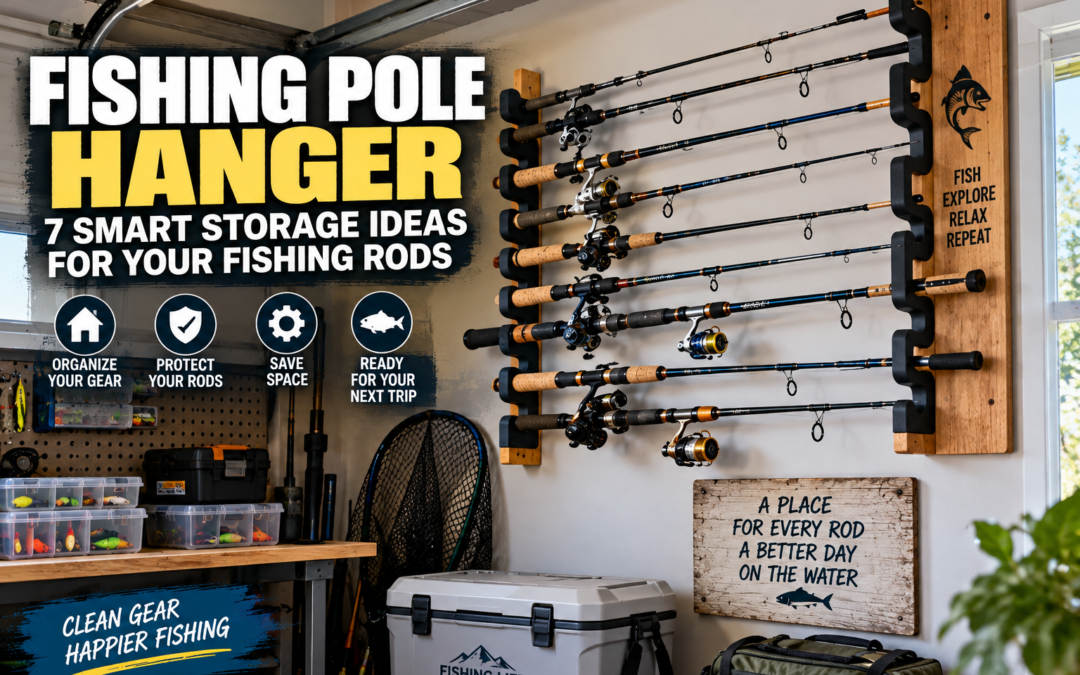
A fishing pole hanger is a simple way to get fishing rods off the floor, away from corners, and into a dedicated storage position. Instead of letting rods lean against a wall or pile together in a garage, a properly installed hanger keeps them separated and easier to access.
For anglers with several rods, storage becomes more important as the collection grows. Spinning rods, baitcasting rods, longer surf rods, and other setups all take up valuable space. The right fishing pole hanger can make a garage, workshop, boat area, or storage room much easier to organize.
This guide covers seven practical hanger styles, where each one works best, what to look for before buying, and how to protect rods while they are stored. For broader rod information, see the fishing rods guide on Hooked Beginner.
What Is a Fishing Pole Hanger?
A fishing pole hanger is a storage device designed to suspend or support fishing rods when they are not being used. Depending on the design, the hanger may attach to a wall, ceiling, cabinet, vertical surface, or another stable structure.
Unlike simply standing rods in a corner, a hanger gives each rod a defined storage position. That can reduce clutter and make it easier to identify the setup you need before a trip.
Some fishing pole hangers are made for only a few rods, while larger systems can hold an entire collection. The best choice depends on how many rods you own, how much space is available, and whether your storage location is a home, garage, shed, boat, or workshop.
Why Use a Fishing Pole Hanger?
Rod storage is not only about keeping a room tidy. Poor storage can expose rods and reels to unnecessary contact, impacts, bends, dirt, and tangles.
Take Me Fishing recommends keeping rods straight and protected during storage and specifically advises using a proper rod storage rack rather than leaning rods together in a garage corner.
A good hanger can provide several practical benefits:
- It keeps rods organized instead of scattered around the floor.
- It separates rods so guides, blanks, and reels are less likely to bump together.
- It uses vertical wall space that might otherwise be wasted.
- It makes frequently used rods easier to identify and retrieve.
- It can help create a dedicated fishing gear storage area.
Organization also makes maintenance easier. When rods are stored individually, it is simpler to inspect guides, clean equipment, and notice damage before the next trip.
7 Fishing Pole Hanger Ideas
1. Wall-Mounted Fishing Pole Hanger
A wall-mounted fishing pole hanger is one of the most practical choices for a garage, fishing room, shed, or workshop. The hanger attaches directly to a wall and holds rods horizontally or vertically depending on the design.
This configuration is useful when floor space is limited. Instead of taking up valuable walking or working space, rods occupy unused wall area.
Wall-mounted designs can also make it easier to group rods according to purpose. For example, spinning rods can occupy one section while heavier setups are stored separately.
Before installing one, measure the available wall width and check the spacing between rods. A hanger that is too compact may make reels or handles interfere with one another.
2. Vertical Fishing Rod Hanger
A vertical fishing pole hanger stores rods upright against a wall. This option can work particularly well where wall height is available but horizontal wall space is limited.
Vertical storage is useful for anglers with several rods because a single relatively narrow area can accommodate multiple setups. It can also make individual rods easy to remove without disturbing the whole collection.
However, the hanger should hold each rod securely and provide enough separation between neighboring setups. The reel, guide train, and rod blank should not be forced against adjacent equipment.
3. Horizontal Fishing Pole Hangers
Horizontal fishing pole hangers support rods along their length. They are especially useful on long garage walls, above workbenches, or in dedicated tackle rooms.
One advantage of horizontal storage is that rods can be displayed clearly. You can quickly see where each setup is located and select the correct one before heading to the water.
For longer rods, pay close attention to the support points. A good hanger should support the rod at appropriate positions instead of placing excessive pressure on a single small section.
4. Multi-Rod Fishing Pole Hanger
A multi-rod hanger is designed for anglers who own several fishing setups. Rather than purchasing separate hangers for each rod, one larger system can organize multiple rods in a single location.
This makes sense for anglers who fish different environments or target different species. A collection might include lightweight freshwater spinning rods, heavier baitcasting setups, and specialized rods for larger fish.
When choosing a multi-rod system, look beyond the advertised capacity. Consider the actual spacing between holders. A system that technically holds ten rods may be difficult to use if ten fully rigged rods are packed tightly together.
5. Fishing Pole Hanger for a Garage
The garage is one of the most common locations for fishing gear storage, but it also creates several challenges. Rods may be exposed to dust, temperature changes, vehicles, tools, and other equipment.
A garage fishing pole hanger should therefore be installed away from areas where vehicles, ladders, bicycles, or heavy tools can strike the rods.
Wall-mounted storage above a workbench or along a low-traffic wall can create an organized fishing station. Keep rods away from areas where doors or equipment swing into the storage space.
For additional gear, Hooked Beginner also covers general fishing pole information and related fishing equipment.
6. Ceiling-Mounted Fishing Pole Hanger
Ceiling-mounted hangers can be useful when wall space is already occupied. They allow anglers to use overhead storage areas while keeping rods away from the main floor.
This type of storage requires careful installation. The mounting point must be strong enough for the system and the weight of the rods being stored.
Ceiling storage is generally better for rods that are not constantly being accessed. If you use a particular setup every day, a wall-mounted hanger at a convenient height may be easier.
7. Boat and Dock Fishing Pole Hanger
Some rod storage systems are designed specifically for boats, docks, or other fishing areas. These setups need to account for movement, moisture, and limited space.
A boat-oriented hanger should secure rods firmly enough that they do not shift unnecessarily. It should also keep reels and rod blanks away from surfaces that can cause scratching or abrasion.
For anglers who regularly fish from boats, dedicated rod holders can also be useful. Hooked Beginner's current product catalog includes options such as the Scotty 290 R-5 Rod Holder, Cannon Rod Holder, and Savage Gear MP Rodholder.
Fishing Pole Hanger vs. Fishing Rod Rack
The terms fishing pole hanger and fishing rod rack are often used interchangeably, but they can describe slightly different storage approaches.
| Feature | Fishing Pole Hanger | Fishing Rod Rack |
|---|---|---|
| Typical installation | Wall, ceiling, cabinet or vertical surface | Floor, wall or freestanding |
| Space use | Often uses wall or overhead space | May require floor space |
| Best for | Compact storage | Larger collections |
| Portability | Usually fixed | Some freestanding racks can move |
| Capacity | Small to large depending on design | Small to very large |
A hanger is usually attractive when the main goal is saving space. A rack may be more appropriate when you want a larger freestanding storage station.
How to Choose the Right Fishing Pole Hanger
Consider Rod Capacity
Start by counting the rods you actually need to store. Do not select a hanger based only on today's collection if you already know you will be adding more setups.
Leave enough room between rods for your hands to remove one without catching another rod, line, or reel.
Check Rod Length
Longer rods require more space. A hanger that works well for shorter freshwater rods may not provide enough clearance for longer surf or specialty rods.
Measure the available storage area before buying. Check both the total length of the rods and the depth or width required by the hanger itself.
Match the Hanger to Your Rod and Reel Setups
A rod may be easy to store by itself but much harder to store when a large reel is attached. Spinning reels, baitcasting reels, and larger conventional reels can require different amounts of clearance.
Make sure the holder does not force the reel body against a wall or another rod.
Look at Padding and Contact Points
The areas that touch the rod matter. Smooth, protective contact points can help reduce scratches and unnecessary pressure on the blank or finish.
Take Me Fishing also recommends protecting rods during storage and avoiding situations where rods rub or bump against one another.
Check Mounting Hardware
A hanger is only as useful as its installation. For a wall-mounted design, use mounting hardware appropriate for the wall structure and the expected load.
Do not assume every screw or anchor is suitable for every wall. Masonry, drywall, wood framing, and other surfaces may require different installation methods.
Think About Access
The best storage location is one where you can quickly reach the rods without moving boxes, vehicles, tackle bags, or other equipment.
A hanger hidden behind several storage containers may technically organize your rods but still create unnecessary friction every time you want to fish.
How Many Fishing Poles Should a Hanger Hold?
There is no universal number because rod collections differ considerably. A beginner may only need space for two or three setups, while an experienced angler may have a dozen or more.
For a small collection, a compact hanger can reduce clutter without taking over an entire wall. For larger collections, a multi-rod storage system or rack may be more appropriate.
Capacity should also be considered alongside accessibility. Ten rods packed into a narrow space may be less practical than eight rods with enough clearance to remove each setup easily.
How to Store Fishing Rods on a Hanger
Before putting rods away, remove lures, hooks, and loose terminal tackle that could catch on another rod. Inspect the blank, guides, and reel for dirt or residue.
After saltwater use, rinse appropriate fishing equipment with fresh water and allow it to dry before long-term storage. Take Me Fishing recommends cleaning fishing gear and keeping rods properly supported during storage.
Once clean and dry:
- Place the rod into the hanger without forcing the blank into position.
- Make sure the rod is supported at the intended contact points.
- Keep neighboring rods separated enough to prevent rubbing.
- Store heavier setups where the hanger is designed to support them.
- Check the hanger periodically for loose hardware or movement.
Common Fishing Pole Hanger Mistakes
Installing Too Close to a Door or Vehicle
A perfectly good hanger can become a problem if a garage door, car door, cabinet, or piece of equipment can strike the rods.
Overloading the Hanger
More capacity is not automatically better. Overloading can reduce accessibility and put unnecessary stress on the mounting system.
Ignoring Reel Clearance
Rod storage should account for the complete setup, not just the bare rod. Large reels need adequate space.
Storing Wet Equipment
Putting wet or dirty gear into storage can make maintenance problems worse. Give equipment the chance to dry and clean it appropriately before extended storage.
IGFA's guidance on tackle organization also emphasizes maintaining an organized storage system so equipment remains easier to locate, inspect, and prepare for the next trip.
Keeping Every Rod in the Same Position
Not every rod needs identical storage treatment. Frequently used rods can be stored where they are easiest to reach, while less frequently used setups can occupy less accessible positions.
Fishing Pole Hanger Ideas for Small Spaces
Small storage areas benefit most from vertical thinking. A narrow wall-mounted hanger can use space above a workbench, beside a cabinet, or along a wall that would otherwise remain empty.
Another approach is to create one dedicated fishing area rather than spreading tackle across multiple rooms. Rods, reels, tackle containers, and accessories can then be grouped logically.
For tackle organization, IGFA recommends structured storage systems that make gear easier to identify and return to its proper location after a fishing trip.
Fishing Pole Hanger for Beginners
Beginners generally do not need the largest or most complicated storage system. A simple hanger that safely supports the first few rods may be enough.
As your fishing interests expand, the storage system can grow with the collection. This is often more practical than buying a large rack before you know how many rods you will actually own.
For beginners building a complete setup, the fishing reels guide can help with reel selection, while the fishing accessories category provides a broader look at related equipment.
Frequently Asked Questions About Fishing Pole Hangers
Are fishing pole hangers better than leaning rods in a corner?
A dedicated hanger is generally a more organized storage method because it keeps rods supported and separated rather than allowing them to lean against one another. Take Me Fishing specifically advises against simply storing rods upright in a garage corner.
Can a fishing pole hanger hold rods with reels attached?
Many hangers can hold complete rod-and-reel setups, but the design must provide enough reel clearance and support. Always check the intended capacity and dimensions.
Where should I install a fishing pole hanger?
Good locations include a low-traffic garage wall, fishing room, workshop, shed, boat storage area, or another dry location where rods can remain accessible without being exposed to unnecessary impact.
How far apart should fishing pole hangers be?
The spacing depends on rod length, reel size, hanger design, and how easily you want each rod to be removed. The key is leaving enough room to prevent neighboring rods and reels from interfering with one another.
Can I use a fishing pole hanger for expensive rods?
Yes, provided the hanger supports the rod properly, uses suitable contact points, is securely mounted, and protects the rod from unnecessary rubbing or impact.
Should rods be stored horizontally or vertically?
Either can work when the storage system supports the rods correctly. The best orientation depends on available space, rod length, hanger design, and ease of access.
Final Thoughts
The right fishing pole hanger can turn a cluttered collection into an organized fishing storage system. Wall-mounted, vertical, horizontal, multi-rod, garage, ceiling, and boat-oriented designs all solve different storage problems.
The important factors are capacity, rod length, reel clearance, mounting strength, spacing, protection, and accessibility. A good storage system should make your fishing equipment easier to find while reducing unnecessary contact between rods and other gear.
Whether you have two rods or an entire collection, dedicated storage is easier to manage than leaving fishing equipment scattered around a garage or leaning together in a corner. Choose a hanger that fits the space you have today while leaving enough room for the fishing setups you are likely to use tomorrow.