
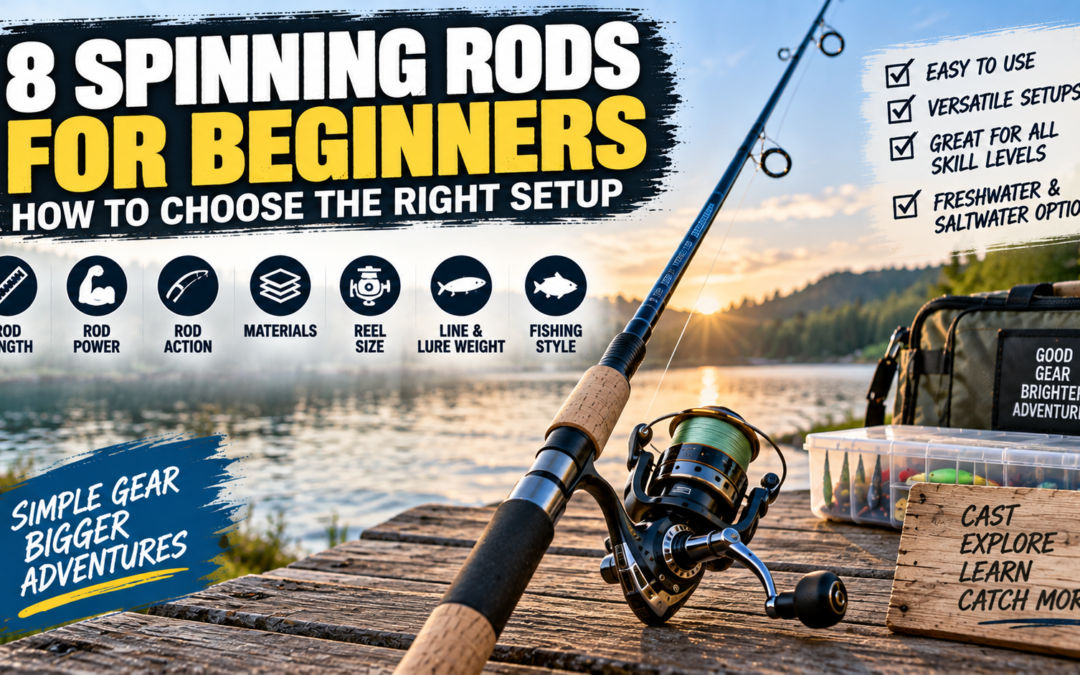
8 Spinning Rods for Beginners: How to Choose the Right Setup
Spinning rods for beginners are popular because they are relatively simple to use, versatile across many fishing situations, and well suited to lighter lines, lures, and bait. For a new angler, a properly matched spinning rod can make learning to cast, detect bites, control a fish, and handle basic tackle much easier.
The biggest mistake is choosing a spinning rod simply because it looks good or has a high price. The right rod depends on where you fish, what you want to catch, the weight of your lure or bait, the line you intend to use, and how much control you have over the equipment.
Take Me Fishing's current rod-selection guidance emphasizes two starting questions: where you will fish and what type of bait or lure you will use. Its guide also describes spinning rods as good general-purpose and beginner rods, particularly for lighter baits and lures. Read the full Take Me Fishing rod-selection guide.
This guide covers eight practical spinning rods for beginners, explains the differences between length, power, and action, shows how to match a spinning reel, and walks you through the specifications that matter before buying.
- Why Spinning Rods Work Well for Beginners
- 8 Spinning Rod Options for Beginners
- Choosing Spinning Rod Length
- Choosing Rod Power
- Understanding Rod Action
- Choosing the Right Rod Material
- Matching the Spinning Reel
- Matching Line and Lure Weight
- Choosing a Spinning Rod by Fishing Location
- Common Beginner Mistakes
- How to Care for a Spinning Rod
- Frequently Asked Questions
Why Spinning Rods Work Well for Beginners
Spinning tackle is one of the most accessible ways to learn fishing because the reel sits underneath the rod and the casting process does not require the same spool-control technique associated with many baitcasting setups.
Spinning rods can also handle a broad range of applications. Depending on the model, they can be used for light panfish tackle, trout fishing, bass fishing, inshore applications, and other general-purpose techniques.
Take Me Fishing's beginner resources recommend starting with basic spinning equipment and keeping the initial setup simple. Its beginner gear checklist recommends a spinning rod and reel combo as a way to reduce the guesswork when selecting compatible equipment. See the beginner fishing gear checklist.
The International Game Fish Association also recommends starting simple when introducing someone to fishing and provides beginner education covering spinning tackle, casting, knots, safety, and basic fishing skills. See the IGFA beginner fishing resource.
8 Spinning Rod Options for Beginners
There is no single spinning rod that fits every beginner. Your ideal setup changes according to the fish, location, lure weight, and fishing technique.
1. 6-Foot Light Spinning Rod
A six-foot light spinning rod can be an excellent choice for beginners who primarily target smaller freshwater species.
The shorter length provides good control and can be easier to maneuver around small ponds, narrow streams, docks, and areas with trees or other obstacles.
A light rod can also make small fish more enjoyable to fight because the blank loads more easily under lighter pressure.
This type of setup can work well for:
- Panfish.
- Small trout.
- Small bass.
- Light lures.
- Small natural-bait rigs.
The limitation is power. A light rod should not be treated as a universal setup for heavy lures, thick line, or large fish.
2. 7-Foot Light Spinning Rod
A seven-foot light spinning rod gives you some additional casting reach without moving into a heavy or specialized setup.
This can be particularly useful when fishing open banks or larger ponds where a little more casting distance is helpful.
The extra length can also provide more line control while still keeping the rod manageable for a beginner.
Pair it with a suitably sized spinning reel and light line, then choose lures that fall within the manufacturer's recommended range.
3. 7-Foot Medium-Light Spinning Rod
A medium-light spinning rod is one of the most useful choices for beginners who want a little more versatility without moving to a heavier rod.
It provides more backbone than a light rod while remaining appropriate for relatively light presentations.
This makes it useful for anglers who may target several freshwater species with small to medium-sized lures.
It can also serve as an intermediate setup for someone who begins with very light tackle but expects their fishing needs to grow.
4. 7-Foot Medium Spinning Rod
A seven-foot medium spinning rod is a practical general-purpose option for many new anglers.
It offers a useful combination of casting distance, control, and power. It can cover a broad range of freshwater applications when matched with the appropriate line, lure weight, and reel.
Take Me Fishing's beginner freshwater guidance describes a pre-spooled spinning reel in the 1000- to 3000-size range mounted on a seven-foot medium-action rod as a useful setup for learning. See the freshwater beginner equipment guide.
This does not mean every beginner should buy exactly that configuration. It is a starting reference that illustrates how rod length, action, reel size, and line can be matched into one practical system.
5. 6-Foot 6-Inch Medium Spinning Rod
A six-and-a-half-foot medium spinning rod can provide a compromise between compact handling and the casting range of a longer rod.
It can be useful for beginners who fish from shore but also spend time around tight cover, smaller rivers, or confined spaces.
This length can also be comfortable for anglers who are still developing their casting motion and do not want to begin with a long blank.
6. 7-Foot Medium-Heavy Spinning Rod
A medium-heavy spinning rod becomes more useful when the target fish, lure weight, line strength, or fishing cover demands additional power.
It can be a suitable starting option for someone who already knows that their fishing will involve stronger species or heavier presentations.
However, beginners should not assume that more power automatically means a better rod.
A medium-heavy rod can feel unnecessarily stiff when paired with very light lures. If your fishing is mainly focused on small fish, a lighter setup can provide a better experience.
For a deeper explanation of power ratings, use the fishing rod power guide.
7. Two-Piece Spinning Rod
A two-piece spinning rod can be a highly practical beginner option when transportation and storage matter.
The rod can be separated into sections, making it easier to fit inside a vehicle or store in a smaller home.
This is especially useful for anglers who:
- Travel to different fishing locations.
- Do not have a large garage.
- Need to carry fishing gear in a small vehicle.
- Want easier storage between trips.
The connection between sections should be checked regularly. Make sure the sections are properly seated before casting.
8. Spinning Rod and Reel Combo for Beginners
A pre-matched spinning rod and reel combo can be one of the simplest ways to start.
Instead of selecting the rod, reel, line, and compatibility specifications separately, the combination is designed to function as a complete setup.
Take Me Fishing explains that pre-configured spinning rod and reel combos reduce the experience required to select compatible equipment because the rod length, action, reel size, and line capacity are already considered in the pairing. Read its explanation of spinning rod and reel combos.
A combo can therefore be a practical starting point for someone who wants to concentrate on learning rather than comparing dozens of separate components.
Choosing Spinning Rod Length
Rod length affects casting distance, control, leverage, transport, and how easily you can maneuver around obstacles.
Shorter spinning rods are often easier to control in tight spaces. Longer rods can provide more casting distance and line control when fishing open water.
Take Me Fishing notes that shorter rods generally provide more power for fighting fish while longer rods can cast farther. Its rod guide also notes that surf and fly rods are often much longer than general-purpose rods. Review its rod-length explanation.
When to Choose a Shorter Spinning Rod
- Small streams.
- Tight bank areas.
- Heavy vegetation.
- Fishing around docks and structures.
- Maximum maneuverability.
When to Choose a Longer Spinning Rod
- Open shorelines.
- Larger lakes.
- Longer casting distances.
- Situations requiring more line control.
You can explore the complete fishing rod length guide before deciding which size fits your normal fishing location.
Choosing Rod Power
Rod power describes how much force is required to bend the blank.
Common ratings include light, medium-light, medium, medium-heavy, and heavy.
For beginner spinning rods, medium and medium-light power can cover many general freshwater applications. Light power is useful for smaller species and lighter presentations, while medium-heavy power becomes more appropriate for stronger fish and heavier tackle.
The rod power needs to work with:
- Target fish.
- Lure weight.
- Line strength.
- Cover and structure.
- Fishing technique.
A common mistake is selecting rod power entirely based on fish size. Lure weight is equally important.
Always check the manufacturer's lure and line ratings before deciding.
Understanding Rod Action
Rod action describes where along the blank the rod bends when pressure is applied.
Fast Action
Fast-action rods bend primarily toward the upper part of the blank. They can provide a more direct feel and are often used when sensitivity and quick response are important.
Moderate Action
Moderate-action rods bend farther down the blank and can provide a more forgiving loading pattern during casting.
Slow Action
Slower actions allow more of the blank to bend and can be useful for particular light-tackle applications.
Beginners do not need to memorize every technical specification immediately. Start with the action that matches the technique you intend to learn and the lure weights you expect to use.
For more detail, see the fishing rod action guide.
Choosing the Right Spinning Rod Material
Fiberglass
Fiberglass rods are generally tough and flexible. They can be forgiving for beginners who are still learning how to handle and cast a fishing rod.
The tradeoff is that fiberglass is usually heavier and less sensitive than graphite.
Graphite
Graphite rods are generally lighter and more sensitive. That can make it easier to detect subtle bites and reduce fatigue during long fishing sessions.
Graphite can also be more vulnerable to damage from impacts, so beginners need to handle the rod carefully.
Composite or Hybrid
Hybrid construction combines characteristics of fiberglass and graphite. These rods can offer a balance between weight, sensitivity, flexibility, and durability.
Take Me Fishing describes fiberglass as tougher and generally more flexible, while graphite is lighter, stiffer, and more sensitive. Compare the rod materials in its guide.
How to Match a Spinning Reel to Your Rod
The rod and reel should be treated as a single system.
A reel that is too large can make a lightweight rod feel unbalanced. A reel that is too small may not have the necessary line capacity or drag range.
When selecting a spinning reel, consider:
- Reel size.
- Line capacity.
- Drag range.
- Overall weight.
- Gear ratio.
- Spool design.
- Handle size.
For many beginner freshwater setups, a 1000- to 3000-size spinning reel can be a useful range to explore, depending on the rod and line. Take Me Fishing currently describes that range alongside a seven-foot medium-action rod in one beginner freshwater configuration. See the source setup and context.
For additional reel information, visit the fishing reels section.
Matching Line and Lure Weight
A beginner spinning rod should be selected together with the line and lure weights you expect to use.
Every rod normally has published line and lure ratings. Those specifications help you stay within the range the rod was designed to handle.
For example, a very light rod may be excellent with tiny lures but uncomfortable when casting heavy weights. A heavy rod may handle large lures but provide less sensitivity with very light tackle.
The same principle applies to line. Line that is much heavier than the rod rating may reduce the usefulness of a light setup, while excessively light line can make stronger applications difficult.
Start by deciding what you plan to fish with, then choose the rod around that application.
Spinning Rod vs. Casting Rod for Beginners
Spinning and casting rods are designed for different reel types and techniques.
Spinning Rod
The reel mounts beneath the rod. Spinning tackle is widely used for light lines, live bait, and smaller lures, and is commonly recommended as a beginner-friendly option.
Take Me Fishing describes spinning rods as user-friendly for anglers of different experience levels and particularly suitable for frequent casting, live bait, light lines, and small lures. Compare spinning and casting rods.
Casting Rod
Casting rods are normally paired with baitcasting or other casting reels and can be useful when heavier artificial lures and specific techniques are involved.
For many first-time anglers, spinning tackle provides a simpler learning path.
Choosing Spinning Rods for Different Fishing Locations
Ponds
A six- to seven-foot light, medium-light, or medium spinning rod can provide useful versatility for pond fishing.
Lakes
Larger lakes may reward additional casting distance, making a medium-length spinning rod a useful choice.
Small Rivers and Streams
Shorter rods can be easier to control where banks are narrow and vegetation limits your casting space.
Large Rivers
A longer rod may provide more useful casting reach and line control when fishing open banks.
Shore Fishing
Shore fishing can cover many different environments. The correct spinning rod depends on the shoreline, target fish, casting range, and tackle weight.
Beginners should avoid assuming that one rod works equally well for every shore environment.
Spinning Rods for Beginners by Target Fish
Panfish
Light or ultralight spinning rods can make small fish more engaging and are well suited to light lures and lines.
Trout
Light and medium-light spinning rods are common choices for trout applications where smaller lures and lighter line are used.
Bass
Medium spinning rods provide a useful general-purpose option for many bass applications, while medium-heavy rods can be used when heavier lures or cover require more power.
Catfish
Catfish equipment varies considerably by species and size. Larger fish and heavier bait may require more power than a typical light or medium beginner rod.
Inshore Saltwater
A spinning setup can also be useful for certain inshore applications, but the rod, reel, line, and construction should be selected for saltwater exposure and the species being targeted.
How to Select a Spinning Rod for Your First Fishing Trip
For a first trip, keep the process simple.
- Choose the fishing location.
- Identify the likely target species.
- Choose bait or lures suitable for those fish.
- Check the lure weight.
- Choose the rod power and action.
- Choose a suitable rod length.
- Match the spinning reel.
- Spool appropriate line.
- Practice casting before fishing in crowded or difficult areas.
Take Me Fishing's beginner resources repeatedly emphasize keeping the first setup simple and gaining experience on the water before moving into more specialized equipment. See its beginner fishing essentials guide.
8 Features to Check Before Buying Spinning Rods for Beginners
| Feature | Why It Matters |
|---|---|
| Length | Affects casting range, control and transport |
| Power | Determines how the rod handles fish and lure weight |
| Action | Changes how the blank bends and loads |
| Material | Influences weight, sensitivity and durability |
| Line rating | Helps match the rod to appropriate line |
| Lure rating | Defines the useful casting-weight range |
| Reel compatibility | Keeps the complete setup balanced |
| Handle and reel seat | Affects comfort and control |
Example Spinning Rods to Compare
Once you understand the specifications, looking at actual rod models becomes easier because you know which features matter to your fishing style.
Hooked Beginner's current product sitemap includes several spinning-rod products that can be used as examples when comparing construction, length, power, and intended application:
The point of comparing products is not simply to choose the one with the highest price. Compare the specifications to the fishing application you already identified.
When a Spinning Rod and Reel Combo Makes More Sense
Buying a matched combo can be a practical choice when you are completely new to fishing.
A pre-matched combination can remove several early decisions:
- Which reel size belongs with the rod?
- Is the reel too heavy?
- Does the rod support the line?
- Are the rod and reel physically compatible?
- Does the setup balance correctly?
Take Me Fishing explains that a matched spinning combo can reduce the guesswork because the main components are already selected to work together. Read its beginner spinning setup guide.
Once you understand your fishing style, you can move toward selecting individual components when you need more specialized performance.
Common Beginner Spinning Rod Mistakes
Choosing the Wrong Length
A rod that is too long can be difficult to control in tight spaces, while a very short rod may limit casting distance in open water.
Choosing Too Much Power
A heavy rod can make light lures difficult to cast and may reduce the fun of fighting smaller fish.
Choosing Too Little Power
A light rod may become inadequate when you move to larger fish or heavier tackle.
Ignoring the Lure Rating
The lure rating should match what you intend to cast.
Ignoring the Reel
A rod should be evaluated as part of a rod-and-reel system.
Buying Only by Appearance
Color and design are personal preferences. Length, power, action, material, and ratings have a more direct relationship with performance.
Starting With Too Many Rods
A beginner usually learns faster with one well-understood setup than with a collection of specialized rods that serve overlapping purposes.
How to Care for a Spinning Rod
Proper care is simple but important.
After fishing, inspect the guides and blank for dirt, sand, or damage. Check the reel seat and handle, and remove debris before placing the rod into storage.
If the rod has been exposed to saltwater, follow the manufacturer's cleaning recommendations and allow the complete setup to dry before storage.
A good fishing rod storage system can keep the blank and tip away from accidental impacts.
Do not place heavy equipment on top of stored rods or leave rods where their tips can be bent against hard surfaces.
When Should a Beginner Upgrade?
There is no requirement to upgrade after a particular number of fishing trips.
Upgrade when your current spinning rod becomes a limitation.
For example, you may need a different rod when:
- You start targeting larger fish.
- You begin fishing heavier cover.
- You use heavier lures.
- You need longer casting distance.
- You want more sensitivity.
- You begin using a specialized technique.
- You move from freshwater to demanding saltwater applications.
Your first rod teaches you what you actually value. That experience makes the second rod easier to choose.
Beginner Spinning Rod Buying Checklist
Before ordering, check every specification:
- Rod type: spinning.
- Length: suitable for your fishing location.
- Power: suitable for your target fish and lure weight.
- Action: suitable for your technique.
- Material: fiberglass, graphite or hybrid.
- Line rating: appropriate for the line you will use.
- Lure rating: compatible with your lures or bait.
- Reel compatibility: properly matched.
- Handle: comfortable in your hand.
- Transportation: one-piece or two-piece according to your needs.
- Environment: freshwater or saltwater.
Frequently Asked Questions
What are the best spinning rods for beginners?
The right beginner spinning rod depends on where you fish and what you target. For many general freshwater applications, a six- to seven-foot light, medium-light, or medium spinning rod can provide a useful starting point.
What length spinning rod is best for a beginner?
A six- to seven-foot rod is a common starting range for general freshwater fishing. Shorter rods provide maneuverability while longer rods can increase casting distance.
What power should a beginner spinning rod have?
Medium power can provide useful versatility for many beginners, while light and medium-light rods suit smaller fish and lighter lures. Medium-heavy rods are better suited to stronger fish and heavier tackle.
Are spinning rods easier for beginners?
They are widely considered beginner-friendly because spinning tackle is relatively simple to cast and works well with light lines and lures.
What size spinning reel should a beginner use?
A 1000- to 3000-size spinning reel is one useful beginner range for many freshwater applications, but the reel should be matched to the rod, line, lure and target fish.
Is fiberglass or graphite better for beginners?
Fiberglass is generally tougher and more flexible, while graphite is lighter and more sensitive. The better choice depends on whether durability or sensitivity is more important for your fishing.
Should I buy a spinning rod and reel combo?
A matched combo can simplify the buying process because the rod and reel are already selected to work together. It is often a practical option for someone buying their first setup.
Can one spinning rod be used for different fish?
Yes. A versatile spinning rod can cover several applications when the lure weight, line, reel, and target species remain within its intended range.
Can beginners use spinning rods for saltwater?
Yes, but the equipment should be appropriate for the saltwater environment. Reel corrosion resistance, line, rod power, and target species all need to be considered.
How long should a beginner keep their first spinning rod?
Keep using it as long as it remains appropriate for your fishing. An upgrade should solve an actual limitation rather than being based solely on how long you have owned the rod.
Conclusion
The right spinning rods for beginners are the ones that match the angler, the fishing location, the target species, and the tackle being used.
A six- to seven-foot light, medium-light, or medium spinning rod can provide an excellent starting point for many freshwater anglers. A heavier rod becomes more useful as fish size, lure weight, cover, or fishing conditions become more demanding.
Before buying, focus on length, power, action, material, line rating, lure rating, and reel compatibility. Those specifications tell you much more about whether a rod fits your needs than appearance or price alone.
Start with one balanced setup and learn how it behaves. As your skills develop, you will have a much clearer idea of whether you need more sensitivity, additional casting distance, heavier power, lighter tackle, or a specialized rod.
For broader information, explore Hooked Beginner's spinning fishing rods section, fishing rods guide, fishing rod buying guide, rod length guide, rod power guide, and rod action guide.
You can also use the IGFA's Intro to Fishing course for beginner instruction on casting, tackle, safety, knots, and responsible angling.
The goal of your first spinning rod is simple: give you a setup you understand, can control, and can confidently take to the water.