
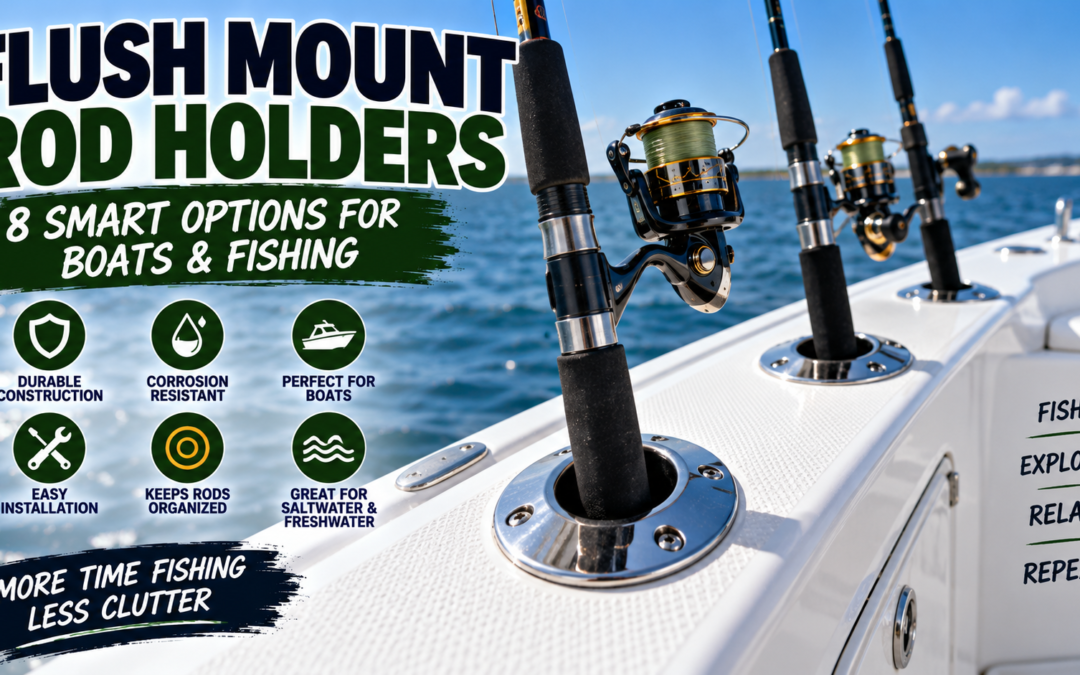
Flush Mount Rod Holders: 8 Smart Options for Boats & Fishing
Choosing the right flush mount rod holders can make a major difference in how organized, accessible, and usable your fishing setup feels. Unlike bulky surface-mounted holders, a flush mount design is recessed into a boat surface so the holder sits closer to the surrounding deck, gunwale, or storage area.
That recessed design can be especially useful when you want a cleaner installation, better use of limited space, and a more organized place to keep fishing rods between casts. However, not every holder fits every boat, rod, or fishing style. Material, angle, tube length, mounting location, rod clearance, and installation method all matter.
This guide explains flush mount rod holders in detail and breaks down eight practical options. You will also learn how to choose the right design, where to install one, which materials to consider, common installation mistakes, and what to check before buying.
What Are Flush Mount Rod Holders?
Flush mount rod holders are fishing rod holders designed to sit inside a recessed opening in a mounting surface. Instead of attaching completely on top of the surface, the body of the holder extends below the mounting area while the rim remains close to the surrounding surface.
This makes them different from many clamp-on, rail-mounted, or surface-mounted rod holders. A flush installation can reduce protrusion and create a more integrated appearance.
They are commonly considered for boat gunwales, decks, transoms, storage areas, and other locations where a permanent mounting solution is appropriate.
The correct holder still depends on the fishing application. Rod length, rod butt diameter, reel clearance, fishing angle, boat construction, and the intended load should all be considered before installation.
Before selecting a holder, it also helps to understand the basics of your fishing equipment. Our fishing rods guide covers the different rod types and applications you may need to match with your storage or boat setup.
Why Use Flush Mount Rod Holders?
There are several reasons anglers consider flush mount rod holders instead of other mounting styles.
1. Cleaner Installation
A recessed holder can produce a cleaner appearance because less of the holder projects above the mounting surface. This can be useful when you want the boat or storage area to remain relatively uncluttered.
2. Better Use of Space
Flush mounting can help reduce the amount of hardware extending into walkways or working areas. This matters on smaller boats where every bit of usable space matters.
3. Easy Rod Access
A properly positioned holder keeps a rod within reach without requiring it to lie loose on the deck. This can make it easier to switch rods or temporarily secure a setup while preparing tackle.
4. Organized Rod Storage
Multiple holders can create dedicated positions for different fishing rods. That can reduce tangles and help keep rods separated during a trip.
The importance of organization extends beyond rod holders. The IGFA tackle organization guide also emphasizes the value of keeping fishing equipment arranged so it is easier to access and maintain.
5. Useful for Permanent Boat Setups
For anglers who fish from the same boat regularly, permanent flush mount rod holders can provide a consistent storage and working system.
8 Types of Flush Mount Rod Holders
1. Stainless Steel Flush Mount Rod Holders
Stainless steel flush mount rod holders are popular when durability, corrosion resistance, and a substantial feel are important. They are often considered for boats that are exposed to water frequently, particularly saltwater environments.
The exact grade and construction matter, so do not choose solely because a holder is labeled stainless steel. Look at the manufacturer's material information, finish, mounting hardware, and intended environment.
These holders can be a good choice when you want a permanent installation that matches other stainless hardware on the boat.
2. Plastic or Composite Flush Mount Rod Holders
Plastic and composite holders can provide a lighter alternative to metal designs. They may also be useful where weight, cost, or resistance to certain types of corrosion is a concern.
Quality varies considerably between products. Pay attention to wall thickness, mounting flange strength, rod tube dimensions, and the type of plastic or composite used.
For lighter freshwater applications, a properly sized composite holder may be sufficient. For demanding applications, however, the mounting surface and holder construction deserve closer attention.
3. Angled Flush Mount Rod Holders
Angled flush mount rod holders position the rod at a fixed angle relative to the mounting surface. This can be useful when you want rods directed outward, backward, or toward a particular fishing position.
The correct angle depends on where the holder is installed and what the rod will be doing. A holder near a gunwale may need a different orientation from one installed on a transom.
Always consider how the rod will sit when fully inserted and whether the reel or handle could interfere with nearby equipment.
4. Vertical Flush Mount Rod Holders
Vertical or near-vertical flush mount designs can be useful for rod storage and situations where you want the rods to remain relatively upright.
These can work well when space is available behind or beneath the mounting area and when the rod does not need to point outward at a large angle.
Before installation, measure both the top opening and the space below the mounting surface. The holder may fit at the surface while still interfering with wiring, tanks, structural components, or other hardware underneath.
5. Recessed Holders With Protective Liners
Some flush mount rod holders incorporate liners or protective materials inside the tube. The purpose is to provide a softer contact point between the holder and the rod butt.
This can be useful when rods will be inserted and removed frequently. A liner can also help reduce direct contact between the rod and hard holder material.
When evaluating this style, inspect the liner material and how securely it is retained. A loose or damaged insert may reduce the practical benefit of the design.
6. Heavy-Duty Flush Mount Rod Holders
Heavy-duty holders are intended for applications where the equipment may experience greater loads or more demanding use. The holder itself is only part of the equation, though.
The mounting surface, fasteners, backing structure, and surrounding material must also be capable of supporting the intended application.
A heavy-duty holder installed into a weak or unsuitable surface will not automatically create a strong installation. The entire mounting system needs to work together.
7. Compact Flush Mount Rod Holders
Compact flush mount rod holders can be useful when installation space is limited. Smaller boats, tight storage areas, and crowded gunwales may require a holder with a smaller footprint.
Compact does not mean you should ignore fit. The tube must still accommodate the rod butt, while the surrounding area needs enough clearance for inserting and removing the rod.
Measure first rather than assuming a compact holder will automatically fit your boat.
8. Multi-Position Flush Mount Rod Holder Setups
Some anglers install several flush mount rod holders around the same boat or storage area. This creates dedicated positions for different rods and fishing techniques.
A multi-holder arrangement can be particularly useful when carrying several rods. You might reserve one position for a primary rod, another for a backup setup, and additional positions for specialized presentations.
Planning the complete layout before drilling is important. Think about rod spacing, casting areas, walking paths, reel clearance, and access to storage compartments.
Flush Mount Rod Holders Comparison
| Type | Key Advantage | Best Suited To | Main Consideration |
|---|---|---|---|
| Stainless steel | Durability and corrosion resistance | Frequent boat use and demanding environments | Material grade and installation quality |
| Plastic or composite | Lower weight | Freshwater and lighter applications | Construction quality |
| Angled | Fixed rod positioning | Gunwales and fishing stations | Correct mounting angle |
| Vertical | Space-efficient rod storage | Storage and upright positioning | Clearance below mounting surface |
| Protective liner | Reduced direct rod contact | Frequent rod insertion and removal | Liner durability |
| Heavy-duty | Built for demanding use | Large rods and heavier applications | Mounting structure |
| Compact | Small installation footprint | Limited-space boats | Rod butt and reel clearance |
| Multi-position | Organized multi-rod layout | Anglers carrying several rods | Spacing and overall layout |
How to Choose the Right Flush Mount Rod Holders
1. Count the Rods You Need to Store
Start with the number of rods you regularly carry or want available. One holder may be enough for a single fishing station, while a larger setup may require several positions.
Do not automatically install as many holders as possible. Too many can make the boat feel crowded and can interfere with movement or equipment access.
2. Measure the Mounting Area
Measure the available surface before purchasing. You need to know whether the mounting flange will fit and whether the recessed body has enough room underneath.
Measure twice before cutting once. A holder that looks small in a product photograph may require more space below the surface than expected.
3. Consider Rod Length
Rod length affects how much space the complete setup needs. Longer rods can extend well beyond the mounting location and may affect nearby anglers, equipment, or walking areas.
Our fishing rod length guide explains how rod length relates to casting, control, and fishing applications.
4. Match the Holder to Rod Power and Use
Rod power does not directly determine the holder size, but it can tell you something about the type of fishing application you are building around.
A holder intended for light freshwater equipment may not be the same choice you would make for larger rods or demanding boat applications.
For a deeper look at rod power, see our fishing rod power guide.
5. Check the Rod Butt Diameter
One of the simplest mistakes is buying a holder without checking the rod butt. The opening needs to accommodate the rods you plan to place inside it.
Measure the actual rod handles or compare them with the holder manufacturer's stated dimensions.
6. Think About the Reel and Handle
The holder opening may fit the rod while the reel still collides with a nearby surface. Consider the complete rod-and-reel setup rather than measuring only the blank.
7. Choose the Right Angle
Think about where the rod tip will point when the holder is installed. An angled holder should support the fishing position you actually need.
Our fishing rod action guide can also help you understand how different rod characteristics affect fishing applications when planning your overall setup.
8. Check the Installation Depth
Flush mounting requires space below the surface. Before drilling, inspect the area beneath the mounting point.
Look for wiring, fuel components, plumbing, flotation structures, reinforcement, storage walls, and other equipment. A clean-looking installation is not useful if the holder damages something hidden beneath the surface.
Choosing Flush Mount Rod Holders for Different Use Cases
Flush Mount Rod Holders for Small Boats
Small boats benefit from space-efficient solutions. A recessed holder can reduce the amount of hardware protruding into a narrow working area.
Prioritize compact dimensions, correct rod spacing, easy access, and a mounting position that does not interfere with seating or movement.
Flush Mount Rod Holders for Bass Fishing
Bass anglers may carry multiple rods for different presentations. A well-planned holder layout can give each setup a dedicated position without forcing rods to lie across the deck.
Think carefully about casting clearance and how quickly each rod can be removed when changing techniques.
Flush Mount Rod Holders for Trolling
Trolling setups often require multiple rods positioned in different directions. Holder angle becomes especially important in this situation.
The layout should keep rods separated while leaving enough room to monitor lines, retrieve rods, and move safely around the boat.
Flush Mount Rod Holders for Saltwater Fishing
Saltwater use places additional importance on corrosion resistance and maintenance. Stainless steel construction can be attractive for this application, but the exact material, hardware, installation, and maintenance routine still matter.
Rinse appropriate equipment after use and inspect the holder, fasteners, and surrounding mounting area regularly.
Flush Mount Rod Holders for Rod Storage
If your primary objective is storage rather than active fishing, focus on rod protection, spacing, and access.
Make sure rods cannot swing into one another, contact sharp hardware, or become trapped beneath other equipment.
Materials and Installation Setup
Stainless Steel
Stainless steel is commonly considered when durability and corrosion resistance are priorities. Verify the specific grade and manufacturer's intended application rather than treating every stainless holder as identical.
Plastic and Composite Materials
Plastic and composite holders can reduce weight and may provide a practical solution for lighter applications. Look for adequate wall thickness and a mounting flange that matches your installation surface.
Mounting Hardware
The fasteners are part of the installation. Their size, corrosion resistance, compatibility with the boat surface, and installation method should all be considered.
Backing and Mounting Structure
Some mounting locations may require additional structural support or backing. The holder should not simply be evaluated as an isolated component.
Installation Planning
Before cutting the opening, mark the location carefully. Confirm the holder orientation, check the underside of the surface, test rod clearance, and make sure the final position will be useful when fishing.
If you are unfamiliar with the construction of your boat, getting professional installation advice may be preferable to cutting into an area that contains hidden components or structural reinforcement.
Common Flush Mount Rod Holder Mistakes
Installing Without Measuring
This is one of the easiest mistakes to avoid. Measure the holder, the opening, the mounting depth, the rod butt, and the surrounding clearance before making changes to the boat.
Ignoring the Space Below the Surface
A flush mount installation extends below the mounting surface. Never assume that an empty-looking location on top is also empty underneath.
Choosing the Holder Only by Appearance
A polished stainless holder may look excellent but still be the wrong size, angle, or mounting style for your setup.
Installing Holders Too Close Together
Multiple holders need enough separation for rods and reels to coexist without constant interference.
Forgetting Reel Clearance
A rod may fit perfectly into the tube while the reel hits the gunwale, seat, rail, or another piece of equipment.
Using the Wrong Holder for the Application
A holder designed for light storage should not automatically be treated as a heavy-duty fishing station. Match the holder and mounting system to the way you intend to use it.
Skipping Regular Inspection
Check the flange, fasteners, surrounding surface, and holder interior periodically. Loose hardware or damage can become more serious if ignored.
Flush Mount Rod Holders Buying Checklist
| Check | What to Look For |
|---|---|
| Holder type | Choose a design that matches your fishing application |
| Material | Consider stainless steel, plastic, or composite construction |
| Opening size | Make sure the rod butt fits correctly |
| Mounting depth | Confirm there is enough room below the mounting surface |
| Mounting diameter | Match the required cutout and flange dimensions |
| Rod angle | Choose an orientation that suits your fishing position |
| Reel clearance | Leave enough room around the complete rod and reel |
| Boat construction | Check the strength and structure of the installation area |
| Fasteners | Use hardware appropriate for the environment and mounting surface |
| Rod count | Plan enough positions without overcrowding the boat |
| Maintenance | Choose a design that can be inspected and cleaned easily |
Related Fishing Rod Guides
Installing flush mount rod holders is easier when you understand the rods you intend to use with them. Continue your research with these Hooked Beginner guides:
- Fishing Rods Guide — Understand common rod types and applications.
- Fishing Rod Buying Guide — Learn what to check before choosing a fishing rod.
- Fishing Rod Length Guide — Compare rod lengths for different fishing situations.
- Fishing Rod Power Guide — Understand light, medium, heavy, and other rod power ratings.
- Fishing Rod Action Guide — Learn how fast, moderate, and slower actions affect rod behavior.
Related Rod Holder Products
Hooked Beginner also has rod-holder products you can compare when researching different mounting approaches. These products are useful for understanding the wider rod-holder category; always verify the specific mounting style and specifications before purchasing for a flush-mount installation.
Frequently Asked Questions
What are flush mount rod holders?
Flush mount rod holders are recessed fishing rod holders installed into an opening in a mounting surface. The holder sits largely below the surface instead of projecting fully above it.
Are flush mount rod holders good for boats?
They can be useful on boats because the recessed design can create a cleaner installation and reduce protruding hardware. The best choice depends on the boat structure, fishing style, rod dimensions, and mounting location.
Are stainless steel flush mount rod holders better than plastic?
They serve different needs. Stainless steel can be attractive for durability and corrosion resistance, while plastic or composite holders can provide lower weight and may be suitable for lighter applications. Compare the actual construction rather than choosing from material name alone.
Where should I install flush mount rod holders?
Install them where the rod will be easy to reach and where the holder will not interfere with seating, casting, movement, storage, or other boat equipment. Always inspect the space beneath the mounting surface first.
How far apart should flush mount rod holders be?
There is no single spacing that works for every boat. Leave enough room for the rod handles, reels, hands, and neighboring equipment. Test the layout with your actual rods before cutting multiple openings.
Can flush mount rod holders be used for saltwater fishing?
Yes, they can be used in saltwater applications when the holder, hardware, mounting surface, and maintenance routine are appropriate for the environment. Corrosion resistance deserves particular attention in saltwater.
Do flush mount rod holders require drilling?
Permanent flush mounting normally requires creating an opening that matches the holder's specified cutout dimensions. The exact installation method depends on the product and mounting surface.
Can I install flush mount rod holders myself?
Installation may be possible for an experienced boat owner, but it requires careful measuring and inspection of the mounting area. You should understand the construction beneath the surface before cutting.
Can one flush mount rod holder fit every fishing rod?
No. Rod butt diameter, handle design, reel position, and holder dimensions vary. Check the holder's internal dimensions against the rods you plan to use.
Should flush mount rod holders be vertical or angled?
It depends on the job. Vertical holders can work well for storage, while angled holders can be useful when positioning rods for active fishing. Choose the orientation based on the location and fishing technique.
Final Thoughts
The right flush mount rod holders can create a cleaner, more organized, and more practical fishing setup. The key is not simply finding a holder that looks good. You need to match the holder to your rods, boat, mounting surface, fishing application, and available space.
Start by measuring the mounting area, checking the rod butt diameter, evaluating the space beneath the surface, and planning how the rods and reels will sit when installed. Then compare materials, holder angles, construction, and mounting requirements.
For a permanent boat setup, careful planning matters just as much as the holder itself. A well-positioned installation can make rod access easier while keeping the fishing area more organized.
Before buying, use the checklist above and compare the specific dimensions and installation requirements of each product. That approach will give you a much better foundation for choosing flush mount rod holders that actually fit your fishing setup.