
How to Hold Fishing Rod: 8 Easy Techniques for Better Control
Learning how to hold fishing rod correctly is one of the first skills every new angler should master. A proper grip gives you better control over the rod, makes casting more consistent, helps you manage the lure during the retrieve, and gives you a more stable position when a fish strikes.
Many beginners simply grab the handle wherever it feels comfortable. That may work for basic fishing, but your hand position becomes much more important when you start casting longer distances, using different reel types, fishing heavier lures, or fighting stronger fish.
The proper way to hold a fishing pole depends partly on the type of rod and reel you are using. A spinning rod is held differently from a baitcasting setup, while a long surf rod or heavy-duty fishing rod may require a different grip from a lightweight freshwater setup.
Take Me Fishing explains that spinning and baitcasting equipment require different casting techniques and hand controls. Its fishing resources also emphasize practicing casting and developing timing and coordination before trying to maximize distance. Learn more about fishing and casting techniques at Take Me Fishing.
This guide explains how to hold fishing rod correctly for different fishing situations, how to position your hands, when to use one hand or two, how to hold a rod while casting and retrieving, and the mistakes that can make fishing uncomfortable or less controlled.
What Does It Mean to Hold a Fishing Rod Correctly?
Knowing how to hold fishing rod correctly means positioning your hands so you have secure control without unnecessarily squeezing the handle. Your grip should allow the rod to move naturally while still giving you enough stability to control casting, retrieving, hook setting, and fighting fish.
The exact grip changes according to the equipment.
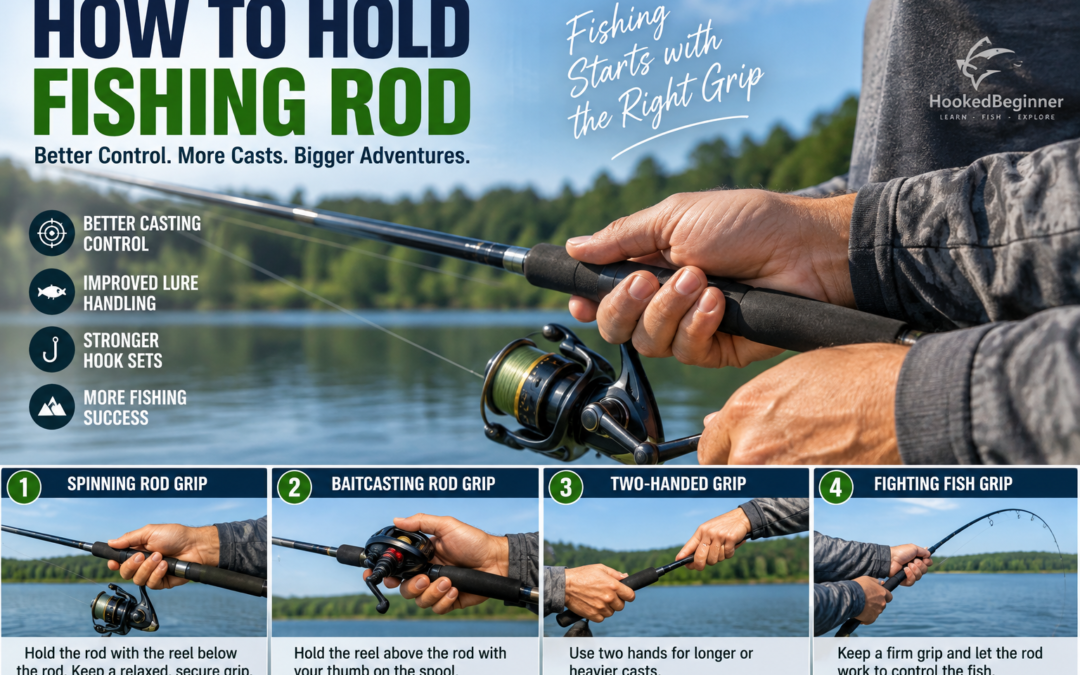
With a spinning rod, the reel sits underneath the rod. Your primary hand normally holds the rod around the handle and reel-seat area, while your index finger can interact with the fishing line during casting.
With a baitcasting setup, the reel sits above the rod. Your thumb becomes especially important because it can control the spool during casting.
This means there is no single universal grip for every fishing rod. The best grip is the one that matches the reel, rod design, fishing technique, lure weight, target species, and fishing environment.
Why Knowing How to Hold Fishing Rod Matters
Understanding how to hold fishing rod matters because your grip affects almost every movement you make while fishing.
Better Casting Control
Your grip determines how easily you can move the rod through the casting motion. A stable but relaxed grip allows the rod to move smoothly instead of forcing every part of the cast with your arm or wrist.
For beginners, learning basic casting mechanics before attempting maximum distance is especially useful. Take Me Fishing recommends practicing casting so anglers can develop timing, coordination, and accuracy. See Take Me Fishing's casting practice guidance.
Better Lure Control
Your grip helps you maintain contact with the rod while retrieving a lure. A controlled grip can make it easier to recognize changes in lure resistance, bottom contact, structure, or a fish interacting with the bait.
More Consistent Hook Sets
When your hand is already in a controlled position, you can react more quickly when a fish takes the lure. You do not want to spend the first moment of a bite trying to find a comfortable grip.
Less Hand and Wrist Fatigue
A death grip can make fishing uncomfortable surprisingly quickly. Holding the handle firmly enough to maintain control while avoiding unnecessary tension can help you fish longer without tiring your hands.
Better Fish-Fighting Control
Once a fish is hooked, the rod becomes part of the entire system used to control the fish. Your grip needs to remain stable while still allowing the rod to work naturally under load.
8 Ways to Hold Fishing Rod for Better Control
1. Use a Relaxed Primary-Hand Grip
The first principle of how to hold fishing rod is avoiding an unnecessarily tight grip.
Place your primary hand around the rod handle where the rod and reel naturally balance. Your fingers should wrap securely around the grip while your thumb rests comfortably along the appropriate side of the handle.
Your hand should feel secure rather than tense. A grip that is too loose can allow the rod to shift unexpectedly, while a grip that is too tight can make your wrist and forearm work harder than necessary.
Try holding the rod with enough pressure that you could maintain control if a fish pulled suddenly, but not so much that your knuckles become tense.
2. Position Your Index Finger for Spinning-Reel Casting
With an open-face spinning reel, the index finger has an important role during casting.
Before casting, place your index finger against the fishing line so you can control it. Once you reach the appropriate release point, allow the line to leave the finger smoothly.
After the cast, return your hand to a comfortable position around the handle so you can begin retrieving without repeatedly changing your grip.
3. Use Thumb Control on a Baitcasting Setup
The proper way to hold a fishing pole with a baitcaster differs from a spinning setup because the reel is mounted above the rod.
Place your primary hand around the baitcasting reel and rod handle with your thumb positioned naturally over the spool. During the cast, your thumb controls spool rotation and helps prevent excessive line release.
Take Me Fishing provides specific baitcaster instructions that emphasize thumb control of the spool during the casting process. See the baitcaster casting guide.
4. Use Both Hands for Longer or Heavier Casts
Some casts benefit from a two-handed grip.
Your dominant hand can stay around the primary handle while the opposite hand supports the lower section of the rod. The second hand gives you additional leverage and can help create a smoother casting motion.
This is particularly useful with longer rods, heavier lures, surf rods, and other setups where additional leverage improves control.
Two-handed casting does not mean simply pulling as hard as possible. Controlled movement and good timing are more important than brute force.
5. Keep the Rod Tip Aligned With Your Body Position
How to hold fishing rod is not only about your hands. Your body position also affects how effectively those hands control the rod.
Keep your body balanced and generally face the casting direction. Allow your shoulders, arms, and hands to work together rather than relying entirely on your wrist.
A stable stance also helps when you are retrieving, setting the hook, or fighting a fish from shore or a boat.
6. Change Your Grip During the Fight When Necessary
When you hook a fish, your grip may need to change slightly.
Keep your primary hand secure around the rod while allowing the rod to remain loaded. Depending on the rod, reel, and size of the fish, the second hand can provide additional support around the lower handle or butt section.
A common mistake is trying to lock the rod completely rigid. Instead, maintain control while allowing the rod to absorb movement and maintain pressure.
7. Keep Your Wrist in a Natural Position
Your wrist should generally remain comfortable rather than being bent aggressively in one direction.
A natural wrist position can make repeated casting and retrieving more comfortable. Excessive wrist movement can also make your casting inconsistent.
Think of your forearm, wrist, and rod as one controlled system rather than trying to generate every movement with your wrist alone.
8. Adjust Your Grip for the Fishing Technique
There is no single how to hold fishing rod technique that works identically for every type of fishing.
A lightweight spinning setup used for panfish may require a light one-handed grip. A long surf rod may benefit from two hands. A baitcaster requires thumb control over the spool. A heavy trolling setup may require a stronger and more secure position.
Learn the basic grip principles and then adjust your hands according to the equipment and fishing conditions.
Fishing Rod Grip Comparison Table
| Situation | Primary Grip | Second Hand | Main Control Point |
|---|---|---|---|
| Spinning reel | Handle and reel-seat grip | Optional | Index finger controls line during casting |
| Baitcaster | Reel and handle grip | Optional | Thumb controls spool |
| Light freshwater fishing | One-handed relaxed grip | Usually unnecessary | Comfort and sensitivity |
| Long casting | Primary hand on handle | Lower handle | Leverage and casting control |
| Surf fishing | Two-handed grip | Used for leverage | Rod stability and casting power |
| Heavy lure | Firm balanced grip | Often useful | Control and leverage |
| Fighting a larger fish | Secure primary grip | Support as needed | Fish control and rod loading |
| Finesse fishing | Light relaxed grip | Usually optional | Precision and sensitivity |
How to Choose the Right Grip for Your Fishing Style
Once you understand how to hold fishing rod, choose your exact hand position according to your equipment and fishing technique.
Choose Based on the Reel
The reel is one of the first things to consider.
Spinning reels require index-finger line control during casting. Baitcasters require thumb control over the spool. Spincasting reels use a different release mechanism.
Take Me Fishing explains that fixed-spool spinning reels are generally mounted below the rod, while baitcasting reels are mounted above the rod. Review the reel-position and reel-type guide.
Choose Based on Rod Length
Shorter rods are often easier to maneuver with one hand, while longer rods can provide more leverage when both hands are involved.
Rod length should match your fishing environment, target species, casting requirements, and personal comfort.
See the HookedBeginner fishing rod length guide for a deeper explanation.
Choose Based on Lure Weight
The weight of the lure affects how the rod loads during casting. A heavier lure may require more controlled use of both hands, especially with a longer rod.
Always stay within the manufacturer's recommended lure range for your fishing rod.
Choose Based on Target Species
A small panfish does not place the same demands on your grip as a strong bass, catfish, or saltwater fish.
Match your hand position, tackle strength, and overall rod control to the species you expect to encounter.
Choose Based on Fishing Environment
Boat fishing, bank fishing, surf fishing, dock fishing, and stream fishing can require different rod positions.
Available space also matters. A compact casting motion may be more practical around a narrow stream than a large two-handed overhead cast.
How to Hold Fishing Rod in Different Use Cases
How to Hold a Spinning Rod
With a spinning rod, place the reel below the rod and hold the handle naturally around the reel-seat area. Your index finger can control the line when preparing to cast.
Keep the other hand available to operate the bail when appropriate, then return it to the rod or reel according to your casting and retrieving technique.
Spinning reels are traditionally mounted below the rod, while baitcasting reels are mounted above it. This basic difference determines several aspects of your grip and casting technique.
How to Hold a Baitcasting Rod
With a baitcaster, the reel sits above the rod. Your primary hand provides a secure grip around the reel and handle while your thumb sits naturally over the spool.
During casting, the thumb controls spool rotation. This is especially important because uncontrolled spool rotation can produce line overruns and tangles.
How to Hold a Fishing Rod From Shore
Bank anglers often move between casting, retrieving, and repositioning. Use a comfortable primary-hand grip that allows repeated casts without excessive wrist tension.
Keep your feet balanced and avoid standing too close to the water's edge while concentrating on your cast.
How to Hold a Fishing Rod on a Boat
Boat anglers need to consider balance as well as grip. Keep the rod securely controlled because the boat can move unexpectedly.
A balanced stance with both hands available can be useful when casting heavy lures or dealing with larger fish.
How to Hold a Fishing Rod for Surf Fishing
Surf rods are often longer and heavier than many freshwater rods. Two-handed control is commonly useful because it provides additional leverage during long casts.
Your lower hand can help drive the rod through the casting motion while your upper hand guides the direction and maintains control.
How to Hold a Fishing Rod for Kids
Children should use tackle that matches their size and strength. A rod that is too long or heavy can make it difficult for them to develop proper control.
Take Me Fishing recommends using appropriately sized equipment and practicing casting on land so young anglers can develop timing and coordination before dealing with fishing conditions on the water. Read the complete youth casting guide.
Materials and Setup for Practicing Your Fishing Rod Grip
You do not need complicated equipment to practice how to hold fishing rod.
- A properly matched fishing rod and reel.
- Fishing line appropriate for the equipment.
- A practice casting plug or another hook-free practice weight.
- A clear outdoor area.
- A visible target for practicing accuracy.
Practice casting plugs without hooks can be useful for beginners because they allow you to concentrate on grip, timing, and accuracy without the same hook-related hazards.
Step 1: Check the Equipment
Make sure the reel is mounted correctly and the rod is appropriate for the intended practice weight.
Review the fishing rod buying guide before choosing equipment.
Step 2: Find the Natural Balance Point
Hold the rod around the handle and see where it naturally balances. You should not need excessive force to keep it in position.
Step 3: Practice the Grip Without Casting
Before making a cast, practice moving the rod through different positions while maintaining a relaxed grip.
Step 4: Add a Practice Cast
Once the grip feels natural, practice short casts toward a large target. Build accuracy before attempting maximum distance.
Step 5: Increase Distance Gradually
Once your timing becomes consistent, gradually increase casting distance. Focus on smooth movement rather than maximum force.
Common Mistakes When Holding a Fishing Rod
Gripping the Handle Too Tightly
Squeezing the rod as hard as possible can cause hand and wrist fatigue. Maintain enough pressure for control without unnecessary tension.
Holding the Rod Too Far Back
Some beginners grip the rod at an awkward point simply because it feels secure. The correct position depends on the handle design, reel placement, and intended technique.
Ignoring the Reel Type
A spinning reel and baitcaster do not use exactly the same hand position. Learn the control points specific to your reel.
Using the Wrist for Everything
Trying to generate the entire cast with your wrist can lead to inconsistent casting and fatigue. Let your arm and body contribute to the motion.
Using One Grip for Every Technique
Different fishing situations require different grips. A small spinning setup, heavy baitcaster, and long surf rod should not necessarily be held in exactly the same way.
Forcing Long Casts
Maximum force is not always the route to better distance. Timing, rod loading, release point, and lure weight all matter.
Ignoring Safety
Always look behind you before casting. Hooks can injure people, damage property, or become caught in vegetation and other objects.
Fishing Rod Grip Buying Checklist
| Check | What to Look For |
|---|---|
| Rod length | Choose a length that you can comfortably control. |
| Rod power | Match power to the fish, lure, and fishing conditions. |
| Rod action | Consider how quickly the rod bends and recovers. |
| Handle design | Choose a handle that fits your hand comfortably. |
| Reel type | Match your grip to spinning, baitcasting, or spincasting equipment. |
| Grip material | Choose a material that remains comfortable during long sessions. |
| Rod weight | Avoid equipment that is unnecessarily heavy for your fishing. |
| Lure rating | Stay within the manufacturer's recommended lure range. |
| Line rating | Match the line to the rod and overall setup. |
| Balance | Look for a rod and reel combination that feels stable in your hand. |
Related Fishing Guides
Once you understand how to hold fishing rod, the next step is learning how the rest of the equipment works together.
- Fishing Rod Length Guide — learn how rod length affects casting and handling.
- Fishing Rod Power Guide — understand rod power and how it affects control.
- Fishing Rod Action Guide — understand how rod action affects casting and hook setting.
- Fishing Rod Buying Guide — compare important rod specifications.
- Fishing Reel Buying Guide — learn how to match a reel to your rod and technique.
- Types of Fishing Rods — compare major fishing rod types.
- Fishing Reel Size Guide — match reel size to your fishing setup.
How to Hold Fishing Rod FAQs
How should a beginner hold a fishing rod?
A beginner should hold the rod securely but comfortably around the handle and reel-seat area. With a spinning reel, keep the reel below the rod and use the index finger to control the line during casting.
What is the proper way to hold a fishing pole?
The proper way to hold a fishing pole depends on the reel and technique. The basic goal is to maintain comfortable control without gripping so tightly that your hand and wrist become fatigued.
Which finger controls the line on a spinning reel?
The index finger is normally used to hold and release the line during a spinning-reel cast.
How do you hold a baitcasting rod?
Hold the reel and rod handle securely with the reel positioned above the rod. Your thumb should rest naturally over the spool so you can control spool rotation during the cast.
Should you hold a fishing rod with one or two hands?
Either can be correct. One hand is often sufficient for lighter setups, while two hands can provide additional leverage for longer rods, heavier lures, surf casting, and certain fish-fighting situations.
How tightly should you grip a fishing rod?
Grip the rod firmly enough to maintain control but avoid excessive tension. A relaxed, secure grip is generally more comfortable for repeated casting and retrieving.
Where should your thumb go when holding a fishing rod?
It depends on the reel. With a baitcaster, the thumb plays a major role in controlling the spool. With a spinning setup, your thumb contributes to the grip while the index finger handles the line during casting.
How can I practice holding a fishing rod?
Practice with your normal rod and reel in an open area. Start with basic movements and short casts, then gradually increase distance as your timing improves. A hook-free practice plug can make this safer for beginners.
Why does my hand hurt when I hold a fishing rod?
Possible causes include gripping too tightly, using equipment that is too heavy, holding the rod in an awkward position, or making excessive wrist movements. Adjust your grip and check whether the rod and reel are appropriately sized for your fishing.
Final Thoughts
Learning how to hold fishing rod correctly gives you a better foundation for almost every other fishing skill. A good grip improves control during casting, retrieving, hook setting, and fighting fish while also making long fishing sessions more comfortable.
The most important lesson is that there is no single grip for every setup. Spinning reels require different line control from baitcasters. Long rods can benefit from two-handed leverage, while lightweight rods may be easiest to control with one hand.
Start with a comfortable, secure grip. Keep your wrist natural, learn the control points of your reel, and practice your casting before trying to maximize distance. As your experience grows, your grip will become more natural and you will learn when to adjust it for different rods, reels, lures, species, and fishing environments.
Most importantly, focus on control before power. A smooth, repeatable grip and casting motion will give you a stronger foundation than simply squeezing the rod harder or trying to cast as far as possible.