
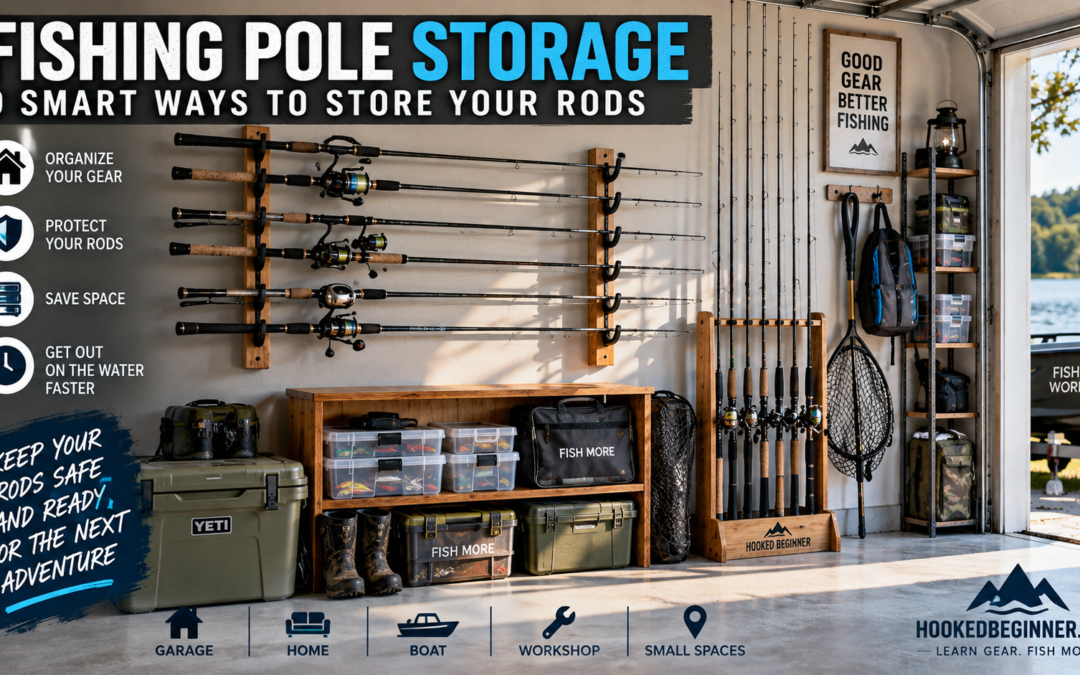
Finding the right fishing pole storage system can make a major difference in how easily you prepare for a fishing trip, protect your rods, and keep your gear organized. Rods are long, awkward to store, and easy to damage when they are left leaning in corners, piled on the floor, or mixed together with tackle.
A good storage system should do more than simply hold your fishing poles. It should keep rods separated, protect blanks and guides, reduce tangles, save space, and make it easy to find the exact setup you need.
This guide covers 9 fishing pole storage ideas for garages, homes, boats, workshops, and fishing areas. You will learn how to choose between vertical and horizontal storage, when a rack makes sense, when a holder is better, how to protect your reels and guides, and how to organize multiple fishing rods without creating a cluttered storage area.
For a broader overview of rods and how they are built, see the verified fishing rods guide.
Table of Contents
- Why Proper Fishing Pole Storage Matters
- 9 Fishing Pole Storage Ideas
- Vertical vs. Horizontal Storage
- Fishing Pole Storage in a Garage
- Fishing Rod Storage at Home
- Fishing Pole Storage on a Boat
- Fishing Rod Rack vs. Fishing Rod Holder
- Choosing the Right Storage Material
- How Much Storage Capacity Do You Need?
- How to Protect Rods While in Storage
- How to Organize Rods by Fishing Style
- Common Fishing Pole Storage Mistakes
- Rod Holder Options from Hooked Beginner
- Fishing Pole Storage Checklist
- Frequently Asked Questions
Why Proper Fishing Pole Storage Matters
Fishing rods are built to flex, but that does not mean they should be stored carelessly. A rod that is repeatedly knocked against hard surfaces, squeezed under heavy equipment, or left where the guides and blanks can collide with other objects can become damaged long before the angler expects it.
Good fishing pole storage solves several problems at once.
Protects rod blanks
The blank is one of the most important parts of a fishing rod. Storage should minimize unnecessary impacts, bending, and pressure on the blank.
Protects guides
Rod guides can become scratched, bent, or damaged if rods are thrown into a pile or stored where metal hardware can hit them repeatedly.
Reduces tangles
Rods stored together on the floor or in a corner often become tangled with fishing line, lure hooks, straps, and other equipment.
Saves space
Even a small collection of fishing rods can occupy a surprising amount of floor and wall space. A rack or organized holder makes much better use of vertical or wall-mounted space.
Makes fishing preparation faster
When every rod has a defined place, it is easier to find a spinning setup, bass setup, saltwater rod, spare rod, or other outfit without searching through a pile.
The International Game Fish Association also emphasizes the value of an organized tackle-storage system and returning equipment to a defined storage location after fishing. Read its tackle organization guide for additional storage ideas.
9 Fishing Pole Storage Ideas
1. Vertical fishing pole rack
A vertical rack stores fishing poles upright instead of laying them across the floor or against a wall.
Vertical fishing pole storage is useful when floor space is limited. The rods stand in individual positions, making it easier to separate different setups and quickly identify what you need.
A vertical arrangement is particularly useful for anglers who own several rods but have limited garage or workshop space.
Best for:
- Garages
- Workshops
- Fishing rooms
- Small storage areas
- Large collections of rods
2. Horizontal wall-mounted rod storage
Horizontal storage places rods along a wall, keeping them off the floor and creating a clean, organized display.
This style can be useful when you have a long uninterrupted wall and want your fishing rods to remain easily visible.
Horizontal racks can also make it easier to organize rods by category, such as freshwater spinning rods, heavier rods, or specialized setups.
3. Ceiling-mounted fishing rod storage
Ceiling storage uses overhead space that would otherwise remain unused.
This can be a practical solution in garages or workshops where wall and floor space are already occupied by tackle boxes, tools, boats, storage cabinets, or other equipment.
Ceiling-mounted storage should be positioned carefully so that rods are easy to access without striking vehicles, lights, doors, or other objects.
4. Portable rod rack
A portable rack allows you to move multiple rods at the same time.
This can be useful when transferring gear between your house, garage, vehicle, boat, dock, or another fishing location.
The main benefit is flexibility. Instead of having each rod permanently mounted, you can move the entire group of setups together.
5. Garage rod-storage station
A dedicated garage storage station can combine rod racks with tackle storage, line storage, tools, and other fishing equipment.
This is especially useful for anglers who want one location where they can rig rods, store spare tackle, and prepare for fishing trips.
For garage storage, keep rods away from areas where vehicles, bicycles, lawn equipment, or heavy tools can hit them.
6. Boat rod storage
Boats often include dedicated rod lockers or rod holders, but additional organization may still be useful.
Rods should be stored so they cannot slide around, strike each other, or become exposed to unnecessary vibration while the boat is moving.
Take Me Fishing's guide on maintaining fishing rods and reels specifically discusses using rod covers, keeping rods organized on boats, and using proper rod storage racks.
7. Freestanding rod rack
A freestanding rack can be placed wherever you need it without permanent wall installation.
This can be convenient for renters, temporary fishing stations, and anglers who frequently reorganize their storage area.
The main consideration is stability. A freestanding rack should remain secure when rods are added or removed.
8. Adjustable fishing pole storage system
An adjustable system allows storage positions to be changed as your collection grows.
This can be useful when you have rods with different lengths and reel sizes. Instead of forcing every setup into identical spacing, the storage system can be adjusted to suit the equipment.
9. Dedicated rod-and-reel storage cabinet
A storage cabinet provides additional protection by keeping rods and reels enclosed.
This approach can be useful when you want protection from dust, household activity, children, pets, or accidental impacts.
A cabinet can also provide space for fishing accessories such as spare line, terminal tackle, tools, and other equipment.
Vertical vs. Horizontal Storage
One of the first decisions in fishing pole storage is whether you want your rods stored vertically or horizontally.
| Storage Style | Main Benefit | Best Environment |
|---|---|---|
| Vertical | Uses limited floor space efficiently | Garages, workshops, small rooms |
| Horizontal | Keeps rods neatly along a wall | Garages, fishing rooms, long walls |
| Ceiling | Uses otherwise-unused overhead space | Garages and workshops |
| Freestanding | Easy to move | Temporary or flexible storage areas |
| Cabinet | Provides additional protection | Indoor storage rooms |
When vertical storage makes sense
Choose vertical storage when floor space is limited and you want each rod to have an identifiable position.
When horizontal storage makes sense
Choose horizontal storage when you have enough wall length and want easy visual access to your entire rod collection.
When ceiling storage makes sense
Choose overhead storage when your walls and floor are already being used for other equipment.
Fishing Pole Storage in a Garage
The garage is one of the most common locations for fishing pole storage, but it is also one of the easiest places to damage fishing rods accidentally.
Vehicles, bicycles, tools, lawn equipment, boxes, ladders, and other objects create constant impact risks.
Choose a dedicated storage zone
Instead of placing rods wherever there is an empty corner, create one clearly defined fishing-equipment area.
Keep rods away from vehicle traffic
Do not position your rack where car doors, trunks, bicycles, or moving equipment can strike the rods.
Keep reels accessible
If your rods remain assembled with reels attached, leave enough room to lift them from the rack without hitting neighboring setups.
Separate active and backup equipment
Store the rods you use most frequently in the easiest-to-reach positions. Less frequently used setups can occupy higher or less accessible positions.
Use wall space efficiently
Adding storage vertically or horizontally can free valuable garage floor space for other equipment.
Anglers who regularly work on their equipment may also find it useful to keep rods close to their tackle-preparation area rather than storing them in a completely separate part of the garage.
Fishing Rod Storage at Home
Indoor fishing rod storage is useful when you want to protect your equipment from temperature changes, dust, moisture, and accidental damage.
A dedicated room, closet, cabinet, or wall-mounted rack can work well.
Protect the tip
The rod tip is especially vulnerable because it is thin and exposed. Make sure the tip cannot contact hard surfaces during storage.
Protect the guides
Do not pile rods on top of one another where guides can strike blank sections or reel components.
Keep hooks secure
Remove loose hooks and lures from positions where they can catch clothing, furniture, or other rods.
Keep rods away from heat
Avoid storing fishing rods immediately beside heating equipment or in locations exposed to unnecessary heat.
For anglers who maintain several specialized setups, dividing the collection according to fishing style can make the storage area much easier to use.
Fishing Pole Storage on a Boat
Boat storage needs special attention because rods are exposed to movement and vibration.
When a boat is underway, loose rods can move, slide, or collide with other equipment. Proper storage prevents unnecessary wear and keeps setups ready to fish.
Keep rods secured
Use dedicated rod lockers or rod holders whenever possible.
Separate rods
Rod tips and guides should not repeatedly strike neighboring rods.
Use rod covers when appropriate
Covers can help keep rods separated and reduce tangles during transportation.
Protect reels
Reels should not be positioned where they can hit the boat deck or other hard objects.
Plan access
The rods you expect to use first should be stored where they can be removed quickly without disturbing the rest of the collection.
Fishing Rod Rack vs. Fishing Rod Holder
The terms fishing rod rack and fishing rod holder are sometimes used interchangeably, but they can refer to different storage purposes.
Fishing rod rack
A rack is generally intended to organize multiple rods. It may be freestanding, wall-mounted, vertical, horizontal, or designed for larger collections.
The main purpose is organization and storage capacity.
Fishing rod holder
A holder typically secures one rod or a smaller number of rods in a particular position. Holders are especially useful on boats, rails, walls, vehicles, or specialized fishing stations.
Hooked Beginner currently lists dedicated rod-holder products, including the verified Scotty 290 R 5-Rod Holder, Cannon Rod Holder, and Savage Gear MP Rodholder.
The site's verified fishing accessories category is another useful place to explore related equipment.
Choosing the Right Storage Material
The material used for your storage system affects durability, weight, moisture resistance, and long-term usability.
Plastic
Plastic storage systems are generally lightweight and can work well for indoor or protected environments.
Metal
Metal racks can provide strong structural support and are useful for larger collections, although corrosion resistance becomes important in damp or saltwater environments.
Composite materials
Composite materials can offer a balance between strength, weight, and resistance to certain environmental conditions.
Wood
Wooden storage can work well for indoor fishing rooms or workshops, especially when appearance is important.
The best material depends on where the rack will be installed and how heavily it will be used.
How Much Storage Capacity Do You Need?
Before buying a rack, count the rods you currently own and consider whether your collection will grow.
| Rod Collection | Storage Approach |
|---|---|
| 1–3 rods | Compact holder or small rack |
| 4–8 rods | Small wall-mounted or freestanding rack |
| 9–15 rods | Larger dedicated rack |
| 16+ rods | High-capacity system or multiple racks |
Do not buy storage based only on today's collection. Think about how many additional rods you are likely to acquire.
However, excessive unused capacity can also waste wall or floor space. The goal is a storage system that fits your collection without creating unnecessary clutter.
How to Protect Rods While in Storage
Keep rods separated
Separation prevents blanks, guides, handles, and reels from constantly contacting one another.
Avoid excessive pressure
Do not wedge rods tightly into a storage space just to fit one more setup.
Remove unnecessary hooks and lures
Loose hooks are a common source of tangles and can scratch other rods or nearby surfaces.
Check rod tips before storage
Make sure the tip is seated safely and cannot fall against the floor or another hard surface.
Clean rods before long-term storage
Remove dirt, sand, salt residue, and other contaminants before storing equipment for an extended period.
Keep reels protected
If your reels remain attached to the rods, give them enough clearance that they do not collide with neighboring equipment.
Proper care is especially important after saltwater fishing. Take Me Fishing's rod and reel maintenance resource recommends cleaning equipment after use and keeping rods protected during storage.
How to Organize Rods by Fishing Style
Good fishing pole storage is easier to maintain when the rods are grouped logically.
Group 1: General freshwater
Keep your most frequently used general-purpose rods together.
Group 2: Bass setups
Dedicated bass setups can be separated from lighter rods so you can quickly identify them when preparing for a bass trip.
Group 3: Saltwater equipment
Keep saltwater gear separate when possible so it can be inspected and maintained after each trip.
Group 4: Specialty rods
Ice-fishing rods, catfish rods, surf rods, fly setups, and other specialized equipment can be placed in separate storage positions.
Group 5: Backup rods
Less frequently used backup equipment can occupy higher or less accessible storage locations.
If you are still deciding which rod types you need, the verified fishing rod buying guide can help you understand the major selection factors.
Fishing Pole Storage for Small Spaces
Limited space does not mean you have to store fishing rods poorly.
Use vertical space
Wall-mounted or vertical storage can hold several fishing poles without taking over the floor.
Use narrow storage positions
Individual rod slots can often organize more equipment than a large open storage area.
Move backup rods higher
Keep daily-use rods at comfortable height and reserve less accessible positions for equipment you use less frequently.
Store tackle separately
Do not allow tackle boxes, tools, and loose accessories to occupy the same storage space as delicate rod sections.
Your verified fishing pole guide can also help you understand how different pole types are used before deciding how to organize them.
Common Fishing Pole Storage Mistakes
1. Leaning all rods against a wall
This creates unnecessary contact between rods and makes the entire collection easy to knock over.
2. Storing rods directly on the floor
Floor storage exposes equipment to impact, dirt, moisture, and accidental stepping.
3. Putting too many rods in one slot
Overcrowding makes rods difficult to remove and increases contact between guides, blanks, and reels.
4. Ignoring reel protection
A storage system must accommodate the complete setup if reels remain attached.
5. Leaving hooks exposed
Loose hooks can catch neighboring equipment and create unnecessary damage or injury risks.
6. Storing dirty or salty equipment
Salt, sand, and debris should be cleaned before long-term storage.
7. Choosing a rack without measuring the space
Measure the wall, ceiling, floor, and clearance before installing storage.
8. Buying too little capacity
A storage system that is already full when installed may become frustrating as your collection grows.
9. Storing rods where they are difficult to access
The best storage system should make the fishing rods easier to use, not create another obstacle before every fishing trip.
Rod Holder Options from Hooked Beginner
Hooked Beginner currently carries several rod-holder products that can be useful when organizing fishing equipment.
Scotty 290 R 5-Rod Holder
The verified Scotty 290 R 5-Rod Holder is designed around multiple rod storage and can be considered when you need more than a single rod position.
Cannon Rod Holder
The verified Cannon Rod Holder provides another dedicated rod-holder option for anglers organizing their fishing equipment.
Savage Gear MP Rodholder
The verified Savage Gear MP Rodholder adds another holder option for anglers who need a dedicated place to secure a fishing rod.
When comparing these types of products, pay attention to the intended mounting position, capacity, rod compatibility, installation requirements, and the environment where the holder will be used.
How to Build a Complete Fishing Storage Area
A good fishing room or garage station should organize more than rods.
Zone 1: Rod storage
Place your primary fishing pole storage system where rods can be accessed easily.
Zone 2: Reel maintenance
Keep cleaning supplies, soft cloths, and approved maintenance products in one defined location.
The verified fishing reel maintenance guide can be used as a reference when establishing a maintenance routine.
Zone 3: Tackle storage
Keep hooks, lures, weights, swivels, and terminal tackle separated and labeled.
Zone 4: Line storage
Store spare fishing line where it remains dry, organized, and protected from unnecessary damage.
Zone 5: Tools
Keep pliers, cutters, scissors, measuring tools, and other fishing accessories in a dedicated location.
Zone 6: Ready-to-fish setups
Reserve the easiest-to-access positions for rods that are already rigged and ready for the next trip.
Fishing Pole Storage for Long-Term Off-Season Storage
Long-term storage deserves a slightly different approach from everyday storage.
Before putting rods away for an extended period, inspect the line, clean the rod, remove hooks or lures, clean reel components according to the manufacturer's instructions, and make sure the storage area is dry and protected.
Do not simply place the entire fishing collection into a corner and forget about it until the next season.
A short maintenance routine before long-term storage can make it much easier to return to fishing later.
Fishing Pole Storage Checklist
- ☐ Every fishing rod has a defined storage position.
- ☐ Rods are separated from one another.
- ☐ Rod tips are protected.
- ☐ Guides are protected from impacts.
- ☐ Reels have enough clearance.
- ☐ Hooks and lures are secured.
- ☐ Storage is away from vehicle traffic.
- ☐ The storage area remains dry.
- ☐ Saltwater equipment is cleaned before storage.
- ☐ Frequently used rods are easy to reach.
- ☐ Specialty rods are separated by type.
- ☐ Backup equipment has a dedicated location.
- ☐ Storage capacity allows some future growth.
- ☐ The rack or holder is stable and properly installed.
- ☐ Tackle and tools are stored separately from delicate rod components.
Frequently Asked Questions
What is the best fishing pole storage method?
The best storage method depends on the number of rods you own, available space, and whether you need portability. Vertical racks work well where floor space is limited, while horizontal and wall-mounted systems work well where there is enough wall length.
Should fishing rods be stored vertically or horizontally?
Either can work. The important factors are stability, protection, separation, accessibility, and whether the storage system supports the rods without unnecessary pressure or contact.
Can I store fishing rods in my garage?
Yes. A garage can be an excellent fishing-storage area, especially when rods are kept in a dedicated rack away from vehicle traffic, tools, moisture, and accidental impacts.
Is a fishing rod rack better than individual holders?
It depends on the application. A rack is usually more useful for organizing multiple rods, while individual holders can be better when rods need to be secured in specific positions such as on a boat or fishing station.
How should I store fishing rods with reels attached?
Use storage that provides enough clearance for the reel bodies and handles. The reels should not collide with neighboring rods or other hard objects.
Should I remove lures before storing fishing rods?
Removing loose lures and hooks can reduce tangles, scratches, and accidental snagging. It also makes it easier to inspect and clean the equipment.
How many fishing rods can one storage rack hold?
Capacity varies by product. Always check the manufacturer's stated capacity and make sure there is enough spacing for the complete rod-and-reel setup.
How should I store fishing rods on a boat?
Use dedicated rod lockers or rod holders when available. Keep rods separated and secured so vibration and movement do not cause unnecessary contact or damage.
How do I store fishing rods in a small apartment?
Vertical wall-mounted storage can make better use of limited space than floor storage. Choose a location where the rods are protected and easy to access.
Should fishing rods be stored in a corner?
A corner can work temporarily, but it is generally less organized and provides less protection than a dedicated rack or holder.
How do I protect fishing rods during long-term storage?
Clean the equipment, remove loose terminal tackle, inspect guides and line, protect the rod tips, and store the rods in a stable rack or protected storage area.
Final Fishing Pole Storage Guide
The right fishing pole storage system should make your fishing equipment easier to protect, organize, and use.
For small collections, a compact holder may be enough. As your collection grows, vertical racks, horizontal wall storage, freestanding systems, or larger dedicated storage stations can make better sense.
The most important principles are simple: separate the rods, protect the blanks and guides, secure the reels, keep hooks controlled, avoid unnecessary pressure, and choose a storage location that protects your equipment from impacts, moisture, and clutter.
Before choosing a storage system, count your rods, measure the available space, consider whether your rods remain assembled with reels, and think about how many additional setups you may add later.
When your rods have a proper home, every fishing trip starts more smoothly. You spend less time searching through clutter and more time preparing the equipment you actually want to fish.
Explore the verified Hooked Beginner fishing rods collection, fishing pole guide, and fishing accessories to organize the rest of your fishing setup.