
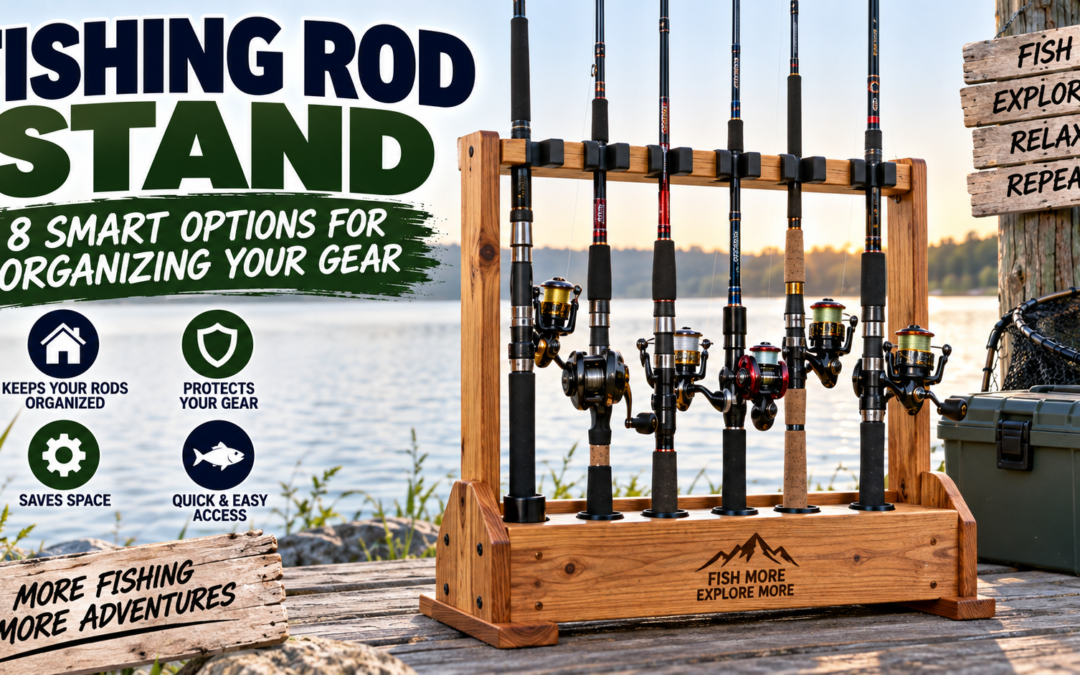
A fishing rod stand gives anglers a simple way to keep rods upright, separated, protected, and ready for the next trip. Instead of leaning rods against a wall, leaving them on the floor, or piling them into a corner, a dedicated stand creates an organized storage point where every rod has a defined place.
The right fishing rod stand can also make a difference in how easily you access your gear. A small stand may work well for a few freshwater rods, while a larger floor rack can accommodate a growing collection of spinning rods, casting rods, surf rods, and other setups.
Rod storage should reflect how and where you fish. A garage setup may prioritize capacity and stability, while a compact home setup may need to conserve floor space. Boat anglers may need a different approach again, especially when storage has to fit into a limited area.
This guide covers eight practical fishing rod stand options, explains what to look for before buying or building one, and shows how to choose a stand based on rod collection, available space, accessibility, protection, and fishing style.
What Is a Fishing Rod Stand?
A fishing rod stand is a freestanding or semi-freestanding storage system designed to hold fishing rods securely when they are not being used. Most stands position rods vertically, although some designs combine upright storage with horizontal supports.
Unlike a simple wall hook, a stand does not necessarily require permanent attachment to a wall. That makes it useful for renters, garages, workshops, sheds, boats, or fishing rooms where the storage location may change.
A basic stand normally includes several rod slots, tubes, clips, or cradles. More advanced designs may provide separate spaces for reels, accessories, or different rod configurations.
Take Me Fishing notes that fishing rods vary considerably in length, power, material, and intended use, so storage needs can also vary depending on the equipment being stored. See the fishing rod selection guide.
Why Use a Fishing Rod Stand?
Leaving fishing rods in random locations creates several avoidable problems. Rods can be knocked over, stepped on, crushed beneath other equipment, or exposed to clutter that makes them difficult to find.
A dedicated stand creates a predictable storage location. This becomes increasingly useful as your collection grows.
Better Rod Protection
Fishing rods are relatively slender pieces of equipment and can be damaged by impacts, pressure, or careless storage. Keeping rods separated reduces the chance that blanks, guides, handles, or reels will become tangled with other gear.
Faster Access
When every setup has a designated position, you can grab the rod you need without moving several other rods out of the way first.
Less Floor Clutter
A properly designed fishing rod stand keeps rods concentrated in one defined area instead of allowing them to spread across a garage, workshop, basement, or fishing room.
Easier Inventory Control
Organized storage also makes it easier to see what equipment you actually own. This can help prevent buying another rod simply because an existing setup was hidden behind other gear.
For broader tackle organization ideas, the International Game Fish Association tackle organization guide recommends creating organized storage systems and returning equipment to designated storage after fishing.
8 Fishing Rod Stand Options
1. Vertical Floor Fishing Rod Stand
A vertical floor stand is one of the simplest storage solutions for anglers who want quick access without installing anything on a wall.
Rods stand upright in individual slots or tubes while the base supports the lower portion of each rod. A properly designed base distributes weight and helps prevent the rack from tipping.
This style works especially well in garages, workshops, tackle rooms, cabins, and other locations where floor space is available.
Vertical storage also makes it easy to group rods by fishing style. For example, spinning rods can occupy one section while casting rods and heavier setups use another.
2. Multi-Rod Fishing Rod Stand
A multi-rod stand is designed for anglers who have more than a few setups. Instead of storing one or two rods, these racks can hold several rods in separate positions.
The biggest advantage is capacity. A multi-rod system can prevent a growing rod collection from becoming a pile of equipment leaning against a wall.
Before choosing one, look at the number of usable slots rather than assuming that the advertised capacity will suit every rod-and-reel combination. Large reels and oversized handles may require more room than thin freshwater rods.
3. Compact Fishing Rod Stand
A compact stand is useful when space is limited. It may hold fewer rods, but its smaller footprint can make it suitable for apartments, bedrooms, small garages, storage rooms, or corners of a workshop.
Compact storage is particularly useful for anglers who own a small number of frequently used rods and do not need a large rack.
The key consideration is balance. A very narrow stand may save floor space, but it still needs enough base width and weight to remain stable when rods are removed or added.
4. Heavy-Duty Fishing Rod Stand
Heavy-duty stands are designed for larger collections, heavier equipment, or environments where the storage system needs to remain particularly stable.
These stands may use thicker materials, wider bases, reinforced joints, or stronger rod supports. They can be appropriate for garages, workshops, commercial fishing spaces, or anglers who store numerous heavy rods.
Capacity should still be checked carefully. A stand designed for many lightweight rods is not automatically suitable for an equal number of heavy setups.
5. Adjustable Fishing Rod Stand
An adjustable design gives you more flexibility when storing rods of different lengths or configurations.
This can be useful if your collection includes short freshwater rods alongside longer rods. Adjustable supports can allow the stand to accommodate different equipment without forcing every rod into the same storage position.
Adjustability is especially valuable for anglers whose equipment changes frequently. As your rod collection grows, a flexible system may remain useful longer than a fixed rack built around one narrow configuration.
6. Portable Fishing Rod Stand
A portable stand is designed for anglers who need to move their rods between locations. Instead of permanently installing storage in one room, you can move the stand between a garage, fishing cabin, workshop, or other storage area.
Portability can also be useful when organizing rods before a fishing trip. You may be able to group several rods together, move them safely, and then return the stand to storage afterward.
Look for a design that is easy to carry without becoming unstable when loaded with rods.
7. Fishing Rod Stand With Reel Storage
Some stands are designed around complete rod-and-reel combinations rather than bare rods.
This approach can make sense when you usually store your equipment fully assembled. The stand needs enough clearance for reel bodies, handles, bails, line, and other components.
Reel clearance deserves special attention. A rack that appears wide enough for rod blanks may become crowded once several reels are installed.
Take Me Fishing describes the rod and reel as complementary components that need to work together as a balanced setup, which is also important when planning storage for complete combinations. Review the rod-and-reel setup basics.
8. Custom or DIY Fishing Rod Stand
A custom stand allows you to build storage around your exact rod collection and available space.
You might build a simple wooden stand for a garage, create a PVC design for lightweight rods, or combine shelving with dedicated rod slots.
The advantage is customization. You can control the number of positions, spacing, height, finish, and overall footprint.
The disadvantage is that poor construction can create an unstable storage system. The base, joints, and rod supports must be strong enough for the intended load.
Fishing Rod Stand Comparison
| Stand Type | Best For | Main Advantage | Important Consideration |
|---|---|---|---|
| Vertical floor stand | Garages and fishing rooms | Easy access | Requires floor space |
| Multi-rod stand | Large collections | High capacity | Needs adequate spacing |
| Compact stand | Small spaces | Small footprint | Check stability |
| Heavy-duty stand | Large or heavy setups | Added strength | Can be larger and heavier |
| Adjustable stand | Mixed rod collections | Flexible configuration | More moving parts |
| Portable stand | Anglers who move gear | Easy relocation | Needs a stable base |
| Reel-storage stand | Fully assembled setups | Stores rods and reels together | Needs reel clearance |
| DIY stand | Custom storage projects | Fully customizable | Construction quality matters |
How to Choose the Right Fishing Rod Stand
The right fishing rod stand depends on more than the number of rods you own. Think about the room, the types of rods, reel sizes, how frequently you use them, and how much space is available.
1. Count Your Rods
Start with the number of rods you currently own. Then consider whether your collection is likely to grow.
Buying a stand with exactly enough spaces for today's collection may leave you needing another rack shortly afterward. At the same time, a huge stand for three rods can waste valuable floor space.
2. Measure the Available Space
Measure the area before buying or building storage.
Record the available width, depth, and height. Do not measure only the empty floor. Also consider doors, cabinets, vehicles, workbenches, and pathways that need to remain accessible.
3. Consider Rod Length
Rod length matters when planning vertical storage. A long rod may require substantial ceiling clearance, especially when reels remain attached.
Take Me Fishing explains that rod length affects casting characteristics and that rods vary substantially in size. Its rod-selection guide notes that longer rods can provide greater casting distance while shorter rods can provide different handling advantages. Read the rod-selection guide.
For a deeper explanation of length, see Hooked Beginner's fishing rod length guide.
4. Leave Enough Rod Spacing
Rod slots should be wide enough that equipment can be removed without constantly hitting neighboring rods.
Spacing becomes even more important when multiple rods have reels attached. Spinning reels may occupy considerably more lateral space than the rod blank alone suggests.
5. Check Base Stability
A tall stand needs a stable base. The higher the rods extend above the base, the more important overall stability becomes.
A stand should not rock excessively when a rod is removed. Test it with the expected load rather than evaluating the empty rack only.
6. Match the Stand to Your Rod Types
Think about the equipment you own.
Spinning rods, casting rods, surf rods, trolling rods, and heavier specialty rods may require different amounts of clearance.
For a broader understanding of rod categories, explore the Hooked Beginner fishing rods guide and the fishing pole guide.
7. Decide Whether Reels Stay Attached
Some anglers remove reels when storing rods for long periods. Others keep their most frequently used setups fully assembled.
If reels remain attached, choose a stand that provides sufficient clearance for the reel body, handle, bail, and line.
8. Think About Access
Storage should not become an obstacle. A stand positioned behind boxes, vehicles, or other equipment may technically hold the rods while still making access frustrating.
Place the rack where you can remove rods without hitting nearby objects.
Choosing a Fishing Rod Stand for a Garage
Garages often provide more storage space than other parts of the home, making them suitable for larger racks.
A garage fishing rod stand should be positioned away from vehicle traffic, heavy tools, and areas where equipment could be knocked over.
Keep rods away from locations where doors, ladders, bicycles, or boxes can strike them.
Vertical floor racks can work particularly well because they consolidate numerous rods into one defined footprint. A larger workshop can also combine a rod stand with shelves or cabinets for tackle and other equipment.
Choosing a Fishing Rod Stand for a Small Home
Small spaces require more careful planning.
A compact stand can fit into a corner without requiring an entire wall. Another approach is to select a narrow vertical design that uses height rather than width.
Measure the space before ordering anything. Consider whether rods will interfere with ceiling fans, doors, windows, closets, or walking paths.
A smaller stand is often more practical than trying to force a large storage system into a room that cannot accommodate it.
Choosing a Fishing Rod Stand for a Boat
Boat storage presents different challenges because space is limited and equipment may be exposed to movement and vibration.
A freestanding stand may not always be appropriate on a moving boat unless it is specifically designed and secured for that environment.
For boat storage, consider whether rods need to be secured against movement and whether a fixed marine rod holder or rack is more appropriate than an ordinary floor stand.
Saltwater anglers should also consider corrosion-resistant materials and rinse equipment after use when appropriate.
Vertical vs. Horizontal Rod Storage
Vertical storage and horizontal storage solve different space problems.
| Feature | Vertical Stand | Horizontal Storage |
|---|---|---|
| Floor space | Usually requires a defined floor footprint | Can reduce floor use when wall-mounted |
| Long rods | Requires sufficient ceiling clearance | Useful where vertical height is limited |
| Access | Quick grab-and-go access | Can work well for protected storage |
| Mobility | Freestanding versions can be moved | Usually fixed to a structure |
| Installation | Little or no permanent installation | Usually requires mounting |
The best choice depends on the room rather than a universal rule. A vertical fishing rod stand may be more convenient in a garage with open floor space, while horizontal storage may make better use of an empty wall.
What Materials Should a Fishing Rod Stand Use?
Rod stands can be made from wood, metal, plastic, PVC, composite materials, or combinations of several materials.
Wood
Wood can provide a strong and attractive storage solution, particularly for garages, cabins, workshops, and home fishing rooms.
Wooden stands can also be customized relatively easily with different finishes, dimensions, and slot arrangements.
Metal
Metal stands can provide strength and rigidity. Steel or aluminum designs may be appropriate for heavier rod collections, depending on the specific construction.
Plastic
Plastic can be lightweight and easy to clean. The specific material and construction quality matter because not every plastic stand is designed for heavy loads.
PVC
PVC is commonly considered for DIY rod storage because it can be cut and assembled into different configurations.
The important consideration with any DIY material is whether the finished structure remains stable under the actual weight of the rods and reels.
How to Keep Rods Safe in a Stand
A stand protects rods only when the storage system is used correctly.
- Keep rod blanks from being crushed by other equipment.
- Do not overload slots beyond the stand's intended capacity.
- Keep rods away from sharp tools and heavy objects.
- Prevent reels from rubbing against neighboring equipment.
- Store rods where they are unlikely to be knocked over.
- Keep hooks and lures secured rather than leaving them loose around rod handles and guides.
After fishing, inspect your equipment before storage. Removing dirt, moisture, and loose tackle can make the next trip easier and can help you notice damage before it becomes a larger problem.
DIY Fishing Rod Stand: Basic Planning
A simple DIY fishing rod stand can be built around a few basic principles: stable base, adequate rod spacing, protected contact points, and enough height for the rods being stored.
Start With Measurements
Measure your longest rod and your largest reel. Then decide how many complete setups the stand needs to hold.
Build a Stable Base
The base should be wide and strong enough that the rack remains stable when rods are inserted or removed.
Protect Rod Contact Points
Where rods touch the stand, use smooth and rounded surfaces rather than sharp edges that could scratch or damage equipment.
Test Before Loading Fully
Place several rods into the stand and check for movement before filling every available position.
Do not assume that a lightweight DIY frame can safely carry a large collection simply because the rods fit physically.
Common Fishing Rod Stand Mistakes
Buying for Capacity Alone
A stand with many slots is not automatically better. If those slots are too close together, rods and reels can become crowded.
Ignoring Reel Size
Rod blanks are thin, but reels are wider and more complicated. Always account for the full setup.
Using an Unstable Base
A narrow or lightweight base can cause the entire rack to move when rods are added or removed.
Putting the Stand in a High-Traffic Area
Even a strong stand cannot protect rods from repeated collisions with vehicles, doors, bikes, tools, or people.
Overloading the Rack
Capacity should be treated as a real storage limit, not simply a suggestion. Keep heavier rods and reels within the stand's intended load range.
Storing Wet Equipment Immediately
After fishing, give equipment appropriate time to dry and inspect it before putting it away for long-term storage.
Fishing Rod Stand Buying Checklist
| Check | What to Ask |
|---|---|
| Capacity | How many rods do I need to store? |
| Rod type | Will it fit spinning, casting, surf, or specialty rods? |
| Reel clearance | Will fully assembled reels fit without touching? |
| Stability | Does the base remain steady when rods are removed? |
| Footprint | Will it fit without blocking walkways or doors? |
| Height | Is there enough vertical clearance? |
| Material | Is the construction appropriate for the intended load? |
| Portability | Does the rack need to move between locations? |
| Protection | Are rod contact points smooth and secure? |
| Future capacity | Will it accommodate additional rods later? |
Related Rod Guides From Hooked Beginner
Your storage system should complement the equipment you actually use. Before choosing a rack, review the fishing rod buying guide to understand the specifications that matter when selecting rods.
You can also learn how rod length affects fishing with the fishing rod length guide, then review the fishing rod power guide and fishing rod action guide when organizing different setups by application.
Take Me Fishing also recommends considering where you will fish and what bait or lures you plan to use when selecting a rod. Read its rod-selection guidance.
Frequently Asked Questions About Fishing Rod Stands
What is the best fishing rod stand for a garage?
A stable vertical floor stand can be practical in a garage because it can store several rods while keeping them accessible. The correct size depends on your rod count, reel sizes, available floor space, and ceiling height.
Can a fishing rod stand hold rods with reels attached?
Yes, but the stand needs adequate spacing and clearance around the reel body, handle, bail, and other components. Check the design before assuming that every slot will fit a fully assembled rod.
How many rods should a fishing rod stand hold?
Choose capacity based on your current collection and realistic future needs. A small stand can suit a few frequently used rods, while a larger collection may require a multi-rod system.
Is vertical storage better than horizontal storage?
Neither is universally better. Vertical storage can provide convenient access and mobility, while horizontal storage can make efficient use of wall space. The choice depends on the room and rod collection.
Can I build my own fishing rod stand?
Yes. DIY stands can be made from materials such as wood or PVC, provided the finished structure has a stable base, sufficient spacing, smooth rod contact points, and enough strength for the intended load.
Should rods be stored with reels attached?
That depends on how you use your equipment. Keeping reels attached is convenient for frequently used setups, while separating components can reduce the size and complexity of long-term storage.
Where should I place a fishing rod stand?
Choose a dry, low-traffic location away from vehicles, doors, heavy tools, and falling objects. The area should also allow you to remove rods without hitting surrounding equipment.
How do I stop a fishing rod stand from tipping over?
Use a stand with a sufficiently wide and stable base, avoid overloading it, distribute rods evenly, and place it on a level surface. Tall racks require particular attention to stability.
What should I look for in a fishing rod stand?
Focus on capacity, stability, rod spacing, reel clearance, materials, footprint, height, portability, and compatibility with the rods you actually own.
Final Thoughts
The right fishing rod stand should make your fishing equipment easier to store, easier to access, and less vulnerable to accidental damage.
Start by counting your rods and measuring the available space. Then consider rod length, reel size, stand capacity, base stability, material, and whether you need a portable or permanent solution.
A small collection may only need a compact stand, while a serious angler with many complete setups may benefit from a larger multi-rod system. The important thing is to match the storage system to the equipment rather than buying based on capacity or appearance alone.
Good storage is part of good gear management. After each trip, inspect your rods, remove loose tackle, clean and dry equipment appropriately, and return every setup to its designated position.
With a properly sized fishing rod stand, your rods stay organized and ready for the next day on the water.