
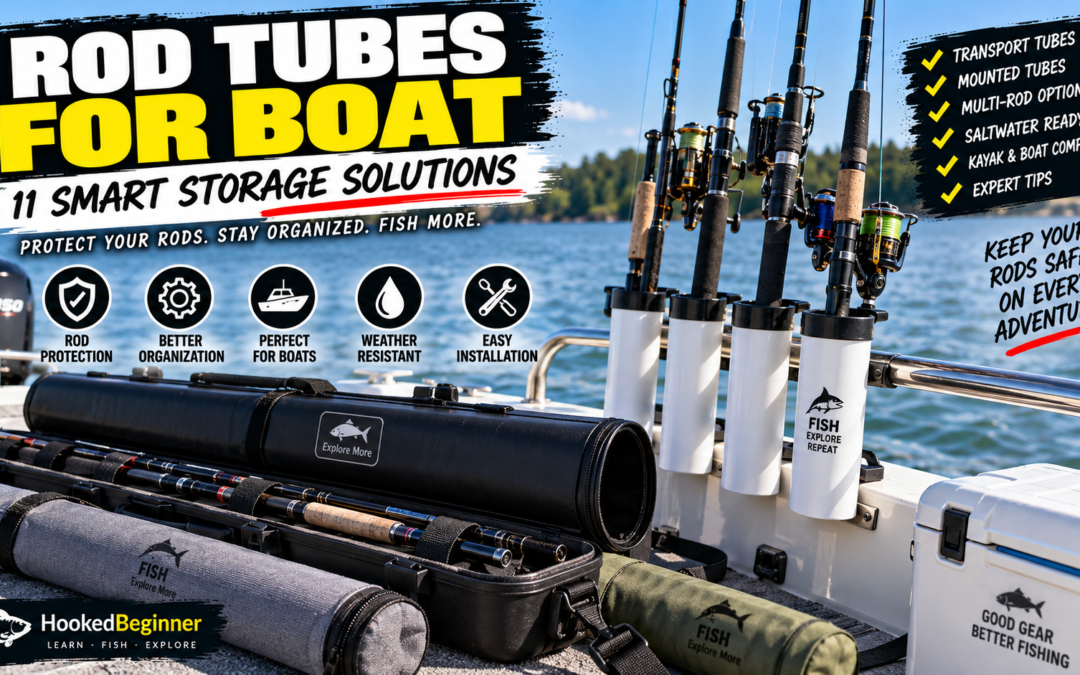
Rod tubes for boat storage can help protect fishing rods while keeping them organized, accessible, and separated from other equipment. Boat decks can become crowded quickly, and loose rods are exposed to impacts, tangles, stepped-on sections, wet surfaces, and accidental drops.
A properly selected rod tube can provide a dedicated place for a fishing rod while also helping protect the blank, guides, reel, and tip. Some tubes are designed mainly for transporting and protecting disassembled rods, while others are open-ended holders intended to remain mounted on a kayak, boat, or pontoon during fishing.
The difference is important. A long protective tube used for transporting a two-piece rod is not the same product as a short mounted tube used to hold a rod butt while fishing. Your boat layout, rod length, reel style, fishing technique, and storage requirements should determine which design makes sense.
Rod tubes also come in different materials and configurations. Rigid PVC systems, hard cases, fabric-covered tubes, composite holders, and mounted open-ended tubes all have different purposes. Shimano, for example, currently offers rod tubes in several lengths and uses rigid PVC in its transport systems, while RAILBLAZA offers a mounted Rod Tube designed for boats, kayaks, and pontoons. See Shimano's rod tube range and view the RAILBLAZA Rod Tube.
This guide explains 11 practical rod-tube solutions, how they differ, how to match tube dimensions to your rods, where to install mounted tubes, what materials to look for, common mistakes, and how to build a secure boat-storage system.
1. Introduction to Rod Tubes for Boat Storage
Boat fishing creates a storage problem that does not always exist when fishing from shore. A rod that can simply be leaned against a wall at home cannot safely be left loose on a moving boat. Waves, acceleration, casting, other anglers, and equipment movement can all create opportunities for damage.
A dedicated rod tube provides a defined storage location. Depending on its design, it can protect a complete rod during transportation or hold the butt section of a rod while the angler fishes.
The best setup is rarely about buying the largest tube available. Instead, it is about matching the tube to the actual job:
- Transporting rods between storage and the boat.
- Protecting rod sections during travel.
- Keeping unused rods away from the deck.
- Holding rods vertically or at a controlled angle.
- Keeping reels away from splashing water.
- Organizing multiple rods without tangling them.
- Creating quick access to frequently used setups.
Some boat anglers need only a few compact mounted holders, while others need long protective tubes for transporting several multi-piece rods. Understanding this distinction will make the buying process much easier.
2. What Are Rod Tubes for Boat?
Rod tubes for boat are cylindrical or tube-shaped storage systems used to protect, transport, or hold fishing rods in marine and small-craft environments.
Transport rod tubes
Transport tubes are usually long enough to contain rod sections. Their purpose is protection rather than quick access during active fishing. A rigid tube can help shield rod sections from impacts during transportation.
Modern transport systems may combine a rigid inner structure with an external fabric layer, carrying handles, shoulder straps, or zippered closures.
Mounted rod tubes
Mounted tubes are shorter and generally function more like rod holders. They can be attached to a kayak, boat deck, rail, track system, or other mounting point.
RAILBLAZA describes its Rod Tube as an open-ended tube for spinning, baitcasting, and fly setups and specifies that it mounts to its StarPort system. Review the RAILBLAZA Rod Tube.
Protective rod cases
A protective case can be considered a tube-style storage system when its primary purpose is protecting the rod during transportation. These designs can be especially useful for anglers moving equipment from a vehicle to the boat.
Tube-style rod holders
Tube-style holders have an opening large enough to accept the butt section of a fishing rod. They are commonly used when the angler needs a rod to remain upright or positioned at a particular angle.
RAM Mounts, for example, offers tube-style fishing rod holders with different mounting configurations. See the RAM Tube Rod Holder.
3. Why Rod Tubes Matter: 11 Practical Benefits
1. Protection from impact
A protective tube can keep rod sections from contacting hard surfaces, tools, tackle boxes, vehicle interiors, and other equipment.
2. Reduced tangling
Separate storage positions prevent multiple rods from becoming tangled together with lines, lures, or other rods.
3. Better deck organization
A mounted tube can remove a rod from the deck and create a dedicated storage position.
4. Easier transportation
Long rod tubes make it easier to carry multiple rod sections without exposing them to unnecessary knocks.
5. Tip protection
The most delicate part of many rods is the tip section. A protective tube can reduce the chance of the tip striking another object during transportation.
6. Faster access
A mounted tube positioned within reach can keep a frequently used rod available without requiring the angler to search through a pile of equipment.
7. Separation from wet surfaces
Tube-style storage can keep rod butts and reel areas away from standing water on a deck.
8. More controlled rod positioning
A properly installed tube can hold a rod at a useful angle instead of allowing it to roll freely across a deck.
9. Safer equipment transport
A protected rod is less likely to become caught underneath other equipment during loading and unloading.
10. Better multi-rod organization
Separate storage positions make it easier to identify a specific rod when several setups are carried on the same trip.
11. Easier long-term storage
Protective tubes can also be useful when rods are stored between fishing trips, especially when space is shared with other equipment.
A rod tube should be considered part of the complete equipment system. Your rod length, power, action, and intended use all influence what storage solution will work. Use HookedBeginner's fishing rod buying guide when reviewing these specifications.
4. 11 Rod Tubes for Boat Storage Solutions
1. Rigid transport rod tubes
Rigid transport tubes are designed primarily to protect rod sections while traveling. They provide a physical barrier around the rods and are particularly useful when the equipment is moved in a truck, car, trailer, or boat-storage compartment.
These systems are available in different lengths, so the tube should be selected according to the rod sections being stored.
2. Hard-case rod tubes
Hard cases provide another level of protection when rods are exposed to heavy handling. They can be useful for anglers who frequently travel with specialized rods.
Hard cases are typically larger than simple soft sleeves, but the extra protection can be useful when transporting valuable equipment.
3. Fabric-covered rigid tubes
A fabric-covered rigid tube combines a hard internal structure with an outer protective material. This can provide a balance between rigidity, portability, and protection.
Shimano currently offers rod tubes using cloth-covered PVC construction in multiple lengths. Review the Shimano specifications.
4. Open-ended mounted rod tubes
Open-ended tubes are designed for active fishing rather than long-distance transport. The rod butt can be placed into the tube while the upper section remains free.
This arrangement can be useful when an angler needs quick access and wants to keep the rod secured in a predictable location.
5. Rail-mounted rod tubes
Rail-mounted systems attach to compatible boat rails or mounting structures. Their main advantage is using existing structural space instead of consuming valuable deck area.
Check the rail diameter and mounting hardware carefully before installation.
6. Track-mounted rod tubes
Track-mounted systems can provide more flexibility because the mounting position can often be adjusted along the track. This makes them useful for boats or kayaks where fishing positions change frequently.
7. Flush-mounted tube holders
A flush-mounted tube is installed into a surface rather than standing above it on a conventional arm. The result can be a cleaner installation with less equipment extending into the walking area.
Installation requires careful measurement because the mounting surface must accommodate the tube and hardware.
8. Adjustable tube holders
Adjustable tube holders allow the angle of the rod to be changed. This can be useful when the same storage location needs to accommodate different fishing positions or techniques.
RAM's tube-holder systems provide examples of designs with adjustable positioning. See the RAM Tube Fishing Rod Holder with Deck Track Base.
9. Kayak rod tubes
Kayaks have limited space, making compact rod tubes particularly useful. A narrow tube can protect the rod butt while keeping the reel above the deck or splash zone.
Before installing a tube on a kayak, make sure the mounting position does not interfere with paddling, seating, fish handling, or other essential equipment.
10. Multi-rod transport tubes
Some protective tubes are designed to carry multiple rod sections. The interior capacity should be evaluated carefully because packing too many sections together can create contact and abrasion.
Internal separators can be valuable when several rod sections share the same case.
11. Long surf and travel rod tubes
Long rods require long protection systems. Surf rods and other long multi-piece rods can require tubes that are substantially longer than those used for compact freshwater rods.
Shimano's current range includes different tube lengths designed around different rod configurations. See Shimano's rod tube lineup.
5. Rod Tubes for Boat Comparison Table
| Tube Type | Main Purpose | Protection | Portability | Active Fishing |
|---|---|---|---|---|
| Rigid transport tube | Rod transportation | High | Good | Low |
| Hard-case tube | Maximum transport protection | Very high | Moderate | Low |
| Fabric-covered rigid tube | Protection and transportation | High | Very good | Low |
| Open-ended mounted tube | On-water storage | Medium | Excellent when mounted | High |
| Rail-mounted tube | Boat organization | Medium | Excellent | High |
| Track-mounted tube | Flexible positioning | Medium | Excellent | High |
| Flush-mounted tube | Low-profile storage | Medium | Low after installation | High |
| Adjustable tube holder | Position control | Medium | Excellent | High |
| Kayak tube | Compact rod storage | Medium | Excellent | High |
| Multi-rod tube | Multiple rod transport | High | Good | Low |
| Long surf/travel tube | Long rod protection | High | Good | Low |
The comparison shows why there is no single tube design for every boat. A transport tube is selected according to rod-section length and protection needs, while a mounted tube is primarily selected around boat layout, mounting compatibility, rod access, and stability.
6. How to Choose Rod Tubes for Boat Storage
Measure the rod sections
Start with the longest section that needs to fit inside the tube. Do not estimate from the rod's advertised total length alone. A two-piece rod advertised as 7 feet long has sections much shorter than 7 feet.
Your storage tube needs to accommodate the actual section length with enough room for safe insertion and removal.
HookedBeginner's fishing rod length guide can help when comparing rod-length terminology and different rod configurations.
Check tube diameter
Length is not enough. The internal diameter must accommodate the rod section, guides, and any other components intended to remain inside the tube.
Consider your reel
A mounted open-ended tube may hold only the butt section of a rod, while a transport tube may be designed for rod sections with the reel removed.
Determine whether your storage system is intended for the complete rod, separate rod sections, or only the rod butt.
Choose the right mounting style
Boat rails, track systems, decks, gunnels, kayak mounting plates, and other surfaces may require different mounting hardware.
Never assume that a tube will fit a particular mounting system simply because both products are marketed for boating. Check compatibility before drilling or permanently installing anything.
Think about access
A tube can be protective but still inconvenient if it is placed behind seats, beneath other equipment, or too close to another rod holder.
Choose a location that allows you to insert and remove the rod without striking other equipment.
Consider water exposure
Boat storage systems can encounter spray, rain, and splashing water. Drainage and drying become particularly important for open-ended holders.
RAM's tube-style rod holder, for example, includes drainage openings at the bottom to help prevent water from pooling inside the holder. View the RAM Tube Rod Holder specifications.
Match the tube to the fishing environment
A small freshwater boat, fishing kayak, offshore boat, and surf-travel setup can have very different storage requirements. Choose the system around your actual environment rather than selecting based only on appearance.
Consider future rod purchases
If you are building a storage system rather than buying one tube for a single rod, consider how many different rod lengths and types you expect to carry.
7. Best Use Cases for Rod Tubes on Boats
Freshwater bass boats
Bass anglers may carry multiple rods rigged for different techniques. Dedicated storage positions can keep those setups organized and reduce unnecessary movement across the deck.
Fishing kayaks
Space is limited on kayaks, so compact mounted tubes can be useful. A good position should keep the rod accessible without interfering with paddle strokes or movement around the seat.
Pontoon boats
Pontoons usually provide more usable space, allowing anglers to consider larger storage systems and multiple tube positions.
Guide boats
Guides may need to accommodate multiple anglers and many rods. Organized tube storage can help keep equipment in predictable locations and reduce clutter.
Traveling anglers
Transport tubes are valuable when rods must travel by vehicle before reaching the boat. The tube provides a protective layer between the rod and other luggage.
Long surf rods
Long surf rods require appropriately sized protective systems. The tube needs enough internal length to hold the sections without forcing them into an unnatural position.
Saltwater fishing
Saltwater environments increase the importance of material selection, drainage, cleaning, and corrosion-resistant hardware.
Trolling setups
Mounted tube holders can provide a convenient storage position between active fishing tasks. However, rod placement and tube strength must be appropriate for the actual fishing technique.
Multi-species boat setups
An angler targeting multiple species may carry rods of different lengths, powers, and actions. A modular storage system can make it easier to keep those rods organized.
For choosing the rods themselves, see HookedBeginner's fishing rod power guide and fishing rod action guide.
8. Rod Tube Materials, Mounting, and Setup
PVC
PVC is commonly used for rigid rod transport tubes because it provides a firm protective structure without requiring a solid metal enclosure. Some manufacturers combine PVC with fabric coverings for additional handling protection.
Composite materials
Mounted tube holders may use strong composite materials. These can be useful when the holder needs to remain relatively light while resisting normal on-water use.
Hard-shell materials
Hard cases provide a more rigid barrier around rod sections. They are particularly useful for transport when equipment may be exposed to bumps or pressure.
Fabric coverings
A fabric outer layer can provide carrying comfort and protect the exterior of a rigid tube from scratches.
Internal padding
Padding or liners can reduce direct contact between the rod and the interior of the tube. This can be useful when the rod will be transported frequently.
Drainage
Mounted open-ended tubes should allow accumulated water to escape. Standing water inside a holder can create unnecessary moisture exposure around the rod butt and reel area.
Mounting hardware
The mounting hardware should be compatible with the boat structure. Depending on the system, installation may involve a track base, rail attachment, flush base, deck plate, or another mounting interface.
Leashes and secondary security
On kayaks and other small craft, a secondary leash can provide an additional layer of security. RAILBLAZA specifically highlights its leash loop on the Rod Tube and recommends securing the holder appropriately. Review the manufacturer's Rod Tube information.
Positioning the tube
Before drilling, temporarily position the tube and simulate inserting and removing a rod. Check whether the rod conflicts with seats, electronics, paddles, tackle boxes, other holders, or walking areas.
Cleaning
Rinse boat-mounted tubes when necessary, especially after saltwater use. Remove sand, debris, and line fragments before storing equipment for an extended period.
The reel is another important part of the storage equation. Use the fishing reel buying guide when matching reels with the rods that will eventually be stored in your system.
9. Common Rod Tube Mistakes
Choosing a tube that is too short
A rod section should never have to be forced into a storage tube. Measure first and choose a suitable internal length.
Ignoring internal diameter
A tube may be long enough but still too narrow for the rod section and its guides.
Installing the tube where it blocks movement
A rod holder should not interfere with seating, casting, paddling, fish landing, or normal movement around the boat.
Using incompatible mounting hardware
Check compatibility before drilling into a boat or kayak. A secure tube starts with a secure mounting point.
Forgetting drainage
Water accumulation can create unnecessary exposure to moisture. Open-ended boat tubes should be positioned and designed so water can escape.
Overloading a transport tube
When multiple rods share one tube, avoid forcing sections together. Internal space should allow the rods to be inserted and removed without excessive friction.
Storing wet equipment for long periods
Even waterproof or corrosion-resistant equipment benefits from drying. Remove moisture and debris before long-term storage.
Using a transport tube as a permanent on-water holder
Long protective transport cases are not automatically suitable for active fishing. A mounted tube holder may be more appropriate when the rod needs to be accessed repeatedly.
Buying based only on rod length
Total rod length is only part of the equation. Section length, guide dimensions, reel position, tube diameter, and storage method also matter.
Ignoring your boat layout
A technically excellent tube can become a poor choice if it occupies the wrong location. Storage should complement the way you actually fish.
10. Rod Tubes for Boat Buying Checklist
| Check | What to Verify |
|---|---|
| Rod section length | Measure the longest section that must fit inside |
| Internal diameter | Confirm adequate clearance around the rod and guides |
| Rod count | Determine whether the tube is for one rod or multiple sections |
| Tube material | Choose a material appropriate for the intended exposure and handling |
| Mounting system | Confirm compatibility with the boat, kayak, rail, or track |
| Drainage | Check whether water can escape from an on-water holder |
| Padding | Look for internal protection when transporting rod sections |
| Access | Make sure the rod can be inserted and removed easily |
| Boat clearance | Ensure the tube does not interfere with movement or fishing |
| Security | Consider leashes or secondary retention on small craft |
| Saltwater use | Check construction and hardware for the intended environment |
| Future equipment | Consider whether your future rods will fit the system |
Before purchasing
- Measure your rods.
- Measure the actual rod sections.
- Measure guide clearance where necessary.
- Identify your available mounting locations.
- Decide between transport protection and active fishing storage.
- Determine whether you need a single tube or a multi-rod system.
Before installing a mounted tube
- Test the location without drilling.
- Insert and remove a rod several times.
- Check clearance around seats and other equipment.
- Check the angle of the rod.
- Confirm that the mounting hardware matches the surface.
- Check how the system will drain water.
11. Related Fishing Rod and Boat Storage Guides
Rod storage works best when the storage system is matched to the equipment. These HookedBeginner guides can help with the surrounding decisions:
- Fishing Rod Buying Guide — review rod specifications before deciding how the equipment should be stored.
- Fishing Rod Length Guide — understand rod length and section considerations.
- Fishing Rod Power Guide — match rod power to the type of fishing you plan to do.
- Fishing Rod Action Guide — understand how rod action affects your fishing setup.
- Fishing Reel Buying Guide — choose a reel that complements the rod system.
- Fishing FAQ — review additional answers to common fishing-equipment questions.
For external reference material, Shimano provides technical product information for its rod tube systems, while RAILBLAZA and RAM provide examples of mounted tube-style storage systems. Shimano rod tubes, RAILBLAZA Rod Tube, and RAM Tube Rod Holder are useful manufacturer references.
12. FAQs About Rod Tubes for Boat Storage
What are rod tubes for boat storage?
Rod tubes are tube-shaped systems designed to protect, transport, or hold fishing rods on or around a boat. Some are long protective cases, while others are short mounted holders.
What size rod tube do I need?
Start by measuring the longest rod section that needs to fit inside the tube. Then check the internal diameter and guide clearance. Do not rely only on the rod's total advertised length.
Are rod tubes waterproof?
Water resistance varies by design. Some transport tubes are designed to protect rods from environmental exposure, while open-ended mounted tubes are primarily intended for on-water rod storage. Check the manufacturer's specifications for the specific tube.
Can rod tubes hold reels?
It depends on the design. Some transport systems are designed for separated rod sections without the reel attached, while mounted tube holders may support the rod butt with the reel remaining outside the tube.
Are rod tubes useful on kayaks?
Yes. Compact mounted tubes can help organize limited kayak space and keep rods in accessible locations. Installation should not interfere with paddling, seating, or other essential kayak functions.
Can I use the same rod tube for different rod lengths?
Only when the longest and largest relevant rod sections fit safely inside. A tube should not be used if shorter or longer rods create excessive movement or require forcing the equipment into place.
What material is best for a rod tube?
There is no single material for every application. Rigid PVC can work well for transport systems, composite materials can be useful for mounted holders, and hard-shell designs can provide additional impact protection.
Should a boat rod tube have drainage?
For open-ended holders exposed to water, drainage can be useful because it helps prevent water from remaining around the rod butt. The actual drainage design depends on the holder.
Where should rod tubes be installed on a boat?
Choose a location that keeps the rod accessible while avoiding interference with seating, casting, walking areas, electronics, other rod holders, and fish-handling space.
Can rod tubes be mounted to a rail?
Some systems are specifically designed for rail mounting. The rail dimensions and attachment hardware must be compatible with the tube system.
Are transport rod tubes different from mounted rod holders?
Yes. Transport tubes are generally longer and designed to protect rod sections during travel. Mounted rod holders are usually shorter and designed for quick access while fishing.
Are rod tubes good for saltwater fishing?
They can be useful for saltwater fishing, but the materials, hardware, cleaning routine, and drainage system should be appropriate for saltwater exposure.
How do I protect rods inside a transport tube?
Use adequate internal clearance and padding or dividers where appropriate. Avoid forcing multiple sections together, and make sure loose components cannot move freely and strike the rod.
Can a rod tube replace a normal rod holder?
Sometimes, but not always. A mounted tube-style holder can perform a similar storage function, but the specific design determines whether it is appropriate for casting, trolling, transportation, or temporary storage.
How should I clean a boat rod tube?
Remove sand, dirt, line fragments, and other debris. Rinse the system as appropriate for its materials and allow it to dry before long-term storage.
13. Final Thoughts on Rod Tubes for Boat Storage
Rod tubes for boat storage can solve several problems at once: equipment protection, organization, accessibility, and deck-space management. The key is choosing a tube based on its actual purpose rather than treating every tube as the same type of product.
For transportation, a rigid or hard protective tube can provide a physical barrier around rod sections. For active fishing, an open-ended mounted tube may provide faster access while keeping the rod in a controlled position. Kayaks may benefit from compact tube holders, while larger boats can accommodate multiple mounted storage positions.
Measurement is one of the most important parts of the selection process. Always consider the actual length of the rod sections, internal diameter, guide clearance, reel position, mounting location, and access requirements.
The boat itself also matters. A tube that works perfectly on one craft may be inconvenient on another because of differences in rail structure, deck space, seating, electronics, or casting position.
Material selection should reflect the environment. Freshwater and saltwater create different maintenance demands, and any mounted system should be checked regularly for dirt, sand, moisture, loose hardware, and other problems.
For anglers carrying several rods, organized tube storage can make the entire fishing setup easier to manage. Instead of allowing rods to lie loosely across the deck, each setup can have a defined location and a predictable retrieval path.
The most useful storage system is therefore the one that fits your rods, your boat, and the way you actually fish. Measure first, select the appropriate tube type, test the installation position, and keep the system clean and secure.
When those details are handled correctly, rod tubes become more than simple storage containers. They become part of a practical boat organization system that helps protect fishing equipment and keeps the deck ready for the next cast.