
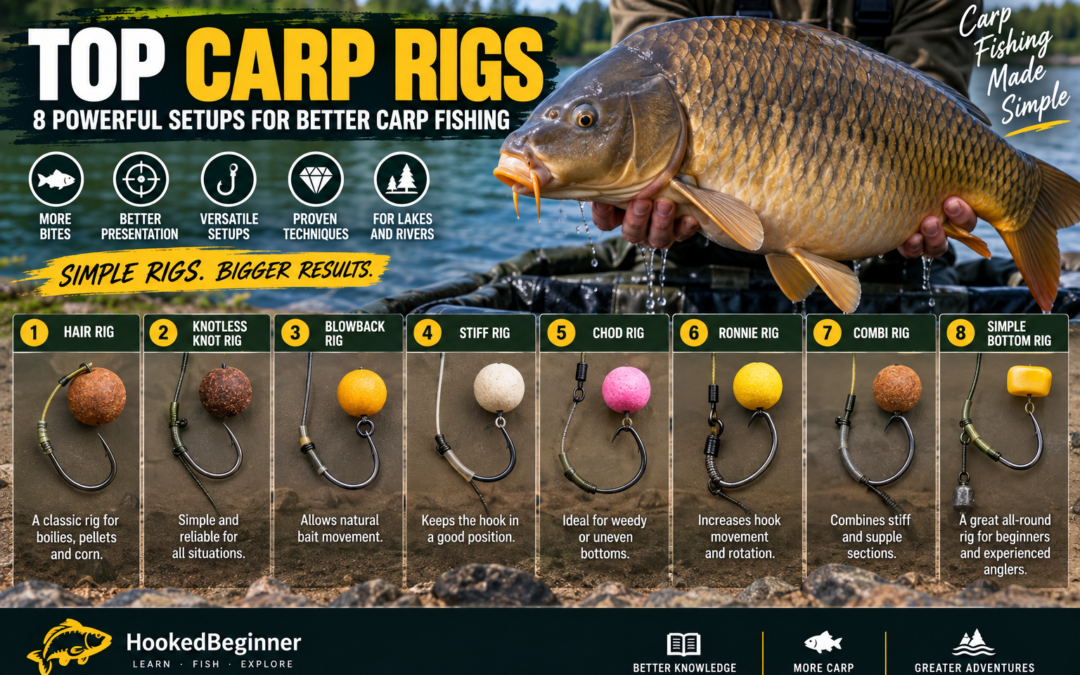
Top Carp Rigs: 8 Powerful Setups for Better Carp Fishing
Carp can be powerful, cautious fish, and the rig you use can make a major difference in how naturally your bait is presented and how effectively a fish is hooked. The top carp rigs are not necessarily the most complicated ones. A good rig is one that matches the bait, hook, lake or river bottom, line, and feeding behavior you are dealing with.
For many anglers, the biggest improvement comes from understanding why a particular carp rig is built the way it is. Hair rigs, simple bottom rigs, stiff rigs, chod-style presentations, and other setups each solve different problems. Carp may feed close to the bottom, around weeds, over soft sediment, or in clearer areas where a subtle presentation matters.
This guide explains top carp rigs in practical terms, including how they work, when to use them, what components you need, and the mistakes that can reduce their effectiveness.
Before choosing terminal tackle, remember that local fishing regulations can restrict bait, hook arrangements, or other methods. Always check the rules that apply to the water you are fishing.
What Are Carp Fishing Rigs?
A carp fishing rig is the terminal arrangement connecting your main line or leader system to the hook and bait. Depending on the presentation, the rig can include hooklink material, a hook, a hair, rig ring, swivel, tubing, lead system, or other components.
The purpose is not simply to hold bait on a hook. A well-designed carp rig should allow the bait to behave naturally while positioning the hook so that a feeding carp can pick it up and become securely hooked.
One of the most important concepts in carp fishing is the hair rig. Instead of placing the bait directly on the hook point, the bait is attached to a short loop or hair extending from the hook. This allows the hook to remain exposed while the bait is presented separately.
IGFA describes the hair rig as a foundation of modern carp rigs and explains that it takes advantage of the way carp feed. Take Me Fishing also explains that the knotless knot is commonly used with hair rigs and leaves a short section of line below the hook for securing bait. Read the IGFA carp fishing guide or learn about the knotless knot.
Why Carp Rigs Matter
Carp are often cautious feeders, so a rig that looks unnatural, catches on debris, or places the hook poorly can create problems. The rig should be matched to the conditions rather than selected only because another angler uses it successfully.
There are several reasons to pay close attention to rig design:
- Bait presentation: The rig controls how the bait sits in relation to the hook.
- Hook positioning: Hook angle and orientation can influence how the hook behaves when a fish takes the bait.
- Bottom conditions: Mud, gravel, weed, silt, and debris can change which presentation works best.
- Bait type: Boilies, pellets, corn, dough baits, and other offerings may require different attachment methods.
- Casting: Some rigs are easier to cast without tangling than others.
- Fish behavior: Feeding patterns can vary between shallow water, margins, open lake bottoms, and rivers.
There is no single universal carp rig. The best approach is to understand several reliable designs and select the one that suits the situation.
8 Top Carp Rigs for Different Fishing Situations
1. Hair Rig
The classic hair rig is one of the most important carp presentations to learn. The bait is mounted on a short hair extending from the hook instead of being threaded directly onto the hook itself.
This setup works particularly well with boilies, pellets, corn and other baits that can be attached to a bait stop. The exposed hook can then move independently of the bait rather than being buried inside it.
A basic hair rig usually consists of a hook, hooklink material, a small hair loop and a bait stop. Many variations can be made by changing the hair length, hook pattern, hooklink material, or tubing arrangement.
The hair rig is especially useful when fishing boilies. IGFA notes that boilies can be particularly effective for larger carp and longer sessions and can be presented on a hair rig.
2. Knotless Knot Hair Rig
The knotless knot combines a hair presentation with a simple method of attaching the hook to the hooklink. It is popular because it is relatively straightforward to tie and keeps the hair positioned in relation to the hook.
To create one, the hooklink is passed through the hook eye, a loop is formed for the hair, and the working end is wrapped around the hook shank before being passed back through the eye.
Take Me Fishing's knotless-knot instructions describe several wraps around the hook shank before passing the working end back through the hook eye. See the knotless knot instructions.
This is a useful starting point for anglers learning carp rigs because the construction is simple while still allowing different bait presentations.
3. Blowback-Style Rig
A blowback-style rig uses a small rig ring or similar component on the hooklink to allow the bait and hair arrangement to move in relation to the hook.
The purpose is to let the bait move without forcing the hook to travel in exactly the same way. As a carp picks up the bait and attempts to move away, the hook can remain positioned to take advantage of the separation between bait and hook.
This type of presentation can be useful when fishing with boilies and when you want more movement around the hook.
The important part is not adding hardware simply for the sake of it. Every component should have a purpose, and the completed rig should remain neat and resistant to tangling.
4. Stiff Rig
A stiff rig uses a relatively rigid hooklink material to control the movement of the hook and bait presentation.
The increased stiffness can help prevent the hooklink from collapsing against the bottom and can make the rig behave differently from a supple braid or soft material.
Stiff materials can be useful around relatively clean lake bottoms where you want the hooklink to maintain a deliberate shape. They may be less suitable when you need the rig to conform closely to uneven or soft bottom structure.
When using a stiff rig, pay attention to how the hooklink lands after casting. A technically correct rig can still perform poorly if it consistently lands awkwardly.
5. Chod-Style Rig
A chod-style rig is designed to present a hook and bait above bottom debris or vegetation. The design gives the hooklink or hook section freedom to sit over uneven ground where a conventional bottom presentation could become hidden.
This makes the concept useful when the bottom is not clean and you are not confident that a longer conventional rig will settle correctly.
Because this is a specialized presentation, component choice and lead arrangement matter. The rig should be balanced so that it remains compact while still allowing the hook section to behave as intended.
Before using a specialized presentation, test it in shallow water where you can observe how it settles. This is one of the easiest ways to learn whether your setup is actually doing what you expect.
6. Ronnie-Style Rig
A Ronnie-style rig uses a hook and swivel arrangement designed to give the hook a high degree of movement around its connection point.
The design is commonly associated with pop-up presentations and is intended to keep the hook positioned in an aggressive orientation while allowing the hook to rotate.
Because this rig uses more components than a basic hair rig, it is important to make sure every connection is secure. Check the hook point, swivel, sleeves and any other small components before casting.
This is another example of why complicated does not automatically mean better. The rig should be used because its particular movement solves a problem for the presentation you are fishing.
7. Combi Rig
A combi rig combines two different hooklink characteristics. One section can be relatively stiff while another remains more flexible.
The idea is to combine the controlled presentation of a stiffer section with the natural movement provided by a more supple section near the hook.
Combi rigs can be useful when you want more controlled behavior around the hook but do not want the entire rig to behave as a rigid piece of material.
They are particularly useful for experienced anglers who already understand how their hooklinks behave. Beginners should first become comfortable with simpler presentations before adding multiple materials and connections.
8. Simple Bottom Carp Rig
A simple bottom rig is often the best place to begin. You do not always need a highly specialized presentation to catch carp.
A basic hooklink, suitable hook, hair and bottom bait can be enough when the water is relatively clear of heavy weed and debris and the fish are feeding confidently.
Take Me Fishing's carp guide describes several practical approaches for targeting carp and notes the use of bottom-oriented presentations in lakes and rivers. See the carp fishing guide.
A simple rig also has a major advantage: it is easy to inspect. You can quickly identify damaged line, a blunt hook or a poorly positioned bait without managing a large collection of components.
Carp Rig Comparison Table
| Rig | Best Use | Typical Bait | Complexity | Main Advantage |
|---|---|---|---|---|
| Hair Rig | General carp fishing | Boilies, pellets, corn | Low | Separates bait from hook |
| Knotless Knot | Simple hair presentations | Boilies, pellets, soft baits | Low | Simple and versatile |
| Blowback-Style Rig | Boilie presentations | Boilies | Medium | Allows bait movement |
| Stiff Rig | Clean bottoms | Pop-ups and bottom baits | Medium | Controlled hooklink behavior |
| Chod-Style Rig | Debris or uneven bottoms | Pop-ups | Medium | Helps present bait above debris |
| Ronnie-Style Rig | Pop-up presentations | Pop-ups | Medium | Hook movement and rotation |
| Combi Rig | Mixed hooklink behavior | Boilies and pop-ups | Medium | Combines stiff and supple sections |
| Simple Bottom Rig | Straightforward bottom fishing | Corn, dough, boilies and pellets | Low | Easy to build and inspect |
How to Choose the Right Carp Rig
Choosing between top carp rigs should begin with the fishing conditions, not the name of the rig.
Start With the Bottom
Look at whether the bottom is gravel, firm clay, mud, silt, sand, or covered with weed. A rig that works beautifully on a hard bottom may not behave the same way when it lands in soft silt.
Consider the Bait
Boilies are commonly associated with hair rigs, while corn and dough-based baits may be used with simpler hook presentations. Match the bait attachment method to the bait's shape, texture and durability.
Think About Fish Behavior
Carp can feed cautiously. If fish are inspecting bait without confidently taking it, a more subtle presentation may be useful. If they are feeding aggressively, a simple rig may perform perfectly well.
Match the Hook
The hook should be appropriate for the bait, rig style, line or hooklink material and size of carp being targeted. Keep the hook point sharp and inspect it regularly.
Keep the Rig Balanced
Do not add swivels, rings, sleeves and other components unless they serve a reason. More components create more potential points of failure and more opportunities for tangles.
Think About Casting
A complicated rig that repeatedly tangles during casting is not useful. Test the rig before fishing and learn how it behaves during the cast and when it lands.
Best Carp Rigs for Different Fishing Situations
Clear, Firm Bottom
A hair rig, knotless knot or stiff-style presentation can work well when the bottom is clean and firm. These conditions make it easier for the rig to settle without being hidden by debris.
Soft Silt
Soft sediment requires extra attention. A heavy terminal arrangement can bury into soft material, so the rig should be selected and balanced with the bottom in mind.
Weedy Areas
When vegetation is present, hooklink and rig movement become particularly important. A presentation that settles directly into dense weed may become difficult for a carp to find.
Pop-Up Fishing
Floating or buoyant baits can be paired with specialized presentations such as chod-style, Ronnie-style or other pop-up rigs. The objective is to position the bait at the intended height while keeping the hook effective.
Longer Sessions
For longer carp sessions, inspect every connection before casting again. Replace damaged hooklinks and hooks rather than trying to extend the life of a questionable rig.
Shore Fishing
Shore anglers need to consider casting distance, rod position and the ability to keep the line controlled. Take Me Fishing notes that rod pods can help keep carp fishing lines still while waiting for a bite. Review the carp fishing guidance.
Carp Rig Materials and Setup
A practical carp rig kit should contain enough components to build and repair the presentations you actually use.
| Component | Purpose |
|---|---|
| Carp hooks | Provides the hook point and hook shape needed for the presentation |
| Hooklink material | Connects the hook to the main terminal system |
| Rig rings | Allows controlled movement of bait or hook components |
| Swivels | Provides secure connections and can allow rotation |
| Silicone tubing or sleeves | Helps position or protect rig components |
| Bait stops | Keeps hair-rigged bait secured to the hair |
| Boilie needle | Helps thread suitable baits onto a hair |
| Hooklink cutter | Creates clean cuts when preparing rig materials |
| Rig box | Keeps completed rigs and small components organized |
When assembling a new setup, inspect the hook eye, knot, hair loop, hook point and connection to the main terminal system. A small weakness in any one part can compromise the complete rig.
For your broader equipment selection, HookedBeginner's fishing rod buying guide and fishing reel buying guide can help match the rod and reel to your overall fishing style.
If you are building a dedicated carp outfit, the Sonik Xtractor Carp Kit is also available on HookedBeginner.
Common Carp Rig Mistakes
Using the Same Rig Everywhere
Different bottoms and feeding situations can require different presentations. Do not assume one rig must work in every location.
Making the Rig Too Complicated
Extra components do not automatically create a better rig. Begin with the simplest presentation that solves the problem you have identified.
Ignoring Hook Sharpness
A dull or damaged hook can reduce your chances of a secure hook-up. Check the point before casting and replace the hook when necessary.
Making the Hair Too Long
The distance between bait and hook changes how the presentation behaves. A hair that is unnecessarily long can produce a presentation that is difficult to control.
Making the Hair Too Short
A bait that sits too close to the hook can also change how the setup behaves. Build the hair around the size and type of bait you are using.
Ignoring Tangles
If a rig continually tangles during casting, stop and correct the problem. A perfect-looking rig is useless if it consistently reaches the bottom in a tangled state.
Fishing Without Checking Local Regulations
Rules concerning bait, hooks, chum, multi-hook arrangements and other methods can vary. Always check the regulations that apply to your fishing location.
IGFA also maintains specific rules governing fishing equipment and hook arrangements. Review the IGFA guidance on two-hook rigs when relevant to your setup.
Carp Rig Buying & Setup Checklist
| Check | What to Look For |
|---|---|
| Target fish | Match hook, line and rig strength to the carp you expect to encounter |
| Bottom | Consider silt, mud, gravel, sand, clay, weed and debris |
| Bait | Choose a rig designed around the bait presentation |
| Hook | Use an appropriately sized and sharp hook |
| Hooklink | Select stiffness and material according to presentation needs |
| Hair length | Keep the bait positioned appropriately relative to the hook |
| Connections | Inspect knots, swivels, rings and sleeves |
| Casting | Test for tangling before fishing at long range |
| Terminal tackle | Replace damaged or worn components |
| Regulations | Confirm that your rig and bait are legal on the water |
Related HookedBeginner Fishing Guides
Carp rigs are only one part of a complete fishing setup. Use these HookedBeginner resources when building or refining your equipment:
- Fishing Rod Buying Guide for choosing an appropriate rod.
- Fishing Reel Buying Guide for matching reel specifications to your rod and fishing style.
- Fishing Rod Power Guide for understanding rod power.
- Fishing Rod Action Guide for understanding how rod action affects performance.
- Types of Fishing Rods for comparing different rod categories.
- Sonik Xtractor Carp Kit for a dedicated carp setup already listed on HookedBeginner.
Frequently Asked Questions
What are the top carp rigs for beginners?
The simplest place to start is usually a basic hair rig or knotless knot hair rig. These presentations are relatively easy to understand and provide a useful foundation for learning how bait, hook position and hooklink behavior work together.
What is the best carp rig for boilies?
A hair rig is one of the most common choices for boilies because the bait can sit on the hair while the hook remains exposed. The exact hooklink, hook pattern and hair length should be matched to the presentation and fishing conditions.
What is a hair rig?
A hair rig places the bait on a short extension below or beside the hook rather than threading the bait directly onto the hook point. This allows the hook to remain exposed while the bait is presented naturally.
What knot should I use for a carp hair rig?
The knotless knot is a common option for tying a hair rig. Take Me Fishing provides a step-by-step guide showing how the line is wrapped around the hook shank and returned through the hook eye. Read the knotless knot tutorial.
Are expensive carp rigs better?
Price does not automatically determine performance. A correctly tied simple rig can be more useful than an expensive setup that is inappropriate for the bottom, bait or fish behavior.
What carp rig should I use on a weedy bottom?
Consider a presentation designed to keep the bait and hook from becoming buried or obscured. The exact choice depends on the density and type of vegetation, the bottom composition and whether you are using a bottom bait or pop-up.
Can I use the same carp rig in a river and lake?
You can use some rigs in both environments, but the conditions may require adjustments. River current, debris, depth and bottom composition can change how the rig settles and how the bait behaves.
How often should I replace a carp rig?
Replace or rebuild a rig whenever the hook becomes damaged, the hooklink is frayed, a knot becomes questionable, or any component shows signs of wear. After landing a strong fish or fishing around abrasive structure, inspect the rig before making another cast.
Do carp rigs work with corn?
Yes. Corn can be incorporated into several carp presentations, including simple hook-and-bait arrangements and suitable hair-rig systems. Make sure the bait attachment method is appropriate for the form of corn being used and permitted by local rules.
Do carp rigs work with pellets?
Yes. Pellets can be presented with hair rigs and other suitable systems. Choose a bait attachment method based on pellet size, hardness and whether the bait is intended to stay intact during casting.
Should I use a stiff or soft hooklink?
It depends on what you want the rig to do. Stiffer materials provide more controlled movement, while softer materials can give a more flexible presentation. Bottom conditions and rig design should determine the final choice.
What should I check before casting a carp rig?
Check the hook point, knot, hair loop, bait attachment, hooklink, swivel and any sleeves or rings. Make sure the rig is not tangled and that the bait is securely attached.
Final Thoughts
The best way to understand top carp rigs is to learn what each design is intended to accomplish rather than memorizing names. Start with a dependable hair rig, learn the knotless knot, understand how the bait sits relative to the hook, and then progress into more specialized presentations as your fishing situations demand them.
When choosing among top carp rigs, consider the bottom, bait, weed, water movement, casting requirements and behavior of the carp. A straightforward rig that lands correctly and presents the bait naturally is often more useful than a complicated design that does not match the conditions.
Build a small selection of proven rigs, inspect them carefully, and learn how each one behaves in the water. With that foundation, you can adapt your carp fishing setup instead of relying on a single presentation for every session.
For reliable knot and rig information, you can also consult Take Me Fishing's carp fishing knots guide and the IGFA carp fishing resource.