
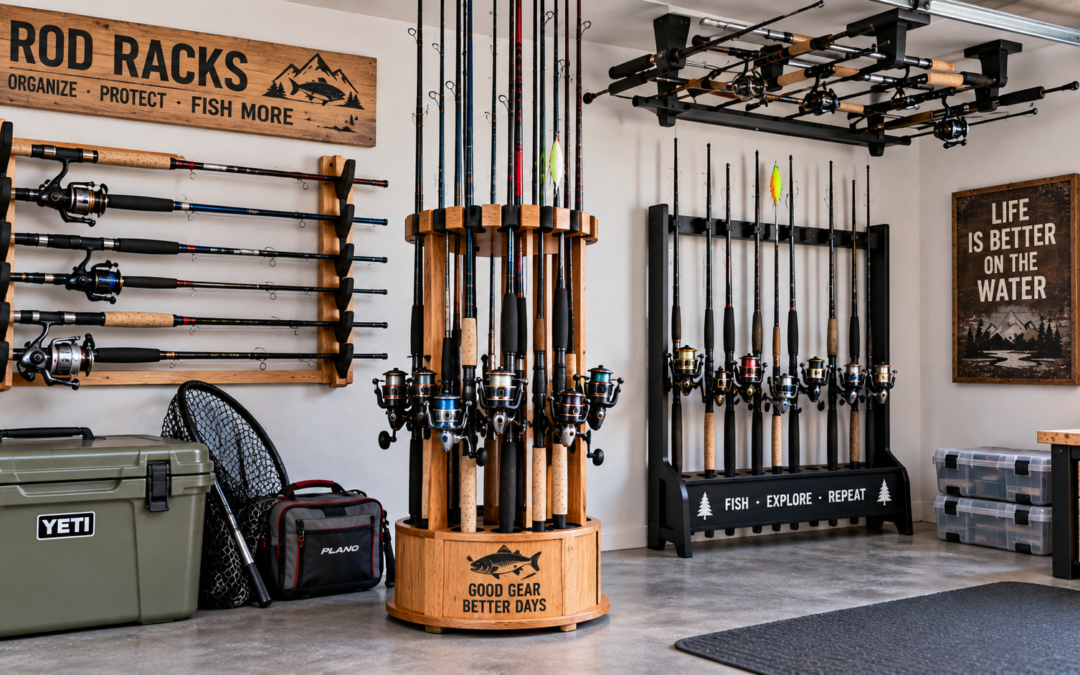
Rod Racks: 8 Smart Storage Solutions for Fishing Gear
Rod racks give anglers a simple way to keep fishing rods organized, accessible, and protected between trips. Instead of leaving rods leaning against walls, stacked in corners, or mixed together with tackle, a dedicated storage system gives each setup a defined place.
As your fishing collection grows, storage becomes increasingly important. A few rods are relatively easy to manage, but a larger collection can quickly become tangled, difficult to identify, and vulnerable to accidental damage.
The right rod racks can also help you use available space more efficiently. Depending on the design, rods can be stored vertically, horizontally, on a wall, on the floor, overhead, or in a boat or other fishing area.
This guide covers eight practical rack types and explains how to compare them based on capacity, rod length, reel clearance, installation, materials, accessibility, and the environment where you keep your fishing equipment.
What Are Rod Racks?
Rod racks are storage systems designed specifically to hold fishing rods in organized positions. Some support individual rod blanks, while others are built to hold complete rod-and-reel combinations.
Rack designs vary widely. A vertical rack may stand on the floor and use very little width. A wall-mounted rack can move rods away from the floor. A horizontal system can make use of a long wall, while an overhead rack can turn unused ceiling space into storage.
The best design depends on your fishing equipment and the space available. A compact setup for several freshwater rods may need only a small wall-mounted rack, while a large saltwater collection may require heavy-duty storage with greater spacing and stronger materials.
The International Game Fish Association also emphasizes the value of organized tackle storage because a systematic arrangement makes equipment easier to manage and prepare for future trips. See the IGFA tackle organization guide.
A good rack should support rods securely without creating unnecessary pressure on the blanks, guides, handles, or reels. It should also let you remove one setup without disturbing the rest of the collection.
Why Rod Racks Matter
Good storage is part of maintaining fishing equipment. Simply placing rods wherever there is available space may create problems that become more obvious as your collection grows.
1. Better Organization
A dedicated rack creates a fixed location for every rod. You can organize your collection by fishing technique, species, rod length, power, reel type, or how frequently you use each setup.
2. Easier Access
When each rod has a defined position, you can identify the setup you need without moving several others first.
This is particularly useful for anglers who keep separate equipment for bass, trout, panfish, catfish, saltwater fishing, surf fishing, or other specialized applications.
3. Reduced Clutter
Fishing rods are long and can occupy a surprising amount of room. Wall-mounted, vertical, and overhead storage can help move equipment out of walkways and working areas.
4. Better Separation
Rods stored together without spacing can become tangled with lines, lures, handles, and reels. Dedicated storage positions help keep individual setups separated.
Take Me Fishing's rod-holder guidance also highlights the importance of organized storage in reducing tangling and unnecessary contact between rods. See the fishing rod holder guide.
5. More Efficient Use of Space
Good storage lets you use wall, ceiling, corner, and floor space more deliberately instead of allowing rods to spread across the room.
6. Easier Gear Preparation
When fishing rods remain organized, it is easier to inspect them, attach reels, organize line, and prepare for a fishing trip.
8 Rod Racks to Consider
1. Freestanding Rod Rack
A freestanding rack is a flexible storage solution because it can be positioned without permanent wall installation.
This type of rack works well in garages, workshops, fishing rooms, sheds, and boat houses. It can also be moved when your storage layout changes.
Freestanding systems are especially useful for larger collections because they can provide several storage positions while keeping the rods grouped in one location.
When choosing one, pay attention to base stability, overall width, rod spacing, and reel clearance.
Best for: Large collections, workshops, garages, and boat houses.
2. Wall-Mounted Rod Rack
A wall-mounted rack is a practical choice when floor space is limited.
By attaching the storage system directly to the wall, you can keep rods off the floor while making use of otherwise unused vertical space.
Wall systems may store rods vertically or horizontally depending on the design. They can be installed in garages, fishing rooms, workshops, and storage areas.
Before mounting the rack, measure the complete rod length and make sure nearby doors, shelves, vehicles, windows, and work areas will not interfere with the rods.
Best for: Small rooms, garages, workshops, and permanent storage.
3. Vertical Rod Rack
A vertical rack stores fishing rods upright and can be useful when available floor width is limited.
This design can fit into a narrow corner while still holding several rods. It also allows you to arrange equipment so frequently used setups are easy to identify and remove.
The main requirement is sufficient vertical clearance. Measure the longest rod in your collection before choosing a location.
A vertical rack should also have a stable base or secure mounting so that the stored rods do not tip into walkways.
Best for: Narrow spaces, fishing rooms, garages, and workshops.
4. Horizontal Rod Rack
A horizontal rack stores rods parallel to a wall or other surface.
This arrangement can work especially well when you have a long wall and want to keep rods off the floor. It can also be useful for longer rods that are inconvenient to store upright.
Horizontal racks need enough length to provide stable support and enough separation between rods to prevent interference between guides, reels, handles, and lines.
Best for: Long walls, boat houses, garages, and large fishing collections.
5. Ceiling-Mounted Rod Rack
A ceiling-mounted rack uses overhead space that may otherwise remain unused.
This can be a practical solution in garages where walls are already occupied by cabinets, shelves, tools, and other equipment.
Because the equipment is stored overhead, installation quality is especially important. The rack needs to be attached securely to an appropriate structural surface and positioned away from garage-door movement, lighting, and other overhead obstacles.
Best for: Garages, workshops, and storage areas with unused ceiling space.
6. Portable Rod Rack
Portable storage is useful for anglers who move equipment between locations.
A portable rack can be used in a garage, vehicle, dock, boat house, or other temporary storage area without requiring permanent installation.
This can also be useful on fishing trips when several rods need to remain organized and accessible.
The main advantage is flexibility, while the main consideration is stability when the rack is moved or loaded with multiple rods.
Best for: Mobile anglers, docks, vehicles, and temporary storage.
7. Boat and Dock Rod Rack
Boat and dock storage requires a slightly different approach because available space is limited and the equipment may be exposed to water, humidity, and salt.
The rack needs to keep rods secure without interfering with passengers, controls, hatches, fishing lines, or other equipment.
For saltwater use, materials and hardware deserve additional attention because repeated exposure to moisture and salt can accelerate corrosion.
Best for: Boats, docks, marinas, and boat houses.
8. DIY Rod Rack
A DIY rack can be useful when you want a custom storage system designed around a particular room or collection.
Take Me Fishing provides a DIY rod-holder project using materials such as PVC pipe and plywood. The design can be arranged to fit specific rod and reel dimensions. Review the DIY rod-holder project.
The biggest advantage of DIY storage is customization. You control the number of positions, spacing, mounting location, and overall dimensions.
The tradeoff is that measurements, construction quality, mounting strength, and protective surfaces are your responsibility.
Best for: Custom spaces, workshops, DIY projects, and budget-conscious anglers.
Rod Racks Comparison Table
| Rack Type | Best Location | Main Advantage | Main Consideration |
|---|---|---|---|
| Freestanding | Garage or workshop | Flexible and movable | Uses floor space |
| Wall-mounted | Garage or fishing room | Saves floor space | Requires secure installation |
| Vertical | Narrow storage area | Uses limited floor width | Needs adequate height |
| Horizontal | Long wall | Good for long rods | Requires wall length |
| Ceiling-mounted | Garage | Uses overhead space | Installation and access |
| Portable | Vehicle or dock | Easy to reposition | Less permanent |
| Boat or dock | Boat or dock | Convenient on-water access | Moisture and corrosion |
| DIY | Custom storage areas | Highly customizable | Requires construction |
How to Choose Rod Racks
Count Your Rods
Start by determining how many fishing rods need to be stored.
Do not only consider the number you own today. If you regularly add equipment, modest additional capacity can make the storage system more useful over time.
Measure Rod Length
Measure your longest rods before deciding between vertical and horizontal storage.
Rod length is particularly important when storage is planned inside a room, garage, boat, or other enclosed space.
For additional information, review the fishing rod length guide.
Consider Reel Clearance
If you store complete rod-and-reel combinations, make sure there is enough room for the reel body, handle, bail, or other components.
A rack designed around bare rod dimensions may not provide adequate clearance for larger reels.
Decide Where the Rack Will Go
The location should determine the rack style.
A narrow room may favor vertical storage. A long garage wall may favor horizontal storage. An overcrowded wall may make ceiling storage more useful.
Match the Material to the Environment
Dry indoor storage provides more material flexibility than a damp garage, dock, or saltwater boat.
For wet environments, consider corrosion resistance, moisture exposure, drainage, and ease of cleaning.
Think About Accessibility
Frequently used rods should be easy to reach. Equipment that is used less often can occupy less convenient positions.
A rack should organize your fishing collection without making basic gear retrieval unnecessarily difficult.
Consider Rod Protection
Look for support points that hold rods securely without excessive pressure.
Leave enough room between storage positions to prevent rods, reels, guides, and lines from rubbing against neighboring setups.
Rod Racks for Different Use Cases
For a Garage
A garage can accommodate almost every major rack style, but wall and ceiling storage are particularly useful when floor space is limited.
Keep fishing rods away from vehicle paths, heavy tools, doors, and other objects that could knock into them.
For a Fishing Room
A dedicated fishing room gives you more control over organization.
You can arrange rods by technique, species, length, power, reel type, or frequency of use.
Vertical racks can display multiple setups while leaving floor space for tackle boxes and other fishing accessories.
For a Boat House
A larger rack can help separate rods for different fishing techniques and environments.
Because boat houses may experience moisture and humidity, material selection and maintenance remain important.
For a Small Space
Vertical or wall-mounted storage can make better use of limited space than a large floor rack.
Measure the full installation area carefully before buying or building anything.
For Saltwater Equipment
Saltwater rods and reels need more attention to moisture and corrosion.
The rack should be suitable for the environment, while the equipment itself should be cleaned and maintained according to manufacturer recommendations before long-term storage.
Rod Rack Materials and Setup
PVC
PVC is popular for DIY storage because it is lightweight, easy to cut, and simple to arrange into multiple storage positions.
It can work particularly well when you need a custom rack with specific spacing.
Wood
Wood can be used to create both freestanding and wall-mounted racks.
It is relatively easy to customize in terms of width, height, spacing, and appearance. In damp areas, however, the material and finish need to be appropriate for the environment.
Plastic and Composite
Plastic and composite materials can provide useful moisture resistance and are often easy to clean.
These materials may be especially useful for racks used around boats and other wet environments.
Metal
Metal provides strong support and can work well for heavy-duty storage.
The metal type, coating, and hardware all matter when the rack is exposed to humidity, water, or salt.
Mounting Hardware
A good rack still needs a secure installation.
Choose mounting hardware based on the type of wall, ceiling, or structural surface being used and the load the rack will carry.
For heavier storage systems, the mounting points should distribute the load rather than placing excessive force on a single attachment point.
Common Rod Rack Mistakes
Buying Without Measuring
One of the easiest mistakes is choosing a rack based only on its advertised capacity.
The rack may hold enough rods numerically but still fail to fit the available wall, ceiling, or floor space.
Ignoring Reel Size
Large reels need more space than bare rod blanks. If you store complete combinations, account for the reel when measuring storage requirements.
Overcrowding the Rack
Filling every possible space can make rods difficult to remove and increase the chance of tangling.
Leave enough separation between neighboring setups for easy access.
Poor Installation
Do not overlook the mounting system.
Follow the manufacturer's installation requirements and use hardware appropriate for the mounting surface.
Choosing the Wrong Location
A rack placed beside a frequently used door, vehicle, tool area, or walkway can expose rods to accidental impacts.
Choose a quieter location with adequate clearance.
Storing Wet Equipment Long-Term
A rack is not a substitute for equipment maintenance.
Clean and dry fishing gear according to manufacturer recommendations before extended storage, particularly after saltwater use.
Failing to Organize the Collection
Even the best rack becomes less useful if all rods are placed randomly.
Create a simple system so you know where each type of equipment belongs.
Rod Racks Buying Checklist
| Check | What to Look For |
|---|---|
| Capacity | Enough spaces for your current collection |
| Future capacity | Reasonable room for additional rods |
| Rod length | Suitable for your longest rods |
| Reel clearance | Enough room for complete setups |
| Spacing | Enough separation between rods |
| Orientation | Vertical, horizontal, floor, wall, or ceiling configuration |
| Material | Suitable for the storage environment |
| Stability | Remains secure when loaded |
| Mounting | Hardware matches the installation surface |
| Accessibility | Frequently used rods are easy to reach |
| Protection | Supports rods without unnecessary pressure |
| Maintenance | Easy to inspect and clean |
Related Fishing Guides
Choosing the right rack is easier when you understand the rods and reels being stored.
Start with the fishing rods guide for an overview of fishing rod selection.
For length considerations, use the fishing rod length guide.
To understand rod strength and behavior, review the fishing rod power guide and fishing rod action guide.
Before purchasing additional rods, see the fishing rod buying guide.
For reels and related equipment, explore the fishing reels guide and fishing reel size guide.
For storage-related fishing equipment, browse the fishing accessories category.
You can also review rod-holder products such as the Scotty 290-R 5 Rod Holder, Cannon Rod Holder, and Savage Gear MP Rodholder.
Frequently Asked Questions
What are rod racks used for?
Rod racks are used to store fishing rods in organized positions. They help separate equipment, reduce clutter, improve accessibility, and provide more controlled storage than simply leaning rods against a wall.
What type of rod rack is best for a garage?
Wall-mounted, vertical, freestanding, and ceiling-mounted systems can all work in garages. The appropriate choice depends on available floor, wall, and ceiling space.
Can rod racks hold reels too?
Some are designed specifically for complete rod-and-reel setups, while others are primarily intended for bare rods. Always check the available reel clearance before purchasing.
Are vertical rod racks better than horizontal racks?
Neither is universally better. Vertical storage can save floor width, while horizontal storage can make better use of a long wall. Choose based on the dimensions of your storage area and rods.
Can I build my own rod rack?
Yes. DIY systems can be built from materials such as PVC, wood, and plywood. Take Me Fishing provides a DIY rod-holder example that can be adapted to different rod and reel sizes. See the DIY rod-holder guide.
How many fishing rods should a rack hold?
That depends on your collection. The rack should provide enough dedicated positions for your current rods while allowing reasonable room for future growth.
What should I consider for saltwater rod racks?
Pay particular attention to moisture resistance, corrosion resistance, hardware, and ease of cleaning. The rods and reels should also be cleaned and maintained according to manufacturer recommendations.
How much space should I leave between rods?
Enough to remove each rod without catching the neighboring setup. The exact spacing depends on the reel size, handle shape, and rack design.
Where should rod racks be installed?
Install them in a location that is accessible but protected from heavy traffic, vehicles, doors, tools, and objects that could strike the rods.
Can rod racks save space?
Yes. Wall, vertical, and ceiling designs can use areas that would otherwise remain unused and reduce the amount of fishing equipment occupying the floor.
Final Thoughts
The right rod racks can transform a disorganized fishing collection into a cleaner and more accessible storage system.
Freestanding racks are useful when flexibility matters. Wall-mounted racks can save floor space. Vertical systems work well in narrow areas, horizontal racks make use of long walls, and ceiling-mounted systems turn overhead space into storage. Portable and boat-specific options provide additional flexibility, while DIY designs allow you to build storage around your exact requirements.
When comparing different racks, focus on capacity, rod length, reel clearance, spacing, materials, mounting strength, accessibility, and the environment where the equipment will be stored.
The goal is not simply to store more rods. The goal is to store them in a way that keeps your equipment organized, accessible, and protected between fishing trips.
For more fishing equipment guidance, continue with Hooked Beginner's fishing rods guide, review the fishing rod buying guide, and explore the fishing accessories category.