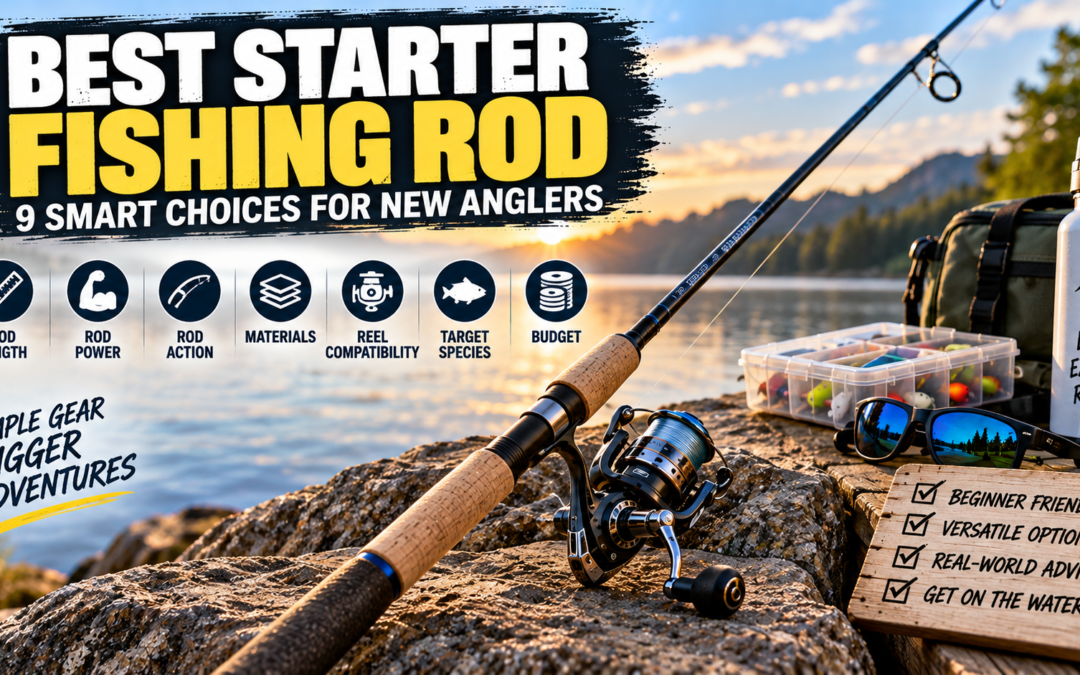
Choosing the best starter fishing rod should not be complicated. For a new angler, the right first rod is one that is comfortable to hold, easy to cast, properly matched to a reel, and suitable for the kind of fishing you actually plan to do. You do not need the most expensive rod, the longest rod, or the most powerful model available.
The biggest mistake beginners make is choosing a fishing rod before thinking about where they will fish and what they want to catch. A rod for a small freshwater pond can be very different from a setup for large bass, surf fishing, or heavy saltwater applications.
Take Me Fishing recommends starting with two basic questions: where you will be fishing and what type of bait or lure you will be using. It also explains that spinning rods are generally good general-purpose and beginner choices, while rod length, power, material, and lure weight all affect which rod makes sense for the application. Read Take Me Fishing's guide to choosing a fishing rod.
This guide breaks down nine practical starter fishing rod options and explains exactly what to look for in length, power, action, materials, reel compatibility, line rating, and budget.
- What Makes a Good Starter Fishing Rod?
- 9 Starter Fishing Rod Options
- Choosing Rod Length
- Choosing Rod Power
- Choosing Rod Action
- Fiberglass vs. Graphite
- Matching the Reel
- Matching Line and Lures
- How Much Should a Beginner Spend?
- Common Beginner Mistakes
- Taking Care of Your First Rod
- Frequently Asked Questions
What Makes a Good Starter Fishing Rod?
A good starter rod should make learning easier rather than adding unnecessary complexity.
That usually means choosing a rod that is comfortable, appropriately sized, and matched to the reel, line, and fishing method you expect to use most often.
A beginner-friendly rod should generally provide:
- A manageable length.
- A suitable power rating.
- An action that is easy to control.
- A comfortable handle.
- A line rating appropriate for the intended fish.
- A lure or bait rating suited to the tackle you will use.
- Compatibility with the chosen reel.
- Enough durability to handle normal beginner mistakes.
Take Me Fishing's beginner gear checklist recommends a simple spinning rod and reel combo, with a six- or seven-foot medium-action rod presented as a practical starting point. Its freshwater beginner guidance similarly recommends a pre-spooled spinning combo with a seven-foot medium-action rod and a 1000- to 3000-size reel for a broad range of freshwater situations. See the beginner fishing gear checklist.
9 Best Starter Fishing Rod Options for New Anglers
There is no single rod that will be correct for every beginner. The nine options below represent different starting points depending on your fishing style.
1. 6-Foot to 7-Foot Medium Spinning Rod
For many first-time anglers, a six- to seven-foot medium spinning rod is one of the simplest places to start.
This size provides a useful combination of casting control, portability, and versatility. It can work for common freshwater fishing situations involving bass, panfish, trout, and other species depending on the specific rod rating and local conditions.
A medium spinning rod is also easy to pair with a beginner-friendly spinning reel.
This type of rod makes sense when you want one setup for:
- Lakes.
- Ponds.
- Small rivers.
- Bank fishing.
- General freshwater fishing.
Take Me Fishing specifically identifies a six- to seven-foot light-to-medium spinning setup as a practical beginner choice. See its beginner fishing basics guide.
2. 7-Foot Medium Spinning Rod
A seven-foot medium spinning rod gives a beginner a little more casting leverage while remaining manageable.
This is a particularly useful choice when you expect to fish a mixture of open banks, ponds, lakes, and rivers.
The additional length compared with a shorter rod can provide useful casting distance without requiring the handling skills of a very long fishing rod.
When matched with a suitable spinning reel, this configuration can also provide a good foundation for learning different casting techniques.
3. 7-Foot Light Spinning Rod
New anglers who mainly target smaller fish may prefer a light spinning rod.
A lighter blank can make small lures and lighter line easier to use while providing more sensitivity to subtle bites.
The tradeoff is reduced power. A light rod may not be suitable for large fish or heavy terminal tackle.
Choose this type when your fishing is focused on smaller species and finesse presentations rather than maximum strength.
4. 7-Foot Medium-Light Spinning Rod
A medium-light rod can be an excellent middle ground between light tackle and a standard medium rod.
It can be useful for anglers who want more sensitivity and flexibility than a medium rod but still need enough backbone for a variety of freshwater applications.
This can work particularly well when your fishing involves small to medium-sized species and relatively light lures.
5. 7-Foot Medium-Heavy Spinning Rod
A medium-heavy spinning rod is useful when you expect to fish heavier lures, stronger line, heavier cover, or larger fish.
It can make sense for beginners who already know they will concentrate on bass or other stronger species and want additional power from their first setup.
The important consideration is not simply choosing a stronger rod. Make sure your reel, line, lure weight, and target fish all match the rod.
For a deeper explanation of rod power ratings, see the fishing rod power guide.
6. Fiberglass Starter Rod
Fiberglass rods are known for being durable and flexible. Those characteristics can make them appealing for beginners who want a rod capable of handling occasional mistakes.
Fiberglass is generally heavier and less sensitive than graphite, but that tradeoff can be useful for a new angler who values durability and a forgiving feel.
Take Me Fishing explains that fiberglass is generally tougher and more flexible than graphite and notes that many beginners start with fiberglass rods. Compare fiberglass and graphite in its rod guide.
7. Graphite Starter Rod
Graphite rods are typically lighter and more sensitive than fiberglass. That can make them attractive when detecting subtle bites matters.
The tradeoff is that graphite can be less forgiving of impacts and improper handling.
A graphite starter rod makes sense for a beginner who is already comfortable handling fishing equipment and wants a lighter, more responsive setup.
Look at the rod specifications rather than assuming that every graphite rod is automatically better. The right choice depends on your fishing style.
8. Two-Piece Starter Fishing Rod
A two-piece rod can be a practical option for beginners who need easy transportation and storage.
Instead of carrying a full-length rod, you can separate the sections for transport in a vehicle, closet, garage, or storage rack.
Two-piece rods are especially useful when:
- You travel frequently.
- You fish away from home.
- Your vehicle has limited storage space.
- You do not have a permanent fishing rod storage area.
The connection between the rod sections should be checked regularly to make sure the pieces remain properly seated during use.
9. Pre-Matched Starter Rod and Reel Combo
For many beginners, a pre-matched rod and reel combo may be the simplest entry point.
The advantage is that the rod and reel are already selected to work together. Some combos also arrive spooled with line, reducing the number of decisions required before your first trip.
Take Me Fishing's beginner gear checklist specifically recommends starting with a spinning rod and reel combo for new anglers because it reduces the guesswork involved in selecting separate components. See the complete beginner gear checklist.
For new anglers who want to concentrate on learning how to cast and catch fish instead of researching dozens of individual components, this can be an efficient starting point.
How Long Should a Starter Fishing Rod Be?
Rod length affects casting distance, control, leverage, transport, and overall feel.
For many beginners, a rod between roughly six and seven feet provides a practical starting range for general freshwater fishing.
Shorter rods can offer more control and maneuverability. Longer rods can provide additional casting distance and leverage.
Take Me Fishing explains that shorter rods can provide more power for fighting fish, while longer rods generally cast farther. It also notes that surf and fly rods can be considerably longer than general-purpose freshwater rods. Read the full rod-length explanation.
Your first rod should be long enough to perform the fishing you plan to do but short enough that you can comfortably control it.
When a Shorter Rod Makes Sense
- Fishing around tight cover.
- Small streams.
- Limited casting space.
- Beginners who value maximum control.
When a Longer Rod Makes Sense
- Open banks.
- Larger lakes.
- Longer casts.
- Applications where additional leverage is useful.
For more detail, use the fishing rod length guide.
How Much Rod Power Should a Beginner Choose?
Rod power describes how much force is required to bend the rod. Common ratings include light, medium-light, medium, medium-heavy, and heavy.
For a general-purpose starter setup, medium power is often a useful place to begin because it can handle a reasonable range of lures, lines, and fish without being excessively specialized.
Light and medium-light rods become more useful for smaller fish and lighter presentations.
Medium-heavy rods become more useful when you expect larger fish, heavier lures, stronger line, or more demanding cover.
Do not choose power based only on the size of the fish. The lure or bait weight and line rating also need to fit the rod.
What Rod Action Is Best for a Starter Fishing Rod?
Rod action describes where the rod bends under pressure.
A fast-action rod generally bends closer to the tip, while a moderate action bends farther down the blank.
For beginners, moderate action can provide a forgiving feel during casting and while fighting fish. Fast-action rods can provide a more direct and responsive feel but may demand a little more familiarity with technique.
The ideal choice also depends on the lure and technique you plan to use.
Use the fishing rod action guide to understand how different actions behave.
Fiberglass vs. Graphite for a Starter Rod
| Feature | Fiberglass | Graphite |
|---|---|---|
| Weight | Generally heavier | Generally lighter |
| Flexibility | Generally more flexible | Generally stiffer |
| Sensitivity | Lower | Higher |
| Durability | Generally forgiving | Requires more careful handling |
Neither material is universally better.
Fiberglass can make sense for someone who values toughness and flexibility. Graphite can make sense for someone who values lower weight and sensitivity.
Hybrid construction is another possibility, combining characteristics of both materials.
How to Match the Reel to Your Starter Fishing Rod
A rod should not be selected separately from the reel.
The reel should fit the rod physically and match its intended line and lure ratings. The combined setup should also feel balanced when held in your normal fishing position.
A reel that is too large can make a light rod feel heavy and awkward. A reel that is too small may not hold enough line or provide the appropriate drag range for the fishing you plan to do.
Take Me Fishing specifically recommends matching the reel to the selected rod and notes that many combination setups are already paired and ready to use. See its rod-and-reel matching guidance.
For broader reel information, visit the fishing reels section.
Matching Line, Lures and Bait
Your starter fishing rod is part of a larger system.
Before buying, check the rod's recommended line and lure ratings. Then select line and tackle that fit those ratings.
For a beginner, this can be much easier than trying to create an advanced setup from scratch.
A medium spinning rod, appropriately sized spinning reel, suitable line, and a few simple lures can cover a surprisingly wide range of beginner situations.
Take Me Fishing's current beginner guidance recommends starting with basic tackle and adjusting the gear to the fish and environment rather than buying equipment for every possible scenario. Review the beginner tackle checklist.
Spinning Rod vs. Casting Rod for Beginners
One of the first decisions beginners encounter is whether to buy a spinning rod or casting rod.
Spinning Rod
Spinning rods are commonly recommended for beginners because the reel sits below the rod and the casting process is relatively straightforward.
They are well suited to lighter baits and lures and can be used in many general-purpose fishing situations.
Casting Rod
Casting rods are often paired with baitcasting or other casting reels. They can be excellent for anglers who want greater control over heavier artificial lures and specific fishing techniques.
However, casting reels can require more practice because spool control is part of the casting process.
For a first-ever setup, a spinning rod is often the simpler starting point.
What Fish Can You Catch With a Starter Fishing Rod?
The answer depends on the rod's power, line, reel, lure and local fishery.
A general medium spinning setup can be used for a variety of freshwater species, but you should not assume that one rod is appropriate for every fish.
Smaller rods can work for:
- Panfish.
- Small trout.
- Small bass.
- Other lightweight freshwater species.
Medium setups can cover a broader range of freshwater applications.
Medium-heavy setups become more appropriate as fish, lures, cover, and line requirements increase.
The key is to match the rod to the actual fishing conditions instead of trying to make one rod handle every possible situation.
How Much Should You Spend on a Starter Fishing Rod?
A beginner does not need to spend heavily to get started.
The priority should be obtaining a rod that is correctly sized and rated, comfortable, compatible with a suitable reel, and durable enough for normal use.
A basic combo can reduce the number of separate decisions you need to make. A mid-range rod may be worthwhile when you already know you will fish regularly and want better components or lower weight.
Premium equipment can wait until your experience tells you which features are actually useful to you.
Take Me Fishing's beginner gear resources emphasize starting with basic equipment and learning through actual time on the water rather than buying a complicated collection of specialized equipment immediately. See the complete beginner fishing checklist.
Starter Rod Features Worth Paying Attention To
Guides
Guides direct the line along the rod. Check that they are properly aligned and appropriate for the line and reel you are using.
Reel Seat
The reel seat should hold the reel firmly without excessive movement.
Handle
A comfortable handle matters because beginners often spend more time practicing casts and retrieving than experienced anglers expect.
Blank
The blank determines much of the rod's overall action, power, weight and feel.
Two-Piece Connection
If you choose a two-piece rod, check the connection regularly and make sure the sections remain properly aligned.
How to Choose the Best Starter Fishing Rod by Fishing Location
Lake Fishing
A six- to seven-foot medium spinning setup can provide a useful starting point for many beginner lake anglers.
Pond Fishing
A shorter or medium-length spinning rod can provide easy casting control around smaller ponds.
River Fishing
Rod selection depends heavily on river size and species. A shorter rod may help in tight streams, while longer rods can be useful where there is more open casting space.
For river-specific equipment, compare the available river fishing rod guide.
Shore Fishing
Shore fishing covers a wide variety of situations. A medium spinning rod can be a useful starting point, but larger open-water environments may require longer equipment.
The IGFA recommends keeping tackle simple when introducing someone to fishing and identifies a simple spin-casting rod and reel as an accessible starting point for shore and stream fishing. See the IGFA beginner fishing guide.
9 Questions to Ask Before Buying Your First Rod
- Where will I fish most often?
- What species do I expect to catch?
- Will I use bait, lures, or both?
- Do I need a spinning or casting rod?
- What rod length feels comfortable for me?
- What power matches the fish and tackle?
- What action suits the type of fishing I want to learn?
- Do I need a one-piece or two-piece rod?
- Should I buy the rod separately or as part of a combo?
Answering these questions before shopping can eliminate a surprising number of unsuitable options.
Common Starter Fishing Rod Mistakes
Buying the Longest Rod
Longer does not automatically mean better. Choose length around your fishing situation and comfort.
Buying the Heaviest Rod
More power is not always an advantage. A heavy rod can make light tackle awkward and reduce sensitivity.
Ignoring the Reel
A rod and reel need to work together. Do not buy the rod first and assume any reel will match.
Ignoring the Line Rating
The line and lure ratings exist for a reason. Stay within the manufacturer's recommendations.
Buying Too Many Specialized Rods
A beginner usually benefits from learning with one versatile setup before building a large collection.
Choosing Only by Price
The cheapest rod is not always the most economical if it does not fit your needs, while the most expensive rod may provide features you do not yet need.
Choosing a Rod Without Holding It
Whenever possible, handle the rod and reel together. Comfort and balance are difficult to judge from a product title alone.
How to Take Care of Your Starter Fishing Rod
Good maintenance can extend the useful life of your first rod.
After fishing, inspect the guides, handle, reel seat, and blank. Remove dirt, sand, or debris before placing the rod into storage.
Do not leave the rod where heavy equipment can fall on it or where the tip can be bent against a wall.
A proper fishing rod storage system can help protect the rod between trips.
If the rod has been exposed to saltwater, clean it according to the manufacturer's instructions and allow it to dry before storage.
When Should You Upgrade Your Starter Fishing Rod?
You do not need to upgrade simply because you have been fishing for a certain amount of time.
Upgrade when your current rod becomes a limitation.
That might happen when:
- You start targeting larger fish.
- You adopt a specialized technique.
- You regularly cast heavier or lighter lures.
- You need greater casting distance.
- You want more sensitivity.
- You need a different rod action.
- You fish a different environment.
Learning what your current rod does well and where it falls short is one of the best ways to choose your next rod.
Starter Fishing Rod vs. Advanced Fishing Rod
| Feature | Starter Rod | Advanced Rod |
|---|---|---|
| Primary goal | Ease of learning | Technique-specific performance |
| Versatility | Usually broad | Often specialized |
| Price | Usually moderate | Can be significantly higher |
| Materials | Fiberglass, graphite or hybrid | Often specialized blanks |
| Technique | General fishing | Specific applications |
Starter Fishing Rod Buying Checklist
Before placing your order, verify every important specification:
- Rod type: spinning or casting.
- Length: suitable for your fishing location.
- Power: appropriate for target fish and lure weight.
- Action: suited to your technique.
- Material: fiberglass, graphite, or hybrid.
- Line rating: compatible with your fishing line.
- Lure rating: compatible with your bait and lures.
- Reel compatibility: matched to the rod.
- Handle: comfortable enough for repeated casting.
- Transport: one-piece or two-piece based on your needs.
- Budget: suitable for your actual fishing frequency.
Frequently Asked Questions
What is the best starter fishing rod for a beginner?
For many beginners, a six- to seven-foot medium spinning rod provides a practical combination of versatility, control, and ease of use. The exact choice depends on where you fish and what species you target.
Should a beginner buy a spinning or casting rod?
A spinning rod is often the easier starting point because the casting process is straightforward and spinning tackle handles a wide range of beginner applications.
What length fishing rod is easiest for a beginner?
A six- to seven-foot rod is a common starting range for general freshwater fishing. Shorter rods can offer more control while longer rods can provide additional casting distance.
Is medium power good for a starter fishing rod?
Medium power can be a versatile starting point for many freshwater applications, but the correct power depends on your target species, line, lure weight, and fishing environment.
Is fiberglass good for beginners?
Fiberglass can be a useful beginner material because it is generally durable and flexible. Its tradeoffs include additional weight and lower sensitivity compared with many graphite rods.
Is graphite good for a starter fishing rod?
Graphite can be an excellent starting material when you value low weight and sensitivity. It typically requires more careful handling than fiberglass.
Should I buy a rod and reel combo?
A matched combo can be a convenient option because the rod and reel are already paired. Some are also supplied with line, reducing the amount of setup work required.
How much should I spend on my first fishing rod?
Spend enough to get a properly rated, comfortable and reliable setup, but there is no requirement to buy premium equipment immediately. Your fishing frequency and target species should influence your budget.
Can one starter rod catch different types of fish?
Yes. A versatile medium spinning rod can handle several common freshwater applications, but specialized fishing eventually benefits from specialized equipment.
When should I replace my starter fishing rod?
Replace or upgrade it when it becomes damaged or when its length, power, action, casting range, or other characteristics no longer suit the fishing you want to do.
Conclusion
The best starter fishing rod is not necessarily the most expensive rod or the one with the most impressive specifications. It is the rod that makes learning easier and matches the fishing you actually plan to do.
For many new anglers, a six- to seven-foot medium spinning rod provides a practical foundation. From there, you can choose lighter or heavier power, different materials, different actions, and different lengths depending on your fishing environment.
Start simple. Match the rod to the reel. Match the line and lure to the rod. Learn how your setup behaves, then upgrade when your fishing style creates a genuine need for different equipment.
Before choosing your first rod, explore the fishing rods section, review the fishing rod buying guide, and use the fishing rod length guide, fishing rod power guide, and fishing rod action guide to understand the specifications.
You can also use the International Game Fish Association's free Intro to Fishing course for additional beginner education covering fishing fundamentals, safety, and responsible angling.
The right first rod should help you spend less time worrying about equipment and more time learning how to cast, read the water, handle fish, and enjoy fishing.