
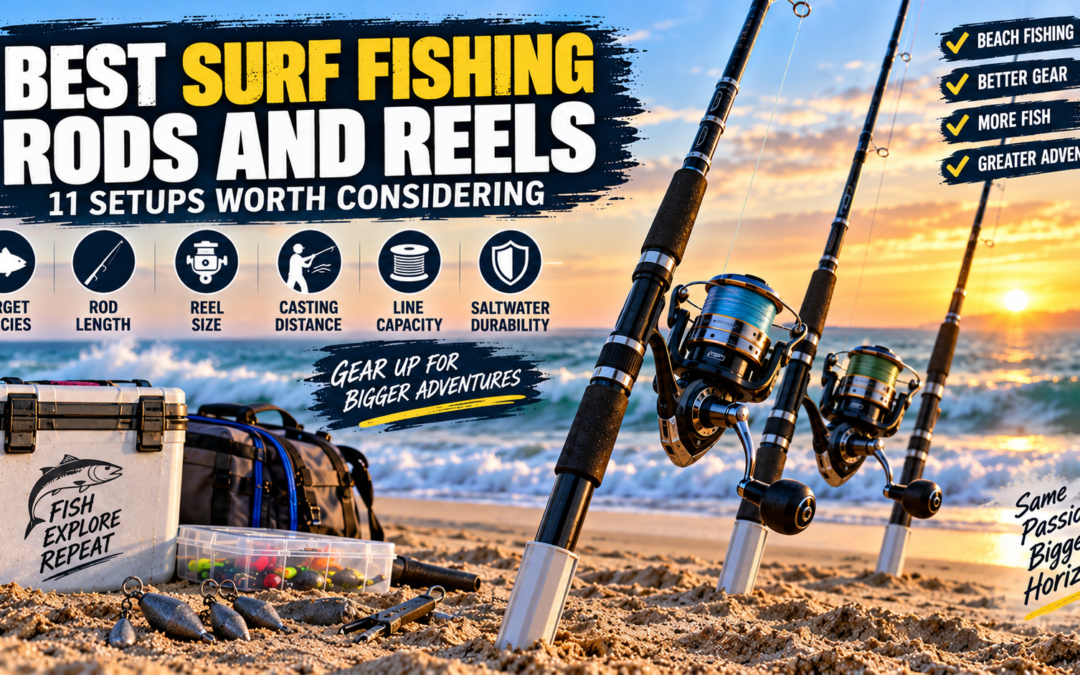
Choosing the right best surf fishing rods and reels starts with understanding how the two pieces of equipment work together. Surf fishing places different demands on tackle than fishing from a lake bank or a small river. You may need longer casts, heavier sinkers, more line capacity, stronger drag performance, and equipment that can tolerate repeated exposure to salt, sand, wind, and moving water.
A good setup is not simply the rod with the highest power or the reel with the largest spool. The goal is balance. Rod length, power, action, casting weight, reel size, line capacity, drag, construction, and comfort should all make sense for the beach, target species, and technique you plan to use.
Current surf-fishing guidance from Take Me Fishing emphasizes matching the best surf fishing rods and reels to the species, casting distance, and weight being cast, while its surf-fishing equipment guidance describes medium-to-heavy action rods, corrosion-resistant spinning reels, heavier line and leader combinations, and sinkers appropriate for current and tidal movement. See the current Take Me Fishing surf-fishing guide.
- What Makes the Best Surf Fishing Rods and Reels Different?
- Best Surf Fishing Rods and Reels Setups
- Choosing Rod Length
- Choosing Rod Power
- Understanding Rod Action
- Choosing Reel Size
- Line Capacity and Line Choice
- Saltwater, Sand and Corrosion
- How to Balance the Rod and Reel
- Spinning vs. Baitcasting for Surf Fishing
- How to Match Rods, Reels, Line and Sinkers
- Common Surf Fishing Rod and Reel Mistakes
- Surf Fishing Conditions Matter
- Surf Fishing Safety
- How to Maintain Your Best Surf Fishing Rods and Reels
- How to Store Your Best Surf Fishing Rods and Reels
- When Dedicated Surf Rods Make Sense
- Best Surf Fishing Rods and Reels Buying Checklist
- Frequently Asked Questions
What Makes the Best Surf Fishing Rods and Reels Different?
Choosing the best surf fishing rods and reels means finding equipment designed around the demands of fishing from shore. Surf anglers often have to cast beyond breaking waves, hold bait in moving water, work heavier rigs, and deal with conditions that can put salt and sand onto equipment.
That changes how you should evaluate a setup.
A freshwater rod that feels perfect on a quiet lake may not be appropriate for casting several ounces of tackle into the surf. Likewise, a small reel that works well for light freshwater fish may not have enough line capacity for a strong saltwater fish that makes a long run away from the beach.
Take Me Fishing specifically notes that surf anglers should consider the species being targeted, the distance required to reach the breaker zone, and the size of the weights being cast before choosing the best surf fishing rods and reels. Review its rod-and-reel selection guidance.
The equipment therefore needs to be viewed as one complete system rather than as unrelated products.
Best Surf Fishing Rods and Reels Setups
1. Light Surf Fishing Rod and Reel
A light surf fishing setup featuring the best surf fishing rods and reels is useful when you are targeting smaller species or fishing beaches where you do not need extremely heavy sinkers. It can also be a practical choice for anglers who value comfort and frequent casting over maximum power.
A lighter rod and reel can be easier to control, especially during a long session. The tradeoff is that you have less power for large fish and heavy rigs.
This type of setup is best suited to situations where:
- The target species are relatively small.
- You use lighter lures or sinkers.
- You do not need extreme casting distance.
- You prioritize lower overall weight.
- You want a manageable setup for shorter surf sessions.
Do not confuse light tackle with inadequate tackle. The objective is to use equipment appropriate for the fish and conditions rather than unnecessarily heavy gear.
2. Medium-Power General Surf Setup
A medium or medium-heavy setup utilizing the best surf fishing rods and reels can provide a useful balance for anglers who want one combination for several beach-fishing situations.
This configuration is often suitable for mixed species, moderate casting distances, and common bait rigs. The exact rod rating still needs to match the manufacturer's casting range.
A general-purpose setup can be particularly useful when you fish different beaches and do not want to own a specialized rod for every situation.
The emphasis should be on versatility:
- Enough rod power for common surf rigs.
- Enough reel capacity for the local fishery.
- Comfortable casting over repeated sessions.
- Reasonable corrosion resistance.
- A balanced feel when the reel is mounted.
3. Long-Casting Surf Fishing Setup
Some beaches require anglers to reach water beyond the nearest breakers. A longer surf rod combined with the best surf fishing rods and reels can provide additional casting leverage and help create distance when paired with the appropriate reel, line, and casting technique.
However, longer does not automatically mean better. A long rod can become tiring, awkward to transport, and difficult for a beginner to control.
Take Me Fishing notes that surf rods commonly fall into a broad range of lengths, with 10 to 12 feet described as a useful general-purpose range and longer rods becoming more relevant when additional casting distance is actually needed. See the rod-length guidance.
When selecting a long-distance setup, consider the complete system rather than length alone. A long rod paired with a poorly matched reel will not automatically produce better casting.
4. Heavy Surf Fishing Rod and Reel
A heavy setup built with the best surf fishing rods and reels is designed for situations involving larger fish, heavier rigs, stronger current, or more demanding surf conditions.
Heavy equipment can provide additional power, but it also increases weight. The setup should therefore be chosen according to actual fishing conditions rather than simply because heavier equipment appears more capable.
A heavy surf setup becomes more useful when you regularly:
- Cast heavier sinkers.
- Use larger natural baits.
- Target strong saltwater fish.
- Fish powerful currents.
- Need greater line capacity.
Current competitor research also shows surf combinations using medium-heavy and heavy rods paired with reels in larger size classes for demanding applications. Compare the surf-combo examples from OGO Fishing.
5. Beginner Surf Fishing Rod and Reel
A beginner should usually prioritize control, balance, ease of use, and a sensible power rating instead of buying the biggest setup available.
For many new surf anglers, a spinning reel matched through the best surf fishing rods and reels is easier to learn than a baitcasting reel because it generally has a simpler casting process and does not require the same level of spool-control technique.
Take Me Fishing's current beginner-oriented surf guidance describes a 10- to 12-foot medium-heavy rod with moderate action and a saltwater spinning reel in the 4500- to 6500-size range as one general starting configuration, while emphasizing that the final choice should depend on the fish, casting needs, and weight being used. Review the full beginner recommendation.
For broader rod education before making a purchase, see Hooked Beginner's fishing rods guide.
6. Portable Surf Fishing Rod and Reel Setup
Traveling anglers may need a transportable combination selected from the best surf fishing rods and reels. A two-piece rod can be more convenient for vehicle travel than a long one-piece rod, especially when multiple pieces of luggage and fishing gear are involved.
Portability should not be the only consideration. Check the assembled rod length, collapsed length, reel size, total weight, and protective storage requirements.
Portable equipment is particularly useful for anglers who:
- Fish multiple beaches.
- Travel regularly.
- Have limited storage space.
- Need equipment that fits inside a vehicle.
- Want a setup that can be transported without specialized racks.
7. Saltwater Spinning Rod and Reel
A saltwater spinning setup chosen from the best surf fishing rods and reels is one of the most accessible ways to approach surf fishing. Spinning equipment is straightforward to cast and can cover a wide variety of beach-fishing applications.
The reel should be selected with saltwater exposure in mind. Corrosion-resistant construction, appropriate seals, suitable materials, and regular maintenance become more important when the equipment is repeatedly exposed to salt and sand.
Take Me Fishing's surf-fishing equipment recommendations include a heavy-duty, corrosion-resistant spinning reel alongside a medium-to-heavy surf rod. See the current equipment guidance.
Hooked Beginner also has a dedicated spinning fishing rods guide for anglers comparing spinning rod options.
8. Large-Capacity Surf Fishing Reel Setup
When targeting powerful fish, reel capacity matters. A fish that runs a long distance can quickly reduce the amount of line remaining on a small spool.
A larger-capacity reel found among the best surf fishing rods and reels can also accommodate heavier line while leaving enough room for meaningful line length. However, a larger spool also increases weight, so it needs to remain appropriate for the rod.
Take Me Fishing's surf guidance uses heavier line and leader ranges for many surf applications and notes that sinker weight may increase when wind, tide, or current demand it. Review its current line and tackle guidance.
For a deeper explanation of reel sizing, use the fishing reel size guide.
9. Premium Surf Fishing Rod and Reel System
Experienced surf anglers may choose higher-end equipment from the best surf fishing rods and reels for specific advantages such as lower weight, improved components, better drag performance, refined balance, or additional corrosion protection.
Premium equipment makes the most sense when those differences solve a real fishing problem. Paying more simply because the equipment is positioned as premium does not automatically make the setup better for your beach or species.
A premium setup should still be evaluated using the same fundamentals:
- Rod length.
- Rod power.
- Rod action.
- Casting weight.
- Reel capacity.
- Drag performance.
- Corrosion resistance.
- Overall balance.
Choosing the Right Surf Fishing Rod Length
Rod length affects casting leverage, control, transport, and the overall physical demands of surf fishing.
A shorter rod can be easier to control and may be sufficient when fish are feeding relatively close to shore. A medium-length rod can provide broader versatility, while longer rods selected from the best surf fishing rods and reels can help when additional casting distance is genuinely needed.
Current Take Me Fishing guidance describes rods between 9 and 14 feet as common for surf fishing and recommends considering whether you actually need the extra distance before moving to the longest options. Read the full rod-length explanation.
Before choosing a length, answer three questions:
- How far do I actually need to cast?
- What sinker or lure weight will I be casting?
- Can I comfortably control the rod for several hours?
For a broader explanation of rod length and fishing applications, use Hooked Beginner's fishing rod length guide.
Choosing Rod Power
Rod power describes how much force is needed to bend the rod. When evaluating the best surf fishing rods and reels, power needs to match the size of your rig and the strength of the fish you expect to encounter.
Light and medium power can be useful for smaller species and lighter rigs. Medium-heavy and heavy rods become more useful as sinker weight, bait size, current, and fish size increase.
One of the biggest mistakes is choosing rod power based only on the expected fish. The casting weight is equally important.
A rod may be capable of fighting a strong fish but still be unsuitable for the weight you are trying to cast.
Before buying, check the printed lure or line ratings on the blank and stay within the manufacturer's specifications.
Hooked Beginner's fishing rod power guide can help clarify how power ratings work.
Understanding Rod Action
Rod action describes where the blank bends when pressure is applied.
Fast-action rods generally bend closer to the tip. Moderate-action rods bend farther down the blank, while slower actions allow more of the rod to load.
For surf fishing using the best surf fishing rods and reels, action affects casting feel, loading characteristics, sensitivity, and hook-setting behavior.
A moderate action can provide a useful combination of casting load and fish-fighting characteristics, while a faster action can offer a more direct feel.
Rather than choosing action by name alone, consider how the action fits your technique, lure or bait presentation, casting style, and target fish.
Learn more about these differences in the fishing rod action guide.
Choosing the Right Reel Size
Reel size should complement the rod. The goal is to have enough line capacity, drag capability, and mechanical strength without creating unnecessary weight.
When comparing the best surf fishing rods and reels, consider:
- Spool capacity.
- Line diameter and strength.
- Drag range.
- Overall reel weight.
- Corrosion resistance.
- Gear ratio.
- Spool design.
- Handle size and leverage.
A reel that is too small can run out of capacity during a long fish run. A reel that is excessively large can make the complete setup tiring and unbalanced.
Take Me Fishing's current beginner surf-fishing guidance provides a 4500- to 6500-size spinning reel as one general reference when paired with a 10- to 12-foot medium-heavy surf rod. See the complete recommendation and its conditions.
Line Capacity and Line Choice
Line selection should be based on the species, abrasion risk, casting requirements, and reel capacity.
Braid
Braided line provides high strength relative to diameter and can increase the amount of line that fits on a spool. Its lower stretch can also provide a more direct connection to the rig.
Monofilament
Monofilament provides stretch and is widely used for fishing applications where shock absorption and simplicity are valuable.
Leader
A leader can provide additional abrasion resistance when fishing around structure, sand, rocks, shell, or powerful fish.
Current Take Me Fishing surf guidance gives 17- to 20-pound main line with 30- to 40-pound leader as one general equipment example, with heavier leaders possible when conditions require heavier sinkers. Review the current surf-tackle recommendations.
These are references, not universal rules. Local fish species, regulations, current, structure, bait, and casting weight should determine the final setup.
Saltwater, Sand and Corrosion
Saltwater is one of the most important reasons to choose the best surf fishing rods and reels carefully.
Salt residue can remain on guides, reel bodies, handles, reel seats, line, and other components. Sand creates another problem because abrasive particles can work into moving parts and contact surfaces.
Look for equipment designed for saltwater exposure, but do not interpret “saltwater ready” as “maintenance free.”
Take Me Fishing recommends corrosion-resistant spinning reels for surf fishing and emphasizes cleaning equipment after exposure to the marine environment. Review its saltwater gear guidance.
A good post-trip routine includes:
- Remove visible sand and debris.
- Clean the equipment according to manufacturer instructions.
- Inspect the guides and reel.
- Check the line for abrasion.
- Dry the equipment thoroughly.
- Store it away from unnecessary moisture and impact.
For reel care, use the fishing reel maintenance guide.
How to Balance the Rod and Reel
A balanced setup feels comfortable when you hold it in the position you normally use while fishing.
Mount the reel and hold the rod by the grip. Pay attention to how much effort is required to keep the setup in position.
If the reel is substantially heavier than the rod can comfortably support, the setup may feel awkward and become tiring during repeated casting.
Balance matters because surf fishing can involve hundreds of casts, long periods of holding the rod, repeated bait checks, and changing positions along the shoreline.
Current OGO Fishing surf-combo testing also places emphasis on how complete rod-and-reel combinations feel in hand and how the pairing performs with particular rig weights. Review its current surf-combo examples.
Spinning vs. Baitcasting for Surf Fishing
Spinning reels are commonly chosen for surf fishing because they are simple to cast and can handle a broad range of beach-fishing applications.
Baitcasting reels can provide precise control and strong mechanical performance, but they require more experience with spool control and casting technique.
For a first set of the best surf fishing rods and reels, matched spinning setups are usually the easier place to start for many anglers.
That does not make baitcasting equipment unsuitable. The best reel type depends on the angler's experience, target species, lure or bait, and preferred casting technique.
How to Match Rods, Reels, Line and Sinkers
Think of your surf setup as four connected decisions:
| Component | Main Question | What It Affects |
|---|---|---|
| Rod length | How far must I cast? | Casting leverage and control |
| Rod power | How heavy is the rig and how strong are the fish? | Loading and fighting power |
| Reel size | How much line and drag do I need? | Capacity and fish control |
| Line and sinker | What conditions must the rig handle? | Casting, bottom contact and abrasion resistance |
When these components are matched, the setup becomes easier to cast, more comfortable to use, and more predictable when fighting fish.
Common Surf Fishing Rod and Reel Mistakes
Buying the Longest Rod
A longer rod is useful only when you can control it and when additional distance actually helps. A shorter, better-balanced rod can be more productive than a long rod that is uncomfortable to cast.
Using an Oversized Reel
A large reel may provide additional capacity, but excessive weight can make the entire combination tiring.
Ignoring the Casting Rating
Never select a sinker simply because the rod looks powerful enough. Follow the manufacturer's published rating.
Forgetting Saltwater Maintenance
Saltwater equipment needs regular care. Rinsing, drying, inspection, and appropriate storage all form part of the setup.
Choosing Line Without Considering the Reel
Line diameter affects how much line fits on the spool and how the setup performs during casting. Always evaluate the line and reel together.
Choosing Equipment for the Biggest Possible Fish
Build the setup around the fish you realistically target. Oversizing every component can reduce comfort without providing a meaningful advantage.
Surf Fishing Conditions Matter
Your equipment should reflect the beach itself.
Strong current may require heavier sinkers. Wind can affect casting and line control. Larger breakers can make line management more difficult. Rocks and structure can increase abrasion.
These conditions should influence the rod power, reel capacity, line and leader selection.
That is why copying another angler's exact surf setup does not always produce the same result. Their beach, target species, casting distance and fishing technique may be completely different from yours.
Surf Fishing Safety
Fishing from the beach also requires awareness of changing water conditions.
NOAA describes rip currents as powerful, narrow currents that move away from shore through the surf zone. They can form around features such as sandbars and structures and can be dangerous to people in the water. See NOAA's beach-safety information.
Anglers should monitor local beach warnings, weather conditions, surf conditions, and access restrictions before entering the shoreline area. Never assume that calm-looking water is automatically safe.
How to Maintain Your Best Surf Fishing Rods and Reels
Maintenance should begin as soon as the fishing session ends.
Start by removing obvious sand and debris. Clean your best surf fishing rods and reels according to the manufacturer's instructions. Inspect line, guides, reel handles, bail components, and other parts that may have been exposed to salt or grit.
Allow everything to dry before storing the equipment. Avoid trapping moisture inside bags, cases, or enclosed storage spaces.
Long-term storage also deserves attention. Store rods where tips cannot be bent or crushed and keep reels away from unnecessary moisture.
How to Store Your Best Surf Fishing Rods and Reels
Proper storage of your best surf fishing rods and reels helps protect the equipment between trips.
Keep assembled rods in a rack or holder that supports them without putting pressure on delicate tips or guides. Avoid leaning multiple rods together in a corner where reels and blanks can collide.
If you are building a larger storage system, Hooked Beginner's fishing rod storage guide covers vertical, horizontal, ceiling and wall-mounted options.
For anglers with several setups, separating freshwater rods from saltwater equipment can also make cleaning and maintenance easier.
When Dedicated Surf Rods Make Sense
You do not necessarily need dedicated surf rods if you are only experimenting with beach fishing. However, purpose-built setups become increasingly useful when you regularly fish from the surf.
A dedicated system can be justified when:
- You regularly cast heavier rigs.
- You fish saltwater frequently.
- You need greater casting distance.
- You target stronger coastal species.
- You want equipment optimized for beach conditions.
The more often you fish in the surf, the more valuable the correct length, power, reel capacity, corrosion resistance and balance become.
Best Surf Fishing Rods and Reels Buying Checklist
Before buying your best surf fishing rods and reels, work through this checklist:
- Target species: What fish do you actually plan to catch?
- Rod length: How far must you cast?
- Rod power: What rig weight and fish size must the rod handle?
- Rod action: How do you want the rod to load and recover?
- Reel size: How much line capacity do you need?
- Drag: Is the reel suited to the target fish?
- Line: Will you use braid, mono, or both?
- Leader: What abrasion resistance is required?
- Saltwater protection: Is the equipment designed for marine exposure?
- Balance: Does the reel complement the rod?
- Comfort: Can you cast and hold the setup repeatedly?
- Transport: Can you safely carry and store it?
- Budget: Are you paying for features that you actually need?
Frequently Asked Questions
What are the best surf fishing rods and reels setups?
A good setup is one that matches the target species, casting weight, casting distance, line, reel capacity and beach conditions. There is no single combination that works equally well for every surf angler.
What length rod is best for surf fishing?
Many surf rods fall within a broad range from roughly 9 to 14 feet. A 10- to 12-foot setup can provide a useful balance for many general-purpose applications, while shorter or longer rods may be better for specific situations. See the current Take Me Fishing rod-length guidance.
What reel size is good for surf fishing?
Reel size depends on the rod, fish, line and conditions. Take Me Fishing currently describes 4500- to 6500-size saltwater spinning reels as one general starting range for certain beginner surf setups using medium-heavy rods. Read the full context before choosing a size.
Is spinning or baitcasting better for surf fishing?
Spinning reels are generally simpler to cast and are widely used for surf fishing. Baitcasting equipment can provide strong control and accuracy but usually requires more casting experience.
How much line capacity do I need for surf fishing?
The correct capacity depends on target species and how far a fish may run. Larger fish and situations requiring longer casts can justify additional capacity. The reel should also retain enough line after the casting distance has been removed.
Is braid or monofilament better for surf fishing?
Both can work. Braid provides high strength relative to diameter and low stretch, while monofilament offers stretch and is widely used for many applications. Choose based on species, structure, casting demands and personal preference.
How do I protect my reels from saltwater?
Use equipment appropriate for saltwater, minimize unnecessary contact with sand, follow the manufacturer's cleaning instructions, and dry the reels properly after use.
Can I use freshwater rods for surf fishing?
Some freshwater rods may physically cast from shore, but equipment should be selected according to the weight being cast, target species, saltwater exposure and expected conditions. Dedicated surf setups are generally easier to match to demanding beach applications.
Do I need special rod holders for surf fishing?
Rod holders or sand spikes can help keep rods in position while protecting reels from direct contact with sand. Take Me Fishing includes rod holders or sand spikes among common surf-fishing equipment. See the complete surf-fishing equipment list.
Conclusion
The right best surf fishing rods and reels are not defined by one number, one brand, or one price range. They are defined by how well the complete systems match the fishing conditions.
Start with your target species and the weight you need to cast. Then choose rod lengths that provide the casting distance you actually require, power ratings that handle your rigs, actions that fit your technique, and reels with enough capacity and drag without making the setups unnecessarily heavy.
Saltwater changes the equation as well. Corrosion resistance, cleaning, storage and maintenance are part of the equipment decisions rather than an afterthought.
For the next step, compare Hooked Beginner's saltwater fishing rods, explore the wider fishing reels section, and use the rod length guide and reel size guide to refine the specifications.
Once the rods, reels, line, sinkers and leaders all make sense together, you have surf setups that are easier to cast, more comfortable to fish, and better prepared for the conditions waiting beyond the breakers.