
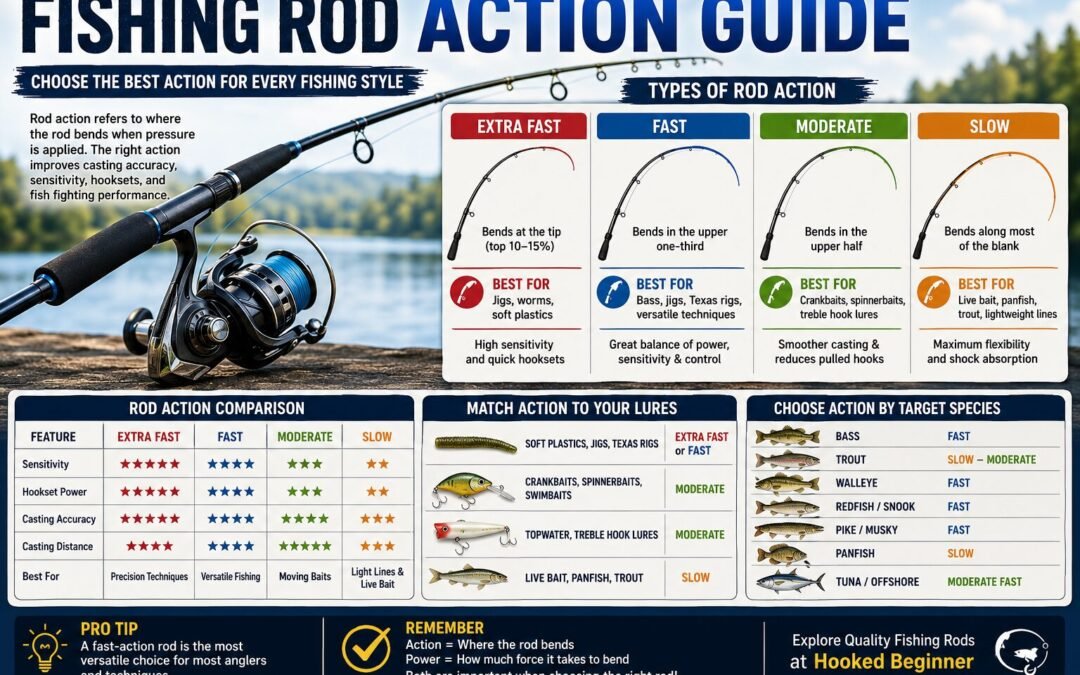
Fishing Rod Action Guide: Choose the Best Action for Every Fishing Style
A complete Fishing Rod Action Guide is one of the most valuable resources for anglers looking to improve casting accuracy, hook-setting performance, and lure presentation. While many anglers focus on rod length or power, rod action has an equally important impact on how your fishing rod performs on the water.
This Fishing Rod Action Guide explains what rod action means, how different actions affect fishing performance, and how to choose the right action for your target species and favorite techniques. Whether you fish freshwater lakes, rivers, saltwater flats, surf beaches, or offshore waters, understanding rod action will help you make better equipment decisions.
Table of Contents
What Is Fishing Rod Action?
A Fishing Rod Action Guide begins by explaining that rod action refers to where the fishing rod bends when pressure is applied. It is different from rod power. While rod power measures how much force is needed to bend the rod, rod action describes where along the blank that bend occurs.
Understanding this distinction is essential because rod action influences casting distance, lure control, sensitivity, hook-setting speed, and the way a rod fights fish. Learning the basics in this Fishing Rod Action Guide will make it much easier to choose the right rod for your preferred fishing style.
Browse our selection of Fishing Rods to compare spinning, casting, and specialty rod options.
Types of Fishing Rod Action
Every Fishing Rod Action Guide divides rod action into several common categories. Each action is designed for specific fishing techniques, lure types, and target species.
| Rod Action | Where the Rod Bends | Typical Uses |
|---|---|---|
| Extra Fast | Very tip of the rod | Jigs, worms, precision hooksets |
| Fast | Upper one-third | Bass fishing, versatile techniques |
| Moderate | Upper half | Crankbaits, spinnerbaits, treble hooks |
| Slow | Most of the rod blank | Live bait, small fish, relaxed fighting action |
This Fishing Rod Action Guide recommends understanding these four action categories before selecting a fishing rod because each offers different casting and fish-fighting characteristics.
Fast Action Rods
Fast-action rods are among the most popular options discussed in every Fishing Rod Action Guide. These rods bend primarily near the tip while the lower portion remains relatively stiff. This design creates excellent sensitivity, quick hooksets, and precise lure control.
Advantages of Fast Action Rods
- Outstanding sensitivity.
- Excellent hook-setting power.
- Better control of soft plastic lures.
- Ideal for jig fishing.
- Highly versatile for freshwater and inshore fishing.
A Fishing Rod Action Guide generally recommends fast-action rods for bass anglers because they provide quick response and excellent lure control.
- Shimano Curado Spinning Rods
- St. Croix Triumph Spinning Rods
- Shimano Clarus E Spinning Rods
- Excellent casting distance.
- Smoother fish-fighting action.
- Ideal for treble-hook lures.
- Helps prevent pulled hooks.
- Forgiving for beginner anglers.
- Maximum flexibility.
- Excellent shock absorption.
- Great for lightweight lines.
- Ideal for panfish and trout.
- Smooth fish-fighting performance.
- Shimano Curado Spinning Rods
- St. Croix Premier 2025 Spinning Rods
- St. Croix Triumph Spinning Rods
- Shimano Grappler Type J Rods
- IMX Pro Blue Saltwater Rods
- Carbon R1 One Piece Fishing Rod
- Fishing Rod Buying Guide
- How to Choose a Fishing Rod
- Fishing Reel Buying Guide
- Fishing Reel Size Guide
- Fishing Reel Maintenance Guide
- Shop Fishing Rods
- Browse Fishing Reels
- Explore Rod & Reel Combos
- Fishing Accessories
- Fishing Rod Buying Guide
- Take Me Fishing – Learn more about fishing techniques, tackle selection, and beginner education.
- International Game Fish Association (IGFA) – Explore ethical angling practices, species information, and world-record catches.
- NOAA Fisheries – Access fisheries regulations, conservation information, and sustainable fishing resources.
Moderate Action Rods
A complete Fishing Rod Action Guide would not be complete without discussing moderate-action rods. These rods bend through approximately the upper half of the blank, creating a smoother casting motion and helping absorb the shock from aggressive fish. This makes moderate-action rods especially effective when using treble-hook lures.
Many anglers following this Fishing Rod Action Guide choose moderate-action rods for crankbaits, spinnerbaits, swimbaits, and other moving lures because the softer bend reduces the chance of pulling hooks free during the fight.
Advantages of Moderate Action Rods
Slow Action Rods
Every Fishing Rod Action Guide should also explain slow-action rods. These rods bend throughout most of the blank, providing maximum flexibility and cushioning during the fight. Although they are less common for modern bass fishing, they remain useful for certain techniques and species.
This Fishing Rod Action Guide recommends slow-action rods for anglers using live bait, ultralight tackle, or targeting smaller fish where a softer presentation is beneficial.
Advantages of Slow Action Rods
Fishing Rod Action Comparison
This Fishing Rod Action Guide compares the most common rod actions to help simplify your buying decision.
| Action | Sensitivity | Hooksets | Best For |
|---|---|---|---|
| Extra Fast | Excellent | Excellent | Jigs, worms |
| Fast | Very High | Very Strong | Bass, versatile fishing |
| Moderate | Good | Moderate | Crankbaits, spinnerbaits |
| Slow | Moderate | Gentle | Live bait, trout |
Using this Fishing Rod Action Guide, most anglers will find that fast-action rods provide the best balance of versatility, sensitivity, and hook-setting performance.
Choosing Rod Action by Target Species
One of the easiest ways to apply this Fishing Rod Action Guide is by matching rod action to the species you fish most often.
| Species | Recommended Action |
|---|---|
| Bass | Fast |
| Trout | Slow to Moderate |
| Panfish | Slow |
| Walleye | Fast |
| Pike | Fast |
| Redfish | Fast |
| Snook | Fast |
| Tuna | Moderate Fast |
This Fishing Rod Action Guide recommends fast-action rods for anglers seeking an all-around solution capable of handling a wide variety of freshwater and inshore saltwater fishing situations.
Helpful collections:
How Rod Action Affects Casting Performance
A complete Fishing Rod Action Guide should explain how rod action directly affects casting performance. The amount and location of the bend determine how efficiently energy is transferred during a cast. Understanding this relationship helps anglers choose equipment that matches both their fishing style and favorite lures.
Fast-action rods recover quickly after loading, producing accurate casts and excellent lure control. Moderate-action rods load more deeply, making long casts with moving baits easier. Slow-action rods bend throughout the blank, delivering lightweight presentations with exceptional smoothness.
| Rod Action | Casting Accuracy | Casting Distance |
|---|---|---|
| Extra Fast | Excellent | Good |
| Fast | Excellent | Very Good |
| Moderate | Very Good | Excellent |
| Slow | Good | Moderate |
This Fishing Rod Action Guide recommends choosing rod action based on your primary fishing technique rather than simply selecting the fastest action available.
Matching Rod Action to Popular Lures
One of the easiest ways to use this Fishing Rod Action Guide is by selecting rod action based on the lures you throw most often.
| Lure Type | Recommended Rod Action |
|---|---|
| Soft Plastics | Fast |
| Football Jigs | Fast |
| Texas Rigs | Fast |
| Spinnerbaits | Moderate |
| Crankbaits | Moderate |
| Topwater Treble Hooks | Moderate |
| Live Bait | Slow |
Using the correct rod action improves hook-up percentages, lure performance, and your overall fishing success.
Common Rod Action Mistakes
Many anglers misunderstand rod action when purchasing new equipment. This Fishing Rod Action Guide highlights several common mistakes that can easily be avoided.
Choosing Extra Fast for Every Technique
Although extra-fast rods are extremely sensitive, they are not ideal for every lure. Moderate-action rods often outperform them when fishing crankbaits and other treble-hook presentations.
Confusing Action with Power
One of the biggest lessons in this Fishing Rod Action Guide is understanding that rod action and rod power are completely different specifications. Action describes where the rod bends, while power describes how much force is required to make it bend.
Ignoring Target Species
Always consider the fish you target most often. A rod that performs exceptionally well for bass may not be the best option for trout, surf fishing, or offshore species.
Overlooking Reel Balance
Even the best rod action cannot compensate for a poorly balanced setup. Pair your rod with a properly sized reel for maximum comfort and casting efficiency.
Recommended Fishing Rods
If you're ready to apply this Fishing Rod Action Guide, explore these rod collections and product pages on Hooked Beginner.
Continue Learning
Frequently Asked Questions
What is the best rod action for beginners?
This Fishing Rod Action Guide recommends a fast-action rod for most beginners because it offers an excellent balance of sensitivity, casting accuracy, and versatility. It performs well with many popular fishing techniques and target species.
Is fast action better than moderate action?
Not always. A fast-action rod excels with soft plastics, jigs, and single-hook lures, while a moderate-action rod is often the better choice for crankbaits, spinnerbaits, and other treble-hook lures. The best option depends on how you fish.
What is the difference between rod action and rod power?
One of the most important lessons in this Fishing Rod Action Guide is understanding that rod action describes where the rod bends, while rod power describes how much force is required to bend it. These two specifications work together but serve different purposes.
Can one rod action handle every fishing technique?
No rod action is perfect for every situation. However, this Fishing Rod Action Guide recommends fast-action rods as the most versatile choice for anglers who regularly fish with a variety of lures and target multiple species.
Which rod action is best for bass fishing?
Fast-action rods are widely considered the best option for bass fishing because they provide outstanding sensitivity, quick hooksets, and excellent lure control. Moderate-action rods are also popular for crankbait and reaction-bait presentations.
Final Thoughts
A complete Fishing Rod Action Guide helps anglers understand one of the most important characteristics of any fishing rod. Choosing the correct rod action improves casting accuracy, lure presentation, hook-setting performance, and your ability to fight fish effectively.
Whether you prefer fast-action rods for bass fishing, moderate-action rods for moving baits, or slow-action rods for live bait and ultralight techniques, understanding rod action allows you to build a balanced setup that matches your fishing style and target species.
Before purchasing your next rod, compare rod action alongside rod power, length, materials, and reel compatibility to ensure your equipment performs at its highest potential every time you hit the water.
Trackbacks/Pingbacks