
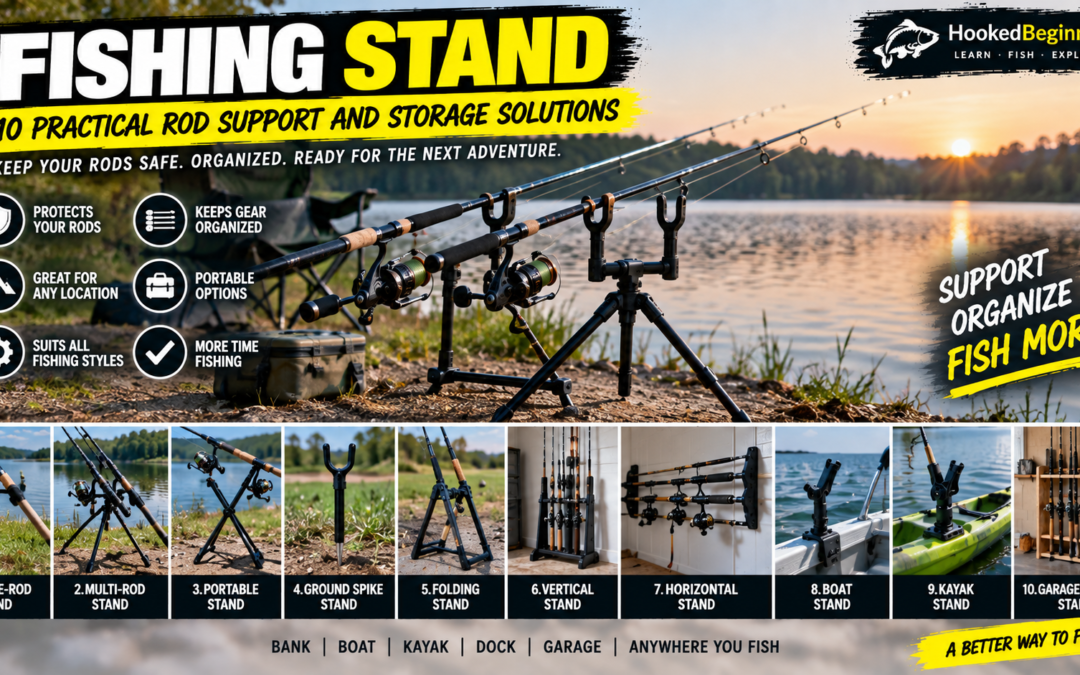
Fishing Stand: 10 Practical Rod Support and Storage Solutions
A fishing stand gives anglers a simple way to support, organize, protect, or temporarily rest fishing rods while they are on the water, on the bank, or storing equipment at home. Instead of laying rods on the ground, leaning them against a wall, or leaving them across a boat deck, a properly designed stand keeps the rod in a controlled position.
Fishing stands can be used for many different purposes. Some are designed for bank fishing and keep a rod elevated above the ground. Others are built for boat or kayak fishing, while storage stands can hold multiple rods between trips. Portable stands can also be useful when an angler needs a quick support system that can be moved from one fishing location to another.
The important thing is to match the stand to the job. A lightweight portable stand that works well for a single rod may not be appropriate for storing a large collection of fully rigged rods. Likewise, a home storage stand may not have the stability or mounting requirements needed for fishing from a boat.
This guide explains how a fishing stand works, the main types available, where each type makes sense, how to choose one, what materials and stability features matter, and which common mistakes can damage rods or make a setup inconvenient.
For the rod itself, start with Hooked Beginner's fishing rod buying guide. You can also use the fishing rod length guide, fishing rod power guide, and fishing rod action guide when deciding what kind of stand will work with your equipment.
What Is a Fishing Stand?
A fishing stand is a structure designed to support one or more fishing rods in a stable and accessible position. Depending on the design, it may be used while actively fishing or simply for storage and organization.
A simple fishing rod stand may have one rod slot and a wide base. A multi-rod stand can contain several holders arranged vertically or horizontally. Some stands fold for transportation, while others are intended to remain permanently installed.
There is an important difference between a stand and a traditional rod holder. A rod holder is generally the individual point where the rod sits. A stand is the larger support structure that may contain one or more holders.
For example, a portable bank-fishing stand may include a base, legs, an upright support, and one or more rod rests. A home storage stand may have several vertical tubes or padded slots. A boat-mounted system may use a base attached directly to the boat rather than standing independently on the ground.
The right design depends on where you fish, how many rods you need to support, how frequently you move the stand, and whether the rods remain fully rigged.
Why a Fishing Stand Matters
It Protects Rods From the Ground
Placing a rod directly on dirt, gravel, sand, concrete, or a boat deck exposes it to unnecessary contact with surfaces that can scratch or damage components. A stand keeps the rod elevated and creates a dedicated resting position.
It Keeps Multiple Rods Organized
Anglers often use more than one rod during a trip or own multiple setups for different techniques. A stand creates separation between rods and reduces the chance of line tangles, accidental stepping, and equipment clutter.
The International Game Fish Association also provides guidance on organizing fishing tackle and equipment, reinforcing the value of keeping gear orderly and accessible. Review the IGFA tackle organization guide.
It Makes Rods Easier to Reach
A good stand puts the rod in a predictable location. This matters when you are switching between rods or need to grab one quickly after a bite.
It Can Improve Bank-Fishing Comfort
Bank anglers frequently have limited places to put rods. A stand can create a stable support point where there is no convenient bench, dock, or built-in holder.
It Helps With Home Storage
Once you return home, a stand can keep rods upright, separated, and off the floor. This makes equipment easier to inspect, clean, and access before the next trip.
10 Practical Fishing Stand Options
1. Single-Rod Fishing Stand
A single-rod stand is a simple solution when you only need one rod supported at a time. It can be useful for casual bank fishing, compact storage, or keeping a rod in a controlled position while you prepare bait or tackle.
The key feature is stability. A narrow stand that tips easily can be more frustrating than helpful. Look for a sufficiently wide base and a holder that grips or supports the rod securely without damaging the blank.
2. Multi-Rod Fishing Stand
A multi-rod stand is designed for anglers who need several rods organized in one location. These stands can be useful in garages, fishing rooms, workshops, boats, or bank-fishing setups where several rods need to remain ready.
Spacing is important. Rods should have enough separation that reels, handles, guides, and lines do not constantly collide.
3. Portable Bank Fishing Stand
A portable bank stand is designed to travel with you. It may use folding legs, adjustable supports, or a compact frame that can be placed on the ground near the fishing position.
This type of fishing stand for fishing rods should be quick to set up and easy to transport. Weight matters, but stability matters just as much. A very light stand can become difficult to use in wind or on uneven terrain.
4. Ground Spike Rod Stand
A ground spike system anchors the rod support into the soil. This can provide useful stability on grassy banks, soft ground, or suitable soil conditions.
The limitation is that hard surfaces, rocky banks, concrete, and some heavily compacted areas may not accept the spike easily.
5. Folding Rod Stand
A folding stand prioritizes portability and storage. It can be useful when the angler needs a temporary support system that packs away between trips.
When evaluating a folding design, check the locking mechanism, base width, hinge construction, and how stable the stand becomes when fully opened.
6. Vertical Rod Stand
A vertical stand keeps rods upright and uses relatively little floor space. This can be particularly useful in garages, workshops, and fishing rooms.
Vertical storage also makes it easy to identify individual rods quickly. However, the base needs to remain stable and the top support should prevent the rods from leaning excessively.
7. Horizontal Rod Stand
A horizontal stand supports rods along their length. This can work well when ceiling height is limited or when you want to keep rods closer to a workbench or storage wall.
The supports should be padded or otherwise designed to avoid pressure points that can damage the rod finish or blank over long periods.
8. Boat Fishing Stand
A boat-oriented stand or support system is designed around limited deck space, movement, and water exposure.
Boat installations should be stable and positioned where they do not interfere with seating, casting, electronics, hatches, or other fishing equipment.
Hooked Beginner also has a Scotty 290-R-5 Rod Holder for anglers comparing dedicated rod-support equipment.
9. Kayak Rod Stand
Kayaks have less available space than most boats, so compact support systems are especially important. A kayak-oriented rod stand or holder should be easy to reach without forcing you to turn excessively or lose balance.
Look at the mounting location, paddle clearance, seat position, and the angle of the rod before installing any support.
10. Workshop or Garage Rod Stand
A garage or workshop stand is designed primarily for storage. The goal is to keep multiple rods protected, separated, and ready for the next trip.
This is often where a larger fishing pole stand makes the most sense. Instead of leaving rods in corners or stacked against walls, you can give each setup a dedicated position.
Fishing Stand Comparison Table
| Stand Type | Best Use | Portability | Rod Capacity | Main Priority |
|---|---|---|---|---|
| Single-rod stand | One rod support | High | 1 | Simple access |
| Multi-rod stand | Multiple rods | Low to moderate | Several | Organization |
| Bank stand | Shore fishing | High | 1 or more | Stability |
| Ground spike stand | Soft ground | Moderate | 1 or more | Anchoring |
| Folding stand | Travel | Very high | 1 or more | Compact storage |
| Vertical stand | Home storage | Low | Several | Space efficiency |
| Horizontal stand | Home storage | Low | Several | Rod support |
| Boat stand | Boat fishing | Low | 1 or more | Secure mounting |
| Kayak stand | Kayak fishing | Low | 1 or more | Compact access |
| Garage stand | Long-term storage | Low | Several | Protection and organization |
How to Choose a Fishing Stand
Start With Where You Fish
The fishing environment should be your first consideration.
| Fishing Environment | Important Stand Feature |
|---|---|
| Grass bank | Stable base or suitable ground anchor |
| Rocky bank | Wide freestanding base |
| Sandy area | Base designed to resist sinking |
| Dock | Compact and stable support |
| Boat | Secure mounting and clearance |
| Kayak | Compact access and low interference |
| Garage | Capacity and long-term protection |
| Workshop | Easy access and organization |
Decide How Many Rods You Need to Support
Capacity should be based on your actual equipment rather than the maximum number advertised by a stand.
If you normally take two rods, a compact stand may be more practical than a large rack. If you maintain a collection of specialized rods, a larger storage system may save space and reduce clutter.
Check Rod Length
Longer rods need enough clearance to remain stable and avoid hitting walls, ceilings, boat equipment, or other objects.
Use Hooked Beginner's fishing rod length guide when planning the storage dimensions for longer rods.
Consider Rod and Reel Orientation
A stand should accommodate the complete setup rather than just the blank. Large spinning reels, baitcasting reels, trigger grips, and other handle designs can require additional clearance.
Place the rod in the stand with the reel attached before finalizing the size and spacing.
Look at Base Stability
A stand that supports a rod but tips over easily is not doing its job. Examine the width of the base, leg design, center of gravity, and surface contact area.
Outdoor stands should also account for wind, uneven ground, and accidental contact.
Check Material and Padding
Metal, plastic, composite, and wood stands can all work. The important questions are whether the material is durable enough for the intended environment and whether the points contacting the rod are protective.
Padding can reduce scratching and pressure against the blank or handle.
Fishing Stands for Different Use Cases
Bank Fishing
Bank anglers benefit from stands that can be placed close to the water without becoming unstable. Look for designs that can handle uneven terrain and allow the rod tip to extend over the water while keeping the reel safely positioned.
A stand can also keep the rod away from mud, sand, wet grass, and gravel.
Pier and Dock Fishing
Docks and piers generally provide a hard, level surface, making a freestanding stand more practical than a ground spike.
The main issue becomes movement and available space. The stand should occupy as little walking area as possible and should not become a trip hazard.
Boat Fishing
Boat fishing demands secure positioning. Rod support should not interfere with the driver's controls, seating, electronics, anchor system, or other equipment.
For boat-specific mounting, Hooked Beginner also covers downrigger mounts and rod tubes for boat storage solutions.
Kayak Fishing
Kayak anglers need compact systems that remain within easy reach. A stand or holder should not interfere with paddling or make the kayak feel awkwardly loaded.
Position the rod so that you can reach it without twisting excessively.
Home Storage
Home storage stands should protect the rod while making it easy to retrieve. Vertical systems can save floor space, while horizontal systems can be useful where ceiling height or wall layout is more suitable.
Garage Storage
Garages often contain vehicles, tools, bicycles, and other equipment, so a stand should be placed where rods will not be struck or crushed.
Leave enough room to remove each rod without knocking neighboring equipment out of position.
Materials and Setup Considerations
A practical fishing rod holder stand can be made from several materials, and the best choice depends on where the stand will be used.
Plastic
Plastic stands can be lightweight and resistant to moisture. They are often useful for portable or indoor applications.
Aluminum
Aluminum can offer low weight with useful rigidity and can be suitable for portable and marine applications when appropriately constructed.
Steel
Steel can provide substantial strength and stability, although weight and corrosion protection become important considerations.
Wood
Wood can be a practical material for garage or workshop storage. It can also be customized to hold a particular number of rods.
Padded Contact Points
Regardless of the frame material, the places that actually touch the rod deserve attention. Padded or smooth contact surfaces can help reduce cosmetic damage.
Stable Footprint
The base should be proportionate to the height and number of rods being supported. As the stand becomes taller or holds more rods, the risk of tipping increases if the base is too small.
How to Set Up a Fishing Stand Correctly
Start by selecting a stable location. Avoid soft ground when using a stand that depends on a flat base, and avoid locations where foot traffic can easily knock the structure over.
Place the stand so that rods are within comfortable reach. When bank fishing, position it close enough to monitor the rod while keeping it safely away from the immediate walking path.
For multiple rods, spread them according to their reel and handle dimensions rather than forcing them into tight slots.
Check that lines cannot wrap around neighboring rods. This is especially important when several rods are fully rigged.
Before leaving the setup unattended, test the stand by gently loading each slot or holder with the corresponding rod. Watch for excessive movement.
If the stand is installed on a boat, kayak, dock, or other permanent surface, confirm that the mounting hardware and mounting location are appropriate for the structure.
Common Fishing Stand Mistakes
Using a Stand That Is Too Small
A small stand may look convenient until several reels, handles, and lines are placed into it. Tight spacing can defeat the purpose of organization.
Ignoring the Ground Surface
A design that works on hard ground may perform poorly on soft sand or loose soil. Match the base or anchoring method to the surface.
Placing the Stand Too Close to the Water
Water access is useful, but an unstable position near the edge can be dangerous for both the equipment and the angler.
Ignoring Reel Clearance
Some anglers select a stand based only on rod blank diameter. The reel and handle can be much larger and require additional space.
Overloading the Stand
Do not exceed the stand's intended capacity simply because the rods physically fit. Stability and structural strength matter more than the number of slots.
Leaving Rods Unsupported at the Tip
Long rods can become awkwardly balanced when supported at only one point. Consider how the entire rod behaves inside the stand.
Using Unpadded Contact Points
Hard edges can scratch rods over time, particularly when rods are inserted and removed frequently.
Putting the Stand in a High-Traffic Area
Even a stable stand can become a problem when placed where people regularly walk or move equipment.
Storing Dirty or Wet Rods
A stand is not a substitute for cleaning. Dirt, water, vegetation, and residue should be removed before long-term storage.
Fishing Stand Buying Checklist
| Check | What to Look For |
|---|---|
| Location | Bank, dock, boat, kayak, garage, or workshop |
| Rod capacity | Enough slots for the rods you actually use |
| Rod length | Enough vertical or horizontal clearance |
| Reel clearance | Space for spinning, baitcasting, or other reels |
| Base stability | Wide enough to resist tipping |
| Material | Suitable for the intended environment |
| Padding | Smooth or protected contact surfaces |
| Portability | Folding or compact design when required |
| Mounting | Secure connection for boat, kayak, or dock use |
| Corrosion resistance | Important for wet or marine environments |
| Line clearance | Enough space to prevent tangles |
| Storage space | Fits the available garage, room, deck, or boat area |
Related Fishing Stand and Rod Storage Guides
Choosing the correct stand begins with understanding the rods you need to support. Hooked Beginner's fishing rod buying guide covers the broader rod-selection process.
Rod dimensions matter as well, so use the fishing rod length guide when planning storage space.
For boat anglers, the rod tubes for boat guide explains another approach to protecting and organizing fishing rods during transport and on-water use.
For anglers using boats and mounted support systems, the Scotty rod holder extension guide covers extensions, rail mounts, adapters, and other mounting solutions.
Another useful external resource is Take Me Fishing's guide to making a DIY fishing rod holder, which provides ideas for building and organizing rod-support systems.
You can also review the IGFA tackle organization guide for broader equipment organization practices.
Frequently Asked Questions
What is a fishing stand used for?
A fishing stand supports one or more fishing rods and can be used during fishing, transportation, or storage. The exact design depends on the intended application.
What is the difference between a fishing stand and a rod holder?
A rod holder is the individual support point for a rod, while a stand is the larger structure that may contain one or more rod holders or support locations.
Can I use a fishing stand on the bank?
Yes. Portable and ground-anchored stands can be useful for bank fishing, provided the design suits the ground surface and remains stable.
Are fishing stands suitable for home storage?
Yes. Vertical, horizontal, and multi-rod stands can help keep rods separated, organized, and protected between fishing trips.
How many rods should a fishing stand hold?
Choose capacity based on the number of rods you regularly need to support. Avoid selecting a stand solely because it has the highest advertised capacity.
What makes a fishing stand stable?
A stable stand normally combines a suitable base footprint, balanced weight distribution, strong construction, and a support arrangement appropriate for the number and length of rods being held.
Can I use a fishing stand on a boat?
Yes, but boat applications require special attention to mounting, clearance, movement, and the structure supporting the stand. A dedicated boat rod-holder system may be more appropriate than a freestanding household stand.
Can a fishing stand hold spinning and casting rods?
Many stands can accommodate both, but the reel and handle dimensions should be checked before purchasing. Casting and spinning setups can have different clearance requirements.
Should fishing rods be stored vertically or horizontally?
Both methods can work when the support is appropriate. Vertical storage can save floor space, while horizontal storage can be useful when ceiling height or wall layout makes it more practical.
Can I make my own fishing stand?
Yes. DIY rod stands can be built from materials such as wood, PVC, or other suitable components. The design should provide adequate support, protect the rod surfaces, and remain stable under the intended load.
Final Thoughts
A fishing stand is a simple piece of equipment, but the right design can make a fishing setup much more organized and easier to manage. Whether you are bank fishing with one rod, keeping several rods ready on a boat, or storing a collection in the garage, the basic goal remains the same: provide stable support without damaging the equipment.
Start by identifying where the stand will be used. Then consider how many rods it needs to hold, the length and reel dimensions of those rods, the surface it will sit on, and whether you need portability or permanent mounting.
For outdoor fishing, stability is especially important. A stand that works perfectly indoors may not perform well on loose soil, sand, rocks, wind-exposed banks, or a moving boat.
For long-term storage, focus on protection, spacing, accessibility, and a structure that keeps rods safely separated. Keeping equipment organized also makes it easier to inspect rods and reels before the next trip.
A well-chosen stand should not simply hold rods. It should make the entire fishing setup easier to manage while reducing clutter, accidental contact, and unnecessary equipment damage.