
Scotty Rod Holder Extension: 12 Mounting Solutions
A Scotty rod holder extension can change where a rod sits on a boat, kayak, downrigger, or other fishing platform. Sometimes the problem is not the rod holder itself. The holder may simply be too low, too far away, blocked by a rail, or positioned at an awkward angle. An extension or adapter can help move the holder into a more practical fishing position.
Scotty offers a broad range of rod holder mounts, adapters, rail systems, post mounts, track accessories, and extenders. Its current mounting range includes post mounts, rail mounts, track mounts, gear-head mounts, downrigger mounts, and adapters for connecting different Scotty components.
This guide explains how Scotty rod holder extension systems work, which mounting arrangements are available, how to choose an extension or mount, how to position a rod holder correctly, and what to check before installing a system on your boat or kayak.
For the rod itself, start with Hooked Beginner's fishing rod buying guide. For rod power and action, see the fishing rod power guide and fishing rod action guide.
What Is a Scotty Rod Holder Extension?
A Scotty rod holder extension is an accessory that adds height, reach, positioning flexibility, or another mounting option between a Scotty rod holder and the surface or mount supporting it.
The important distinction is that not every accessory performs the same job. Some components increase height. Others move the holder closer to the angler. Some convert a rail or track into a compatible mounting point. Others adapt one Scotty mounting system to another.
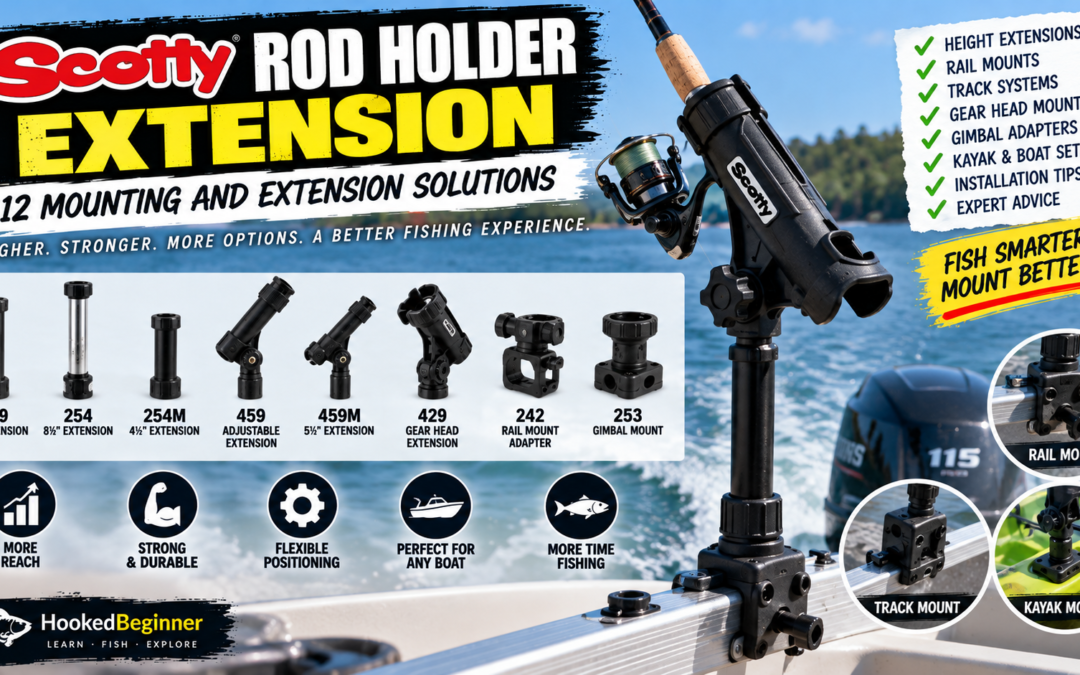
Scotty's current extender and adapter range includes the 259 Rod Holder Height Extender, the 254 Rod Holder Height Extender, the 459 Adjustable Rod Holder Extender, the 254M Mini Rod Holder Height Extender, the 459M Mini Double Ended Rod Holder Extender, and the 429 Gear Head Mount Extender.
The 259 raises a compatible Scotty post-mount rod holder by 6 1/2 inches, while the 254 raises compatible post-mount holders by 8 1/2 inches. Scotty states that the 254 uses a stainless-steel shaft and works with all Scotty post-mount rod holders.
The 459 provides adjustable positioning and extends the rod holder by 9 1/2 inches. Scotty describes it as a way to bring a rod holder closer to the angler on a kayak or downrigger and to improve the fishing position.
Why a Rod Holder Extension Matters
It Can Raise the Rod Holder
One of the simplest reasons to use an extension is height. A holder mounted close to the deck may position the reel too low for comfortable access. Raising the holder can improve visibility and make it easier to reach the rod.
Scotty's height extenders are designed specifically for this type of adjustment. The 254M Mini Rod Holder Height Extender, for example, adds 4 1/2 inches and is intended to lift compatible post-mounted rod holders away from the deck.
It Can Move the Rod Into a Better Fighting Position
An extension does not necessarily need to increase height alone. Positioning can matter just as much. A rod that sits several inches closer to the angler may be easier to grab quickly when a fish strikes.
Scotty describes the 459 Adjustable Rod Holder Extender as a positioning accessory for moving the holder into a more useful fishing and fish-fighting location.
It Can Help With Rails and Obstructions
Boat rails, seats, electronics, coolers, gunnels, and other hardware can interfere with where a rod holder can sit.
A suitable extender or rail adapter can move the rod holder away from an obstruction while preserving access to the rod.
It Can Expand Mounting Options
Scotty's system is modular. The company offers rail mounts, track mounts, post mounts, adapters, and other accessories that allow rod holders to be positioned on different types of watercraft.
12 Scotty Rod Holder Extension and Mounting Solutions
1. Scotty 259 Rod Holder Height Extender
The 259 is designed to increase rod holder height and provide easier access to the rod and reel. Scotty states that it extends compatible rod holders by 6 1/2 inches and works with Scotty post-mount rod holders except the 240 Striker.
This type of extension makes sense when the existing holder position works horizontally but is simply too low.
2. Scotty 254 Rod Holder Height Extender
The 254 provides a larger height increase than the 259. Scotty lists an 8 1/2-inch increase and specifies that it works with all Scotty post-mount rod holders. It also includes a stainless-steel shaft.
This can be useful when a deck-mounted holder needs substantially more clearance.
3. Scotty 254M Mini Rod Holder Height Extender
The 254M adds 4 1/2 inches of height and is intended for Scotty post-mount rod holders. Scotty specifically describes it as a way to lift the rod holder off the deck and improve movement and versatility.
It can be useful when only a modest height adjustment is needed and a larger extension would be unnecessary.
4. Scotty 459 Adjustable Rod Holder Extender
The 459 is designed around positioning flexibility rather than a fixed height increase alone. Scotty states that it adds 9 1/2 inches and can bring the rod holder closer to the angler on a kayak or downrigger.
This makes it especially relevant when reach is the problem rather than simple deck clearance.
5. Scotty 459M Mini Double Ended Rod Holder Extender
The 459M adds 5 1/2 inches to the rod holder post and is intended to help create a better fishing position. Scotty describes it as useful for lifting a rod holder away from the deck or overcoming a difficult fishing position.
6. Scotty 429 Gear Head Mount Extender
The 429 combines a Gear Head Mount, adjustable extension, and post mount. Scotty describes it as a system for bringing the rod closer while allowing the user to customize the rod holder and mount combination.
This approach is useful when you want a more modular system instead of a simple fixed-height extension.
7. Scotty 412 Replacement Rod Holder Post
The 412 is not a height extender by itself, but it is an important component when rebuilding or replacing the post connection. Scotty states that the replacement post fits all Scotty post-mount rod holders and bases.
Replacement components can be useful when the existing post is worn or damaged and you do not need to replace the entire rod holder system.
8. Scotty 242 Rail Mount Adapter
The 242 provides a way to connect Scotty post-mount rod holders to compatible rails. Scotty states that it fits 7/8-inch and 1-inch round rail as well as 1-inch square rail and works with Scotty post-mount rod holders.
This is valuable when drilling a new deck mounting hole is undesirable or when the boat already provides a suitable rail.
9. Scotty 238 Rail Mount Adapter
The 238 is designed to work with the 237 Triggerlock mount and is intended for 222 and 223 Sidewinder rod holders. Scotty specifies compatibility with 7/8-inch and 1-inch round rail.
Because this is a more specialized arrangement, compatibility should be confirmed before ordering.
10. Scotty 320 Adaptable Rail Mount
The 320 is designed around versatile rail positioning. Scotty says it can be positioned along a 2-inch rail and includes inserts for 1.5-inch round rails and 1.25-inch square rails commonly found on some pontoon boats. It also includes the 241 Side Deck Mount.
For anglers who want to move rod holders along a rail rather than maintain a single permanently fixed position, an adaptable rail mount can provide more flexibility.
11. Scotty 253 Gimbal Mount
The 253 Gimbal Mount is designed to allow Scotty rod holders to be attached through factory-installed flush rod holders. Scotty describes it as a strong and durable mounting solution for that type of installation.
This type of adapter can be useful when a boat already has a flush-mounted rod holder but you want to use a Scotty rod holder system.
12. Scotty Track and Gear-Head Systems
Scotty's mounting range also includes track and gear-head systems designed for quick repositioning and modular accessory placement. The company's marine catalog describes low-profile track systems and gear-head adapters designed to mount post-mounted rod holders and accessories.
Track systems can be useful when you want the option to move the rod holder instead of committing to one permanent position.
Scotty Rod Holder Extension Comparison
| Solution | Main Purpose | Positioning Benefit | Best For |
|---|---|---|---|
| 259 | Height increase | Raises holder 6 1/2 inches | Deck clearance |
| 254 | Height increase | Raises holder 8 1/2 inches | Greater elevation |
| 254M | Mini height increase | Adds 4 1/2 inches | Small clearance changes |
| 459 | Adjustable extension | Adds 9 1/2 inches | Reach and fighting position |
| 459M | Mini extension | Adds 5 1/2 inches | Compact positioning |
| 429 | Gear-head extension | Modular positioning | Kayaks and flexible setups |
| 242 | Rail adapter | Rail-based mounting | Round and square rails |
| 320 | Adaptable rail mount | Movable rail positioning | Pontoon and rail setups |
| 253 | Gimbal adapter | Uses existing flush holder | Pre-installed flush mounts |
How to Choose a Scotty Rod Holder Extension
Measure the Problem First
Before buying an extension, identify exactly what is wrong with the current position.
Is the holder too low? Too close to a seat? Too far away? Blocked by a rail? Unable to clear a gunwale? Or do you simply want to reposition the rod without drilling a new mounting hole?
The answer determines whether you need a height extender, adjustable extension, rail adapter, track system, or another mounting component.
Check Rod Holder Compatibility
Compatibility matters because Scotty offers several different mounting systems and rod holder families.
For example, the 259 is intended for compatible Scotty post-mount rod holders, while the 238 has a more specific relationship with the 237 Triggerlock and 222 and 223 Sidewinder holders.
Never assume that every Scotty accessory connects directly to every Scotty rod holder.
Consider the Mounting Surface
Think about whether you are mounting to a flat deck, gunnel, rail, track, flush rod holder, downrigger, or kayak mounting point.
Scotty's current mount system includes post mounts, rail mounts, track mounts, gear-head mounts, adapters, and other mounting formats.
Think About Reach
A rod holder can be physically strong but still be inconvenient if the rod sits too far away from the angler.
That is one reason adjustable extensions can be valuable. The 459, for example, is specifically designed to bring the rod holder closer to the angler and improve fishing position.
Consider Clearance
Look for anything that could interfere with the rod, reel, or extension. Railings, seats, electronics, coolers, hatches, downrigger booms, and other equipment can all affect the final position.
Think About the Fish-Fighting Angle
The most convenient position for storing a rod is not necessarily the most practical position when fighting a fish.
You want the rod and reel to be easy to grab, with enough clearance to work the rod through a fight without hitting the boat or other equipment.
Scotty Rod Holder Mounting by Boat Type
Aluminum Fishing Boats
Aluminum boats often provide rails, gunnels, decks, or other surfaces that can accommodate different mounting systems. Rail adapters can be particularly useful when you want to use an existing structure without drilling additional holes.
Pontoon Boats
Pontoon layouts can benefit from adaptable rail systems. Scotty's 320 Adaptable Rail Mount is designed around rail positioning and includes inserts for specific rail dimensions used on some pontoon boats.
Kayaks
Kayak fishing often requires compact and highly accessible rod positions. An adjustable extension or gear-head system can help position the rod where it can be reached without excessive movement.
The 429 Gear Head Mount Extender is specifically positioned by Scotty as a kayak-friendly modular extension system.
Boats With Existing Flush Rod Holders
When the boat already has factory-installed flush holders, replacing the entire mounting structure may be unnecessary.
The Scotty 253 Gimbal Mount provides a way to use Scotty rod holders with factory flush-mounted rod holders.
Downrigger Setups
Downrigger fishing presents another positioning challenge because the rod holder needs to remain accessible while the downrigger occupies valuable deck space.
The 459 Adjustable Rod Holder Extender is described by Scotty as usable with previous downrigger boom-mounted rod holders to bring the fish-fighting action closer to the angler.
Installation and Positioning Tips
Start by assembling the system before permanently tightening everything. Place the rod holder where you believe it should sit, then simulate the motions you will make while fishing.
Reach for the rod from your normal seated or standing position. Check whether the reel clears the seat. Move the rod through the range you might use during a fight. Look for contact with rails, electronics, cleats, and other equipment.
When using rail adapters, carefully verify the rail size before installation. The Scotty 242, for example, is designed around specific round and square rail dimensions.
With a deck-mounted system, the mounting surface should be capable of supporting the forces produced by the rod, holder, and fish. A thin or flexible mounting area may require appropriate reinforcement.
Scotty's marine documentation also describes backing-plate options for adding structural support when mounting to thin-walled watercraft.
After installation, test the holder with the rod in place before fishing. Apply moderate manual force in several directions and inspect the mount for movement.
Common Scotty Rod Holder Extension Mistakes
Buying the Wrong Extension
The most common problem is choosing an accessory based on appearance instead of mounting compatibility.
Check the rod holder family, post style, rail dimensions, base type, and any required adapter before ordering.
Ignoring Rail Dimensions
A rail adapter is only useful when the rail dimensions fall within its specified compatibility range.
Measure the rail instead of guessing.
Using Too Much Extension
More height is not automatically better. A very tall rod holder can create a different leverage point and may make the setup less convenient depending on the boat.
Use the smallest extension that solves the positioning problem.
Mounting Too Close to an Obstruction
The holder may look fine when empty but become difficult to use once a rod and reel are installed.
Always test with the complete rod and reel.
Failing to Check the Fighting Position
Consider what happens after the strike. The rod must be accessible quickly, and there needs to be enough room to move it during the fight.
Overlooking Structural Support
A strong accessory cannot compensate for a weak mounting surface. Thin-walled or flexible surfaces may need additional support.
Forgetting Corrosion and Fasteners
Boat environments can expose hardware to water, salt, dirt, and repeated vibration. Inspect mounting hardware regularly and replace damaged or compromised components.
Scotty Rod Holder Extension Buying Checklist
| Check | What to Confirm |
|---|---|
| Rod holder model | Confirm compatibility with the extension or adapter |
| Mount style | Post, rail, track, flush, gear head, or another system |
| Height requirement | Measure how much additional clearance you actually need |
| Reach requirement | Determine whether the holder needs to move closer |
| Rail size | Measure round or square rail dimensions |
| Deck space | Check surrounding equipment and access |
| Structural strength | Confirm the mounting surface can support the system |
| Fish-fighting clearance | Allow enough room to move the rod safely |
| Installation hardware | Confirm required fasteners or adapters are included |
| Water exposure | Consider corrosion, drainage, and maintenance |
Hooked Beginner also has the Scotty 290-R-5 Rod Holder available for anglers evaluating a complete Scotty rod holder setup.
Related Fishing Rod and Mounting Guides
Choosing the extension is only one part of the complete fishing setup. Start with the fishing rod buying guide to match the rod to your application.
Then review the fishing rod power guide and fishing rod action guide to understand how the rod itself affects lure control and fish fighting.
For reel selection, see the fishing reel buying guide and fishing reel size guide.
For official product specifications and the current Scotty mount range, the Scotty mounts collection is the appropriate manufacturer reference.
The manufacturer's current extender and adapter collection is also useful when comparing dedicated height extenders, adjustable extenders, rail adapters, and other mounting accessories. View Scotty's extenders and adapters.
Frequently Asked Questions
What does a Scotty rod holder extension do?
It can raise, reposition, or otherwise adapt a compatible Scotty rod holder so the rod sits in a more practical position for fishing.
Which Scotty extension gives more height?
The exact choice depends on the required increase and compatibility. Scotty currently lists the 259, 254, 254M, 459, and 459M among its extension options, with different extension lengths and intended uses.
Can a Scotty rod holder be mounted to a rail?
Yes. Scotty offers dedicated rail mounts and rail adapters for several rod holder systems, including the 242 Rail Mount Adapter and 320 Adaptable Rail Mount.
Can I use a Scotty extension on a kayak?
Some Scotty extension systems are specifically intended for kayak positioning. The 429 Gear Head Mount Extender is described by Scotty as a kayak accessory that brings the rod closer to the angler.
How do I know which Scotty rod holder mount I need?
Start with the mounting surface and the rod holder you already have or intend to use. Identify whether the system will attach to a deck, rail, track, flush holder, gimbal, or downrigger-related mounting point, then confirm the accessory's compatibility.
Can I use a rail adapter without drilling my boat?
Some rail-mounted solutions are designed specifically to use an existing rail instead of requiring a new deck hole. Scotty describes its rail mounts as versatile options for mounting without drilling additional holes in some applications.
What is the difference between an extension and an adapter?
An extension primarily changes position, height, or reach. An adapter primarily allows one mounting system or accessory to connect to another compatible system. Some Scotty components combine both functions.
Should the rod holder be as high as possible?
No. The correct height depends on the boat layout, reel position, fishing technique, and how comfortably you can reach and fight a fish. The objective is a useful and stable position, not maximum height.
Do I need a backing plate?
That depends on the mounting surface. Thin-walled or flexible surfaces may benefit from additional structural support. Scotty lists backing-plate solutions for certain mounting situations.
Can I use a Scotty extension with a downrigger rod holder?
Some extensions are designed for downrigger-related applications. Scotty specifically describes the 459 as usable with previous downrigger boom-mounted rod holders.
Final Thoughts
A Scotty rod holder extension is most useful when you treat it as a positioning solution rather than simply another accessory. The correct extension can raise a holder, improve reach, clear an obstruction, or create a more practical fighting position.
Start by identifying the problem. Measure the space, check the mounting surface, confirm the rod holder compatibility, and determine whether you need additional height, additional reach, a rail adapter, a track system, or another mounting solution.
Scotty's current range gives anglers several ways to build a modular rod holder system, including height extenders, adjustable extenders, rail adapters, adaptable rail mounts, gear-head systems, gimbal adapters, and other mounting accessories.
The most important step is compatibility. Do not buy an extension simply because it looks like it should fit. Match the rod holder, post, base, rail, track, and adapter requirements before installation.
Once the system is properly matched, position the holder where the rod is easy to reach, clear of surrounding equipment, and comfortable to use during an actual fish fight. That approach will give you a cleaner and more practical boat setup than choosing an extension based on height alone.