
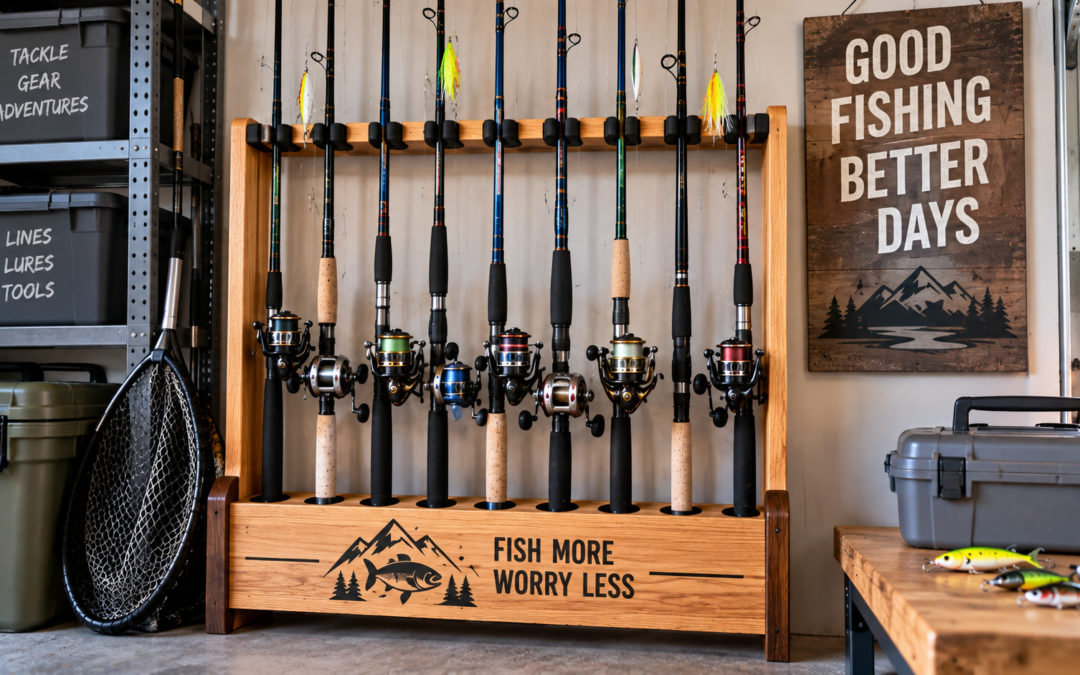
Rod Rack: 8 Smart Storage Options for Organized Fishing Gear
A rod rack gives anglers a practical way to organize fishing rods, reels, and complete fishing setups without leaving valuable gear leaning against walls or scattered across a garage, boat house, bedroom, or workshop.
As a fishing collection grows, storage becomes more important. One or two rods can be placed in a corner temporarily, but several rods quickly become difficult to manage when they are stored together without a system. Rod tips can become tangled, reels can bump into other equipment, and fishing line can catch on nearby objects.
The right rod rack creates a dedicated place for each fishing setup. Depending on the design, a rack can hold rods vertically, horizontally, on the floor, against a wall, or overhead. Some systems are designed for individual rods, while others provide enough clearance for complete rod-and-reel combinations.
This guide covers eight practical storage options, explains what makes each design useful, compares their advantages, and shows how to choose a rack based on capacity, available space, rod length, reel size, materials, and the environment where your equipment will be stored.
What Is a Rod Rack?
A rod rack is a storage system specifically designed to hold fishing rods in an organized and protected position.
Unlike simply leaning rods against a wall, a dedicated rack separates individual setups and provides controlled support. The rack may be freestanding, wall mounted, ceiling mounted, or integrated into a boat or other fishing-storage area.
Some rack designs hold the handle or butt section of the rod, while others use multiple contact points to support the rod along its length. The appropriate design depends on the rod style, the amount of equipment being stored, and whether reels are left attached.
A rack should also be considered as part of a larger fishing-storage system. Rods, reels, tackle boxes, line, lures, pliers, and other accessories all need their own places. The International Game Fish Association recommends maintaining an organized approach to tackle storage so fishing equipment can be inventoried, maintained, and quickly prepared for future trips. See the IGFA tackle organization guide.
For many anglers, the most useful rack is not necessarily the largest one. It is the system that fits the rods they actually own while keeping those rods secure, accessible, and separated from unnecessary clutter.
Why a Rod Rack Matters
Fishing rods can be damaged or become difficult to manage when they are stored without adequate support. A dedicated rod rack provides several practical advantages.
1. Keeps Fishing Rods Organized
A rack gives every rod a defined storage position. This makes it easier to separate different setups instead of creating one large bundle of rods and reels.
You can organize your collection by species, technique, rod power, rod length, reel type, or frequency of use.
2. Reduces Clutter
Fishing rods take up a surprising amount of space because of their length. A vertical or wall-mounted rack can move them away from walkways and open floor areas.
This is especially useful in garages and workshops where fishing equipment competes for space with tools, bicycles, vehicles, lawn equipment, and storage boxes.
3. Makes Rods Easier to Access
A properly arranged rack allows you to identify and remove the setup you need without moving every other rod first.
This can save time when you maintain several specialized setups for bass, trout, panfish, catfish, saltwater fishing, surf fishing, or other techniques.
4. Helps Prevent Tangling
Rods stored in a pile can become tangled with line, lure hooks, straps, and other equipment. Dedicated spacing reduces unnecessary contact between individual setups.
Take Me Fishing's DIY rod-holder guide specifically discusses organization, line tangling, and preventing rod tips and guides from being nicked during poor storage. See the DIY fishing rod holder guide.
5. Uses Space More Efficiently
A rack can turn unused wall or ceiling space into fishing storage. This can be valuable when floor space is limited.
6. Keeps Complete Setups Together
Many anglers prefer storing their rods with reels already attached. A properly sized system keeps the complete setup together so it can be retrieved and used more quickly.
8 Rod Rack Options to Consider
1. Freestanding Rod Rack
A freestanding rod rack is a flexible choice because it does not require permanent mounting to a wall.
You can place it in a garage, fishing room, workshop, shed, or boat house and reposition it later if the layout changes.
This style can also work well for anglers with larger collections because floor-standing designs can provide many storage positions without requiring extensive wall installation.
Look for a wide and stable base, adequate spacing between rod positions, and enough clearance for reels if complete setups will remain assembled.
Best for: Larger collections, garages, workshops, and boat houses.
2. Wall-Mounted Rod Rack
A wall-mounted rack is one of the most useful choices when you need to preserve floor space.
The rack attaches directly to the wall and can hold rods vertically or horizontally depending on the design.
A wall-mounted system can work particularly well above a workbench, inside a fishing room, or along a garage wall that would otherwise remain unused.
Before installation, measure the full rod length and surrounding clearance. A long fishing rod can extend far beyond the rack itself, so doors, shelving, vehicles, and other equipment need to be considered.
Best for: Garages, fishing rooms, workshops, and compact spaces.
3. Vertical Rod Rack
A vertical rack stores rods upright and is useful when horizontal wall space is limited.
Because the rods occupy relatively little width, this design can make efficient use of a narrow corner or section of a storage room.
Vertical racks work especially well when the rods are arranged by type or frequency of use. Heavier or more frequently used setups can be positioned where they are easy to retrieve, while less frequently used rods can occupy the remaining spaces.
The rack needs to be stable, and the surrounding ceiling height needs to accommodate your longest rods.
Best for: Narrow spaces, fishing rooms, garages, and workshops.
4. Horizontal Rod Rack
A horizontal rack stores rods parallel to the wall. This can be useful when you have a long, open wall but limited floor space.
Horizontal storage also gives anglers a convenient way to display and organize longer rods without standing them upright.
The main consideration is wall length. A rack may fit easily on paper but still require additional clearance when fully loaded with long rods and attached reels.
Best for: Long garage walls, boat houses, workshops, and larger collections.
5. Ceiling-Mounted Rod Rack
Ceiling storage is useful when the walls and floor are already occupied.
A ceiling-mounted system can use unused overhead space to keep fishing rods out of the way while still providing an organized storage position.
This design needs careful installation because the rack and the fishing equipment are suspended above the floor. The mounting hardware should be appropriate for the structure being used, and there should be enough clearance from garage doors, lighting, vehicles, and other overhead equipment.
Best for: Garages, workshops, and storage spaces with unused ceiling area.
6. Portable Rod Rack
A portable rack is useful when fishing gear moves between locations.
Anglers who regularly fish from multiple boats, docks, vehicles, or fishing spots may prefer a storage system that can be carried or repositioned rather than permanently installed.
Portable storage can also make temporary organization easier during fishing trips, particularly when several rods need to remain together without being placed on the ground.
Best for: Mobile anglers, docks, vehicles, and temporary fishing-storage situations.
7. Boat and Dock Rod Rack
Boat storage introduces a different set of requirements. Rods need to be accessible without interfering with passengers, controls, hatches, or fishing operations.
Boat and dock racks should also account for water exposure and, in saltwater environments, the additional corrosion concerns associated with salt and moisture.
The rack should keep rods secure enough that they do not move unnecessarily when the boat is being operated or when people are moving around the fishing area.
Best for: Boats, docks, boat houses, and anglers who fish regularly on the water.
8. DIY Rod Rack
A DIY rack can be a good option when the available space has unusual dimensions or when an angler wants complete control over spacing and capacity.
Take Me Fishing provides a DIY fishing rod holder design using plywood, PVC pipe, screws, and basic tools. Its instructions show how PVC sections can be spaced according to rod and reel size and mounted to a backing surface. Review the DIY rod-holder project.
The main advantage of building your own rack is customization. You can decide exactly how many rods it should hold, where it should be mounted, and how much space should be left between setups.
The tradeoff is that measurements, material quality, mounting strength, and protective surfaces become your responsibility.
Best for: Custom spaces, workshops, budget-conscious anglers, and DIY projects.
Rod Rack Comparison Table
| Rack Type | Best Location | Main Advantage | Main Consideration |
|---|---|---|---|
| Freestanding | Garage or workshop | Flexible and movable | Uses floor space |
| Wall-mounted | Garage or fishing room | Saves floor space | Requires secure mounting |
| Vertical | Narrow storage area | Uses limited floor width | Needs adequate height |
| Horizontal | Long wall | Good for long rods | Requires wall length |
| Ceiling-mounted | Garage | Uses overhead space | Installation and access |
| Portable | Vehicle or dock | Easy to move | Less permanent |
| Boat or dock | Boat or dock | Convenient on-water access | Moisture and corrosion |
| DIY | Custom spaces | Highly customizable | Requires building and installation |
How to Choose a Rod Rack
Measure Your Rod Collection
Start with the equipment you already own.
Count the number of fishing rods you intend to store and measure the longest ones. If most of your rods are stored with reels attached, measure the reel dimensions as well.
A rack that fits bare rods may not provide enough clearance for large spinning reels, baitcasting reels, or larger saltwater reels.
For more information about rod dimensions and how length affects fishing equipment selection, see the fishing rod length guide.
Decide Whether Reels Stay Attached
This decision can significantly affect your storage requirements.
Storing rods without reels allows tighter spacing, but it means you need another location for your reels. Keeping complete combinations together makes preparation easier but requires more room around each storage position.
Consider Rod Capacity
Do not select capacity based only on how many rods you own today.
Some anglers gradually add specialized rods for different techniques. A small amount of extra capacity can make a storage system more useful over time.
At the same time, avoid buying a rack that is dramatically larger than your needs if you have very limited storage space.
Choose the Right Orientation
Vertical racks are useful where width is restricted. Horizontal systems work well when a long wall is available. Freestanding racks provide flexibility, while ceiling systems help use overhead space.
The best orientation depends on the room rather than the rack alone.
Match the Rack to the Environment
A dry indoor room is less demanding than a boat, dock, or damp garage.
Where moisture or saltwater exposure is expected, pay attention to corrosion resistance, hardware, coatings, drainage, and the ease of cleaning the rack.
Think About Accessibility
Good storage should make equipment easier to retrieve, not harder.
Place commonly used rods in positions that can be reached quickly. Less frequently used equipment can occupy higher, lower, or less accessible positions where appropriate.
Consider Rod Protection
Look for designs that provide stable support and avoid unnecessary pressure on sensitive portions of the rod.
Spacing also matters. Rod tips, guides, lines, handles, and reels should not be forced into contact with neighboring equipment.
Your rack should organize the equipment without creating another source of damage.
Rod Rack Use Cases
Rod Rack for a Garage
A garage is one of the most common places for fishing equipment storage because it often provides open walls, corners, and overhead space.
A wall-mounted or ceiling-mounted system can keep rods out of the way of vehicles and other equipment. A freestanding unit can work better when you want to move the storage arrangement later.
Before installing anything, consider the location of your garage door, vehicle path, tool cabinets, workbench, and shelving.
Rod Rack for a Fishing Room
A dedicated fishing room provides more opportunities for organization.
You can arrange rods by species, technique, power, length, reel type, or frequency of use. A vertical rack can display the collection while keeping floor space available for tackle boxes and other gear.
Rod Rack for a Boat House
A boat house may need storage for many different rod types. A larger horizontal or vertical rack can make it possible to keep freshwater, saltwater, trolling, casting, and spinning equipment separated.
Moisture should remain a major consideration when choosing materials and mounting hardware.
Rod Rack for a Small Apartment or Limited Space
Small spaces benefit from compact vertical or wall-mounted storage.
Instead of placing rods in a corner, use a dedicated storage section that occupies minimal floor area.
Measure carefully before installation because long rods can require more clearance than expected.
Rod Rack for Saltwater Fishing Gear
Saltwater fishing equipment needs additional attention because salt residue can contribute to corrosion.
Storage should come after the equipment has been cleaned and maintained according to the manufacturer's recommendations. The rack itself should also be suitable for the environment.
Rod Rack Materials and Setup
PVC
PVC is commonly used for simple DIY rod-storage projects because it is lightweight, easy to cut, and relatively easy to arrange into multiple storage positions.
Its flexibility makes it particularly useful when building a custom rack around your own rod collection.
Wood
Wood works well for freestanding and wall-mounted storage systems. It is also easy to customize in terms of length, height, spacing, and appearance.
For damp locations, however, the wood and its finish need to be appropriate for the conditions.
Plastic and Composite
Plastic and composite materials can be useful where moisture resistance is important.
They are often lightweight and can be easy to clean, which can be useful around fishing equipment.
Metal
Metal can provide strong support for larger storage systems.
The finish and metal type matter, particularly in damp or saltwater environments. Hardware should also be appropriate for the environment where it will be installed.
Mounting Hardware
Rack installation is just as important as rack construction.
A well-built rack can still fail if it is attached to an unsuitable surface or with inadequate hardware. Match your fasteners to the wall, ceiling, or structural surface and the expected load.
For heavier systems, pay particular attention to how the load is distributed across the mounting points.
Common Rod Rack Mistakes
1. Choosing a Rack Without Measuring
Never assume that a rack will fit just because the product dimensions look close to your available space.
Measure the complete installation area and account for rod length, reel clearance, and access space.
2. Ignoring Reel Clearance
Rods may fit perfectly while attached reels collide with neighboring setups.
This is especially common when storing complete rod-and-reel combinations on racks designed primarily around bare rod dimensions.
3. Overcrowding the Storage Positions
Too many rods in too little space can make the rack difficult to use.
Overcrowding increases interference between rod handles, reels, lines, and guides.
4. Installing the Rack in a High-Traffic Area
Fishing rods are long and can be easily knocked when stored in busy walkways.
Place the rack where the equipment can remain protected from vehicles, tools, doors, and frequent foot traffic.
5. Using Weak Mounting Hardware
Do not concentrate only on the rack itself. The mounting system needs to support the complete load.
Follow the manufacturer's installation requirements and choose hardware suited to the mounting surface.
6. Storing Wet Gear for Long Periods
Moisture can create problems for rods, reels, hooks, line, and other fishing gear.
Allow equipment to be properly cleaned and dried according to manufacturer recommendations before long-term storage.
7. Keeping Everything in One Undifferentiated Group
A large rack becomes much more useful when it is organized intentionally.
Group similar setups together so that you can identify the correct rod quickly.
Rod Rack Buying Checklist
| Check | What to Look For |
|---|---|
| Capacity | Enough positions for your current and expected collection |
| Rod length | Compatible with your longest rods |
| Reel clearance | Enough space for complete combinations |
| Rack orientation | Vertical, horizontal, floor, wall, or ceiling arrangement |
| Material | Suitable for the storage environment |
| Spacing | Enough separation to reduce tangling and interference |
| Stability | Rack remains secure when fully loaded |
| Mounting | Hardware matches the installation surface |
| Accessibility | Frequently used rods are easy to retrieve |
| Protection | Contact points support rods without unnecessary pressure |
| Environment | Appropriate for moisture, saltwater, or indoor storage |
| Future capacity | Room for reasonable expansion |
| Maintenance | Easy to clean and inspect |
Related Fishing Guides
A rod rack works best when your storage system is designed around the rods and reels you actually use.
Start with the fishing rods guide to understand the main equipment types and selection considerations.
For rod dimensions, review the fishing rod length guide.
To understand how rod strength relates to storage and equipment selection, see the fishing rod power guide and the fishing rod action guide.
Before buying a new setup, use the fishing rod buying guide to compare the characteristics that matter for your fishing.
For additional fishing equipment, explore the fishing accessories category.
For rod-holder equipment, you can also examine the Scotty 290-R 5 Rod Holder, Cannon Rod Holder, and Savage Gear MP Rodholder.
For broader equipment organization, the IGFA tackle organization guide provides additional ideas for keeping fishing gear organized.
Frequently Asked Questions
What is the purpose of a rod rack?
A rod rack is designed to store fishing rods in defined positions rather than leaving them loose on the floor, leaning against walls, or bundled together. The goal is to improve organization, access, and protection.
Should I store fishing rods vertically or horizontally?
Both approaches can work. Vertical storage can be useful when floor width is limited, while horizontal storage can work well when you have a long open wall. The better option depends on your available space, rod length, and how you want to access your equipment.
Can a rod rack hold rods with reels attached?
Yes, but the rack needs enough clearance for the reel. Always check the rack's dimensions and design before storing complete rod-and-reel combinations.
How many rods can a rod rack hold?
Capacity varies by design. Compact systems may hold a handful of rods, while larger floor, wall, and custom systems can accommodate much larger collections. Choose capacity based on your current collection and reasonable future growth.
What is the best material for a rod rack?
There is no universal material choice. PVC, wood, plastic, composite, and metal can all be suitable depending on the installation location and environmental conditions.
Can I build a rod rack myself?
Yes. DIY systems can be built around the size and layout of your collection. Take Me Fishing provides a PVC-and-plywood rod-holder design that can be customized according to rod and reel size. See the DIY rod-holder instructions.
Where should I install a rod rack in a garage?
Choose a location away from vehicle paths, garage doors, heavy tools, and busy walkways. Wall and ceiling areas that would otherwise remain unused can be particularly useful.
Should fishing rods be stored with reels attached?
That depends on how you use your equipment. Keeping reels attached makes setups quicker to deploy, while storing rods separately may require less rack space. If reels remain attached, make sure the rack provides adequate clearance.
How do I stop fishing rods from tangling in storage?
Use dedicated storage positions, provide enough spacing between rods, control loose fishing line, and avoid overcrowding the rack. Hooks and lures should also be secured so they cannot catch neighboring equipment.
Can a rod rack be used for saltwater fishing rods?
Yes. However, the rack materials and hardware should be appropriate for the environment. Saltwater equipment should also be cleaned and maintained according to manufacturer recommendations before extended storage.
Final Thoughts
The right rod rack can make a major difference in how easily you manage a growing fishing collection.
For small collections, a compact wall-mounted or vertical rack may provide all the organization you need. Larger collections may benefit from a freestanding or horizontal system, while garages with limited wall space can make use of ceiling-mounted storage. Anglers who move their equipment between locations may prefer portable solutions, and DIY builders can create a rack around their exact rod and reel dimensions.
The key is to choose storage based on the actual equipment you own. Consider rod length, reel clearance, capacity, spacing, mounting strength, accessibility, materials, and the environment where the rack will be installed.
A good storage system should make your fishing equipment easier to find and easier to use. When every setup has a defined place, rods are less likely to become tangled, knocked over, or buried beneath other gear.
For more equipment guidance, continue with the fishing rods guide, review the fishing rod buying guide, and explore the fishing accessories category for additional fishing gear.