
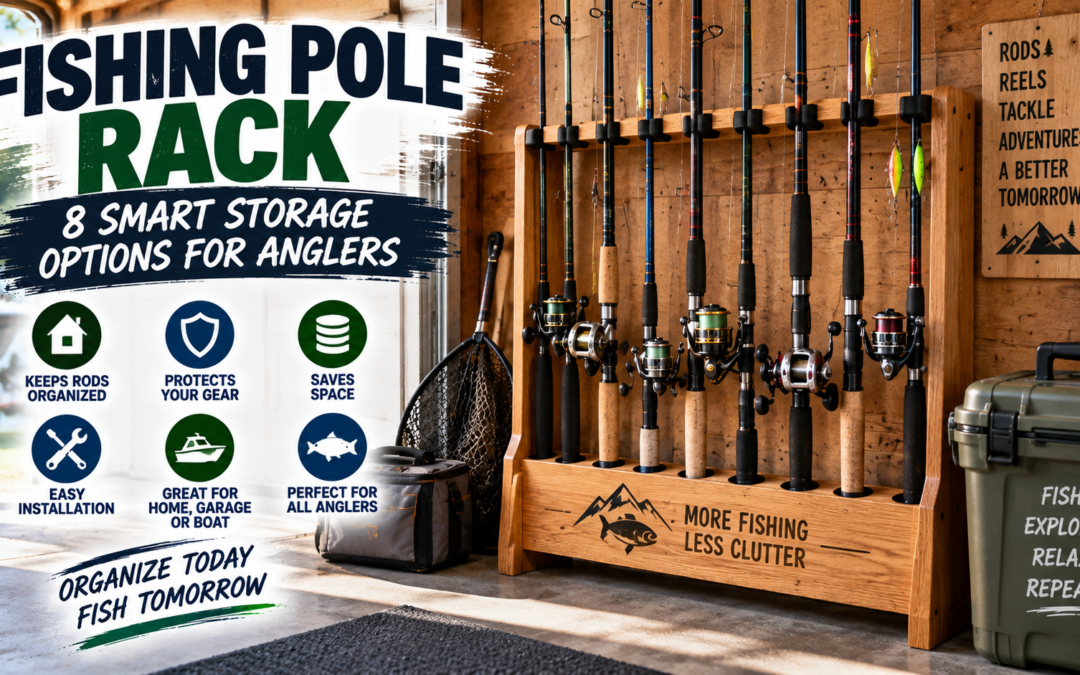
A good fishing pole rack does more than keep fishing rods off the floor. The right storage system helps organize your rods, reels, lines, and tackle while making it easier to find the setup you need before heading to the water.
Whether you keep a few rods in a small apartment, several combinations in a garage, or a large collection in a boat house, the storage method should match the number of rods you own, the amount of space available, and the type of fishing equipment you use.
A well-designed fishing pole rack can also reduce clutter and help prevent rods from being knocked over, stepped on, or tangled together. Take Me Fishing notes that dedicated rod holders can help prevent unnecessary stress and damage while keeping fishing equipment organized. See the fishing rod holder guide from Take Me Fishing.
In this guide, we will compare eight practical rack styles, explain where each works best, cover the materials and setup considerations that matter, and show you how to choose storage based on your actual fishing gear.
What Is a Fishing Pole Rack?
A fishing pole rack is a storage system designed to hold fishing rods or complete rod-and-reel combinations in an organized position. Depending on the design, a rack can stand on the floor, attach to a wall, mount to a ceiling, or be fitted into a boat, truck, dock, or other fishing-storage area.
Some racks hold rods vertically, while others store them horizontally. Certain designs are made for individual rods, while larger systems are designed to hold multiple complete combos.
The most useful rack depends on how your equipment is configured. A small freshwater angler with four rods may need only a compact wall-mounted rack. Someone with a large collection of surf or offshore equipment may need a larger floor rack with wider spaces between rod positions.
A fishing rod rack should provide enough support that the rods remain stable without putting unnecessary pressure on delicate guides, blanks, handles, or reels.
Storage also needs to account for the environment. A rack used in a dry indoor room has different requirements from one used in a garage, boat house, dock, or saltwater environment.
Why a Fishing Pole Rack Matters
Fishing rods are long, relatively delicate pieces of equipment, so uncontrolled storage can quickly become inconvenient. Leaning rods against a wall may work temporarily, but it makes equipment easier to knock over and can create a tangle of lines and rod tips.
A dedicated storage system creates a defined position for each setup.
1. Better Organization
A rack allows you to separate different rod and reel combinations instead of placing everything into one pile. You can organize rods by species, technique, length, power, or frequency of use.
2. Easier Access
When every rod has a defined storage position, it takes less time to find the setup you need. A bass setup can stay together, while lighter panfish or trout gear can occupy a different section.
3. Less Floor Clutter
Wall-mounted and vertical racks can move fishing equipment away from walkways and working areas. This is especially useful in garages, workshops, storage rooms, and small boat houses.
4. Better Protection
Take Me Fishing explains that dedicated rod holders can help prevent rods from being damaged when they are simply leaned against walls or left in corners. A proper rack can also help keep rod tips and guides from becoming tangled with other equipment. Read the full rod-holder guidance.
5. More Efficient Use of Space
Horizontal wall racks, ceiling systems, and vertical organizers allow anglers to use areas of a room that might otherwise remain empty.
8 Fishing Pole Rack Options to Consider
1. Freestanding Floor Fishing Pole Rack
A freestanding rack is one of the most flexible storage choices because it does not require permanent wall mounting. You can position it in a garage, shed, storage room, boat house, or workshop and move it when necessary.
This style works particularly well for anglers who own many rods or frequently rearrange their storage space.
Look for a stable base and enough space between rod positions to keep reels and handles from interfering with each other. Larger racks should also remain stable when partially loaded.
Some commercial floor systems are designed specifically for complete rod-and-reel combos. For example, large tackle-storage stations can combine rod storage with additional tackle organization. See an example of a mobile tackle-storage station.
Best for: Garages, workshops, boat houses, and larger collections.
2. Wall-Mounted Fishing Pole Rack
A wall-mounted fishing pole rack is one of the best options when floor space is limited.
Instead of placing rods against a corner, the rack secures them against the wall in a controlled arrangement. Depending on the design, rods may be held vertically or horizontally.
Wall-mounted systems are particularly useful for anglers who want fishing equipment close to a workbench, tackle station, garage door, or preparation area.
Before installation, confirm that the wall and mounting hardware can safely support the expected load. The rack should also be mounted where rod tips will not interfere with doors, vehicles, shelves, or other equipment.
Best for: Small rooms, garages, workshops, and anglers who want permanent organization.
3. Vertical Fishing Rod Rack
A vertical rack stores rods upright and uses relatively little floor or wall width. It can be a useful option when ceiling height is available but horizontal wall space is limited.
Vertical storage also makes individual rods easy to identify because the handles and reels can remain grouped together at one level.
Make sure the rack is tall enough for your longest rods and stable enough to resist tipping. A heavily loaded rack should not be placed where people regularly walk past it.
Best for: Garages, fishing rooms, workshops, and compact storage areas.
4. Horizontal Fishing Pole Storage Rack
Horizontal storage works well when you have a long section of wall but limited floor space. Rods can be arranged parallel to the wall, keeping the floor underneath available for tackle boxes, coolers, or other gear.
This approach can also be useful for longer fishing rods that are awkward to store vertically.
Commercial horizontal systems are available for both conventional freshwater equipment and large saltwater setups. Some are specifically designed to accommodate oversized rod handles and larger offshore equipment. See an example of a horizontal rod-storage system.
Best for: Long walls, garages, boat houses, and large rod collections.
5. Ceiling-Mounted Fishing Pole Rack
A ceiling-mounted system makes use of overhead space that may otherwise be wasted. This can be particularly useful in garages where wall space is already occupied by tools, shelves, cabinets, and other equipment.
Ceiling storage should be planned carefully because the rack and rods must remain secure overhead. Installation hardware needs to match the structure being used rather than simply relying on a weak surface.
Leave enough clearance so stored rods are not constantly brushing against lights, garage doors, vehicles, or other objects.
Best for: Garages and storage areas with unused overhead space.
6. Portable Fishing Pole Rack
A portable rack is useful for anglers who need storage in more than one location. You may want to move the same collection between a garage, dock, boat house, or fishing vehicle.
Portable systems can also be helpful when rods need to remain organized during fishing trips.
One example of a portable storage approach is a rod caddy designed to hold multiple rods in an upright arrangement while remaining easy to carry. See an example of a portable rod-retainer caddy.
Best for: Mobile anglers, docks, boats, garages, and temporary storage.
7. Boat or Dock Fishing Pole Rack
Anglers who fish from boats need storage that works with the available deck, gunwale, hatch, wall, or other mounting location.
A boat-oriented fishing pole rack should keep rods secure while still making them accessible. The material should also match the environment, especially where equipment is exposed to moisture and saltwater.
Some rod racks are designed to mount on boat gunwales or other vertical surfaces and use retention systems to help keep rods secure. See an example of a gunwale-mounted rod rack.
Best for: Boats, docks, boat houses, and anglers fishing regularly on the water.
8. DIY Fishing Pole Rack
A DIY rack can be a practical solution when you need a custom configuration or want to build storage from inexpensive materials.
Take Me Fishing provides a DIY fishing rod-holder project using materials such as PVC pipe, plywood, screws, and basic tools. The project is designed to help anglers organize rods and avoid damage and tangling. Review the DIY fishing rod-holder project.
The biggest advantage of DIY storage is customization. You can design the rack around your available wall dimensions, rod lengths, reel sizes, and storage capacity.
The main disadvantage is that the design, measurements, mounting strength, and protective surfaces become your responsibility.
Best for: Custom spaces, workshops, budget-conscious anglers, and anglers who enjoy building their own storage solutions.
Fishing Pole Rack Comparison
| Rack Type | Best Location | Main Advantage | Space Requirement |
|---|---|---|---|
| Freestanding floor rack | Garage or boat house | Flexible and easy to reposition | Floor space |
| Wall-mounted rack | Garage or fishing room | Saves floor space | Wall space |
| Vertical rack | Workshop or storage room | Efficient use of narrow spaces | Vertical clearance |
| Horizontal rack | Garage or boat house | Works well for long rods | Long wall area |
| Ceiling rack | Garage | Uses overhead storage space | Ceiling area |
| Portable rack | Dock, vehicle, garage | Easy to move | Portable floor area |
| Boat or dock rack | Boat or dock | Convenient on-water access | Mounting area |
| DIY rack | Custom storage areas | Highly customizable | Depends on design |
How to Choose a Fishing Pole Rack
The best storage solution is not necessarily the largest rack. It should match the actual rods, reels, space, and environment you have.
Consider Your Number of Rods
Start by counting the equipment you actually want to store. Do not buy a rack based only on today's collection if you know you will add more rods soon.
A rack that is slightly larger than your current collection can give you useful expansion room without forcing you to replace the system quickly.
Measure Your Available Space
Measure the wall, floor, ceiling, or mounting area before buying anything.
Remember to consider rod length and reel width, not just the rack's published dimensions. The full setup needs enough clearance to be removed without hitting nearby objects.
For rod and reel dimensions, understanding the characteristics of the rod itself is useful. See Hooked Beginner's fishing rod length guide for more information about how rod length affects equipment selection and use.
Think About Rod-and-Reel Combos
If you store complete setups, measure the reel as well as the rod. A rack designed for bare rod blanks may not provide enough space around larger reels.
This is particularly important for larger saltwater or offshore equipment.
Choose the Right Orientation
Vertical storage is often useful when floor width is limited. Horizontal storage can work well when you have a long wall. Ceiling storage is useful when walls and floors are already occupied.
Choose based on your room rather than choosing a rack simply because it looks convenient.
Consider Your Fishing Environment
Freshwater storage in a dry room gives you more material choices. Boats, docks, garages, and saltwater environments require greater attention to moisture resistance, corrosion, hardware, and cleaning.
Some commercially available marine-oriented racks use corrosion-resistant materials and stainless-steel hardware, while heavy-duty saltwater designs may use waterproof composite construction. See an example of a corrosion-resistant rod-storage design.
Think About Accessibility
A rack is supposed to make equipment easier to use. Do not place the most frequently used rods behind other equipment or at an inconvenient height.
Arrange your fishing gear so your most commonly used combinations are easy to remove and return.
Fishing Pole Rack Use Cases
For a Garage
A garage gives you several options, including wall racks, vertical racks, freestanding systems, and ceiling storage.
A good arrangement can keep fishing rods separated from bicycles, tools, lawn equipment, and vehicles. Wall or ceiling storage can be particularly valuable when floor space is needed for other purposes.
IGFA emphasizes the importance of having an orderly storage system for fishing equipment rather than simply leaving everything piled together between fishing trips. Read IGFA's tackle-organization guidance.
For a Small Fishing Room
A narrow vertical or wall-mounted rack can make better use of limited space than a large freestanding unit.
Organize rods by technique or species so you can quickly identify what you need.
For a Boat House
A larger rack may be appropriate when many rods need to remain ready for different fishing situations.
Prioritize secure retention and materials appropriate for moisture exposure.
For a Boat
Boat storage should keep rods secure while avoiding interference with passengers, hatches, controls, and fishing operations.
Compact gunwale or vertical systems can be useful when space is restricted.
For Saltwater Rods
Saltwater equipment needs storage that takes corrosion and exposure seriously. After fishing, rods and reels should be cleaned according to the manufacturer's recommendations before long-term storage.
A rack alone cannot protect equipment from corrosion if wet, salt-contaminated gear is put away without proper care.
Fishing Pole Rack Materials and Setup
Fishing pole racks can be made from plastic, PVC, wood, composite materials, metal, or combinations of several materials.
PVC
PVC can be useful for inexpensive DIY designs. It is lightweight and relatively easy to cut and assemble.
Wood
Wood can provide a sturdy and attractive storage system, particularly for a garage or dedicated fishing room. It can also be customized to match the dimensions of the space.
Plastic and Composite
Plastic and composite systems can be useful where moisture resistance matters. Some commercial marine-storage products use composite materials specifically for wet environments.
Metal
Metal can provide strong support for heavier storage systems. However, the type and finish of the metal matter, particularly in damp or saltwater environments.
Mounting Hardware
The strongest rack is not useful if it is poorly mounted. Select fasteners based on the surface you are attaching the rack to and the weight it needs to support.
For permanent installations, make sure the rack is securely attached to an appropriate structural surface rather than relying only on a weak finishing material.
Common Fishing Pole Rack Mistakes
Using a Rack That Is Too Small
A rack that barely fits your current collection may become crowded quickly. Crowding can make rods harder to remove and increase the chance of tangling.
Ignoring Reel Size
A rod may fit into a rack while the attached reel does not have enough clearance. Always think about the complete setup when buying a rack for rod-and-reel combinations.
Storing Long Rods Without Measuring
Long fishing rods need enough vertical or horizontal clearance. Measure the actual rod length and the surrounding area before installing your storage.
Choosing Location Before Measuring
Do not install a rack simply because an empty section of wall looks convenient. Doors, windows, vehicles, workbenches, shelves, and ceiling fixtures can interfere with the final arrangement.
Overloading the Rack
Never assume that more rods automatically means better use of storage. Follow the rack manufacturer's capacity guidance and make sure the mounting system can safely handle the intended load.
Putting Wet or Dirty Gear Away
Storage should normally come after basic equipment care. Salt, moisture, and debris should be dealt with according to the equipment manufacturer's maintenance recommendations before long-term storage.
Making Access Too Difficult
A storage system that protects rods but makes them difficult to retrieve may become frustrating to use. Leave enough space around the equipment so rods can be removed without catching neighboring setups.
Fishing Pole Rack Buying Checklist
| Check | What to Look For |
|---|---|
| Rod capacity | Enough positions for your current collection and reasonable future growth |
| Rod length | Compatible with your longest stored rods |
| Reel clearance | Enough room for complete rod-and-reel combinations |
| Orientation | Vertical, horizontal, floor, wall, or ceiling storage that fits your room |
| Materials | Material appropriate for your storage environment |
| Mounting | Hardware and attachment method suited to the mounting surface |
| Stability | Rack should remain secure when loaded |
| Spacing | Enough room between rods to reduce interference and tangling |
| Accessibility | Frequently used rods should be easy to reach |
| Environment | Consider moisture, saltwater, UV exposure, and temperature |
| Future capacity | Consider whether you expect to add more rods |
| Installation | Confirm required tools and mounting hardware before buying |
Related Fishing Guides
Choosing the right rack is only one part of building an organized fishing setup. Understanding your rods and reels will also help you create a storage system that fits your equipment.
Start with the fishing rods guide to learn more about the equipment itself.
For rod dimensions and selection, continue with the fishing rod length guide, the fishing rod power guide, and the fishing rod action guide.
You can also use the fishing rod buying guide before deciding which setups need dedicated storage.
For reel-related equipment, see the fishing reels guide and fishing reel size guide.
For physical storage and rod-holder equipment, browse Hooked Beginner's fishing accessories category.
Relevant products in the Hooked Beginner catalog include the Scotty 290-R 5 Rod Holder, Cannon Rod Holder, and Savage Gear MP Rodholder.
Frequently Asked Questions
What is the best type of fishing pole rack?
There is no single rack design that fits every angler. The appropriate choice depends on the number of rods, available space, rod length, reel size, and storage environment. Wall-mounted, vertical, horizontal, floor, ceiling, and portable systems each solve different storage problems.
Should fishing rods be stored vertically or horizontally?
Either can work when the rods are properly supported. Vertical storage can save wall width and floor space, while horizontal storage can work well on long walls and for certain longer rods. Choose the orientation that provides stable support without interfering with other equipment.
Can I make a fishing pole rack myself?
Yes. DIY rack systems can be made from materials such as PVC and wood. Take Me Fishing provides a DIY rod-holder example designed to help anglers organize equipment and reduce the risk of damage and tangling. See the DIY rod-holder instructions.
How many fishing rods should a rack hold?
The answer depends on the number of rods you own and how much space you have available. Choose a rack with enough capacity for your current collection without creating excessive crowding.
Can a fishing pole rack hold rod-and-reel combos?
Many racks are specifically designed to store complete rod-and-reel combinations, but not every rack provides enough clearance for larger reels. Check the manufacturer's dimensions and capacity before purchasing.
Are fishing pole racks suitable for garages?
Yes. Garages are a common location for fishing equipment storage. Freestanding, vertical, wall-mounted, and ceiling-mounted systems can all work depending on the available space.
What material is best for a fishing pole rack?
The right material depends on the environment. Wood, PVC, plastic, composite, and metal can all work in appropriate applications. Damp and saltwater environments require greater attention to corrosion resistance and moisture exposure.
Should I store wet fishing rods on the rack?
It is generally better to clean and dry fishing equipment according to the manufacturer's recommendations before putting it away for extended storage. This is particularly important for equipment exposed to saltwater.
How do I prevent fishing rods from tangling on a rack?
Use appropriate spacing, keep lines controlled, and avoid overcrowding the storage positions. A rack with dedicated rod locations makes it easier to separate individual setups.
Where should I put a fishing pole rack in a garage?
Choose a location that is easy to access but away from vehicle doors, heavy traffic, tools, and other objects that could knock into the rods. Measure the full clearance required before mounting the rack.
Final Thoughts
The right fishing pole rack can turn an untidy collection of rods into an organized, accessible fishing setup.
For a small collection, a compact wall or vertical system may be enough. Larger collections may benefit from a freestanding floor rack, horizontal storage, or a dedicated boat-house system. Anglers who need mobility can also consider portable storage, while DIY builders can create a custom rack around the exact dimensions of their equipment and available space.
The key is to choose storage around the actual fishing rods and reels you own rather than choosing a rack based only on appearance. Consider capacity, rod length, reel clearance, spacing, materials, mounting strength, accessibility, and the environment where the gear will be stored.
Organized storage also makes future fishing trips easier. When each setup has a defined place, you can find the right equipment faster, reduce unnecessary clutter, and spend more time preparing for the water.
For more equipment guidance, continue through Hooked Beginner's fishing rods guide, review the fishing rod buying guide, and explore the fishing accessories category for rod-storage and related equipment.