
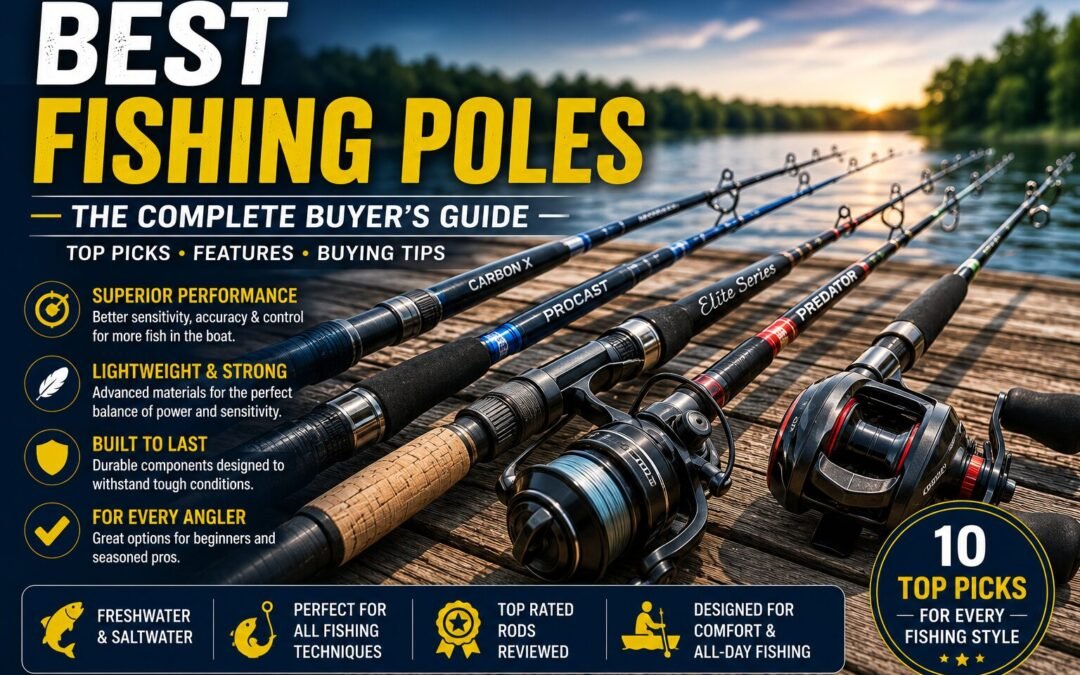
Best Fishing Poles: 9 Smart Options for Different Fishing Styles
Choosing the best fishing poles starts with understanding how you actually fish. A fishing pole that works well for panfish or trout may not be the right choice for bass, catfish, surf fishing, or heavier freshwater applications. Length, power, action, construction, reel compatibility, line rating, and lure weight all influence how a pole performs.
The terms “fishing pole” and “fishing rod” are commonly used interchangeably in everyday fishing conversations. What matters most is selecting equipment that matches your target species, fishing environment, tackle, and technique.
This guide explains how to compare the best fishing poles for beginners, freshwater fishing, bass, trout, panfish, catfish, and other common applications. It also covers pole length, power, action, materials, spinning and casting setups, buying mistakes, and the questions to ask before purchasing.
What Are the Best Fishing Poles?
The best fishing poles are the ones that properly match your intended fishing application. There is no single pole that performs perfectly for every angler, species, lure, environment, and technique.
A useful fishing pole should provide an appropriate combination of strength, flexibility, sensitivity, length, and casting characteristics. A light pole can be useful for smaller fish and lightweight lures, while a more powerful pole may be necessary for heavy lures, larger fish, or fishing around thick cover.
Before buying, consider what you fish for, where you fish, what line you use, and the weight of your bait or lures. Take Me Fishing's fishing rod guide also emphasizes matching rod specifications to fishing conditions and tackle.
Why Choosing the Right Fishing Pole Matters
The correct fishing pole affects casting distance, lure control, sensitivity, hook setting, and how effectively you can fight a fish.
A pole that is too light can become difficult to control when used with heavy tackle or larger fish. A pole that is excessively powerful can make light presentations harder to cast and reduce the enjoyment of catching smaller species.
Length also matters. A longer pole can provide additional casting distance and leverage, while a shorter pole can be easier to control around trees, docks, vegetation, narrow streams, and other confined fishing areas.
The best approach is to match the pole to the complete fishing setup rather than choosing based only on price or brand.
9 Fishing Pole Types to Consider
1. Spinning Fishing Poles
Spinning poles are among the most versatile options for general fishing. They are designed to work with spinning reels and can handle many lighter to moderate freshwater applications.
Spinning equipment is also commonly used by beginners because it is relatively straightforward to cast and can accommodate a broad selection of bait and artificial lures.
Read our spinning fishing pole guide for additional information.
2. Casting Fishing Poles
Casting poles are designed for baitcasting and other casting-style reels. They are often selected by anglers who need additional control with artificial lures and heavier presentations.
Bass anglers frequently use casting setups, especially when fishing techniques require stronger line, heavier lures, or precise lure placement around cover.
See our guide to casting rods for additional information.
3. Ultralight Fishing Poles
Ultralight poles are designed around very light line and small lures. They are frequently used for trout, crappie, bluegill, perch, and other smaller fish.
The lighter construction makes smaller fish more exciting to catch while offering useful sensitivity for lightweight presentations. However, ultralight tackle should not be used outside its intended lure and line range simply because the pole feels comfortable.
4. Light Fishing Poles
Light-power poles offer more strength than ultralight equipment while retaining a relatively sensitive and flexible feel.
They can be useful for anglers who target smaller to medium-sized freshwater species and want a setup that remains comfortable for repeated casting.
5. Medium-Light Fishing Poles
Medium-light poles provide a useful balance between sensitivity and strength. Depending on the exact specifications, they can work for trout, walleye, perch, finesse bass fishing, and other light to moderate techniques.
When comparing medium-light options, always check the lure and line ratings instead of relying only on the power label.
6. Medium Fishing Poles
Medium-power poles are among the most versatile choices for general freshwater fishing. They can work across several techniques when paired with suitable line and lures.
A medium spinning setup can be a practical starting point for beginners who want a single pole that covers a variety of common fishing situations.
7. Medium-Heavy Fishing Poles
Medium-heavy poles offer additional backbone for larger lures, stronger fish, and situations where the angler needs to move fish away from cover.
They are common in bass fishing and can be particularly useful around vegetation, timber, docks, and heavy structure.
8. Heavy Fishing Poles
Heavy-power poles are designed for demanding applications that require more lifting strength and control.
They may be appropriate for large catfish, heavy bass techniques, predator fishing, and other situations where lighter tackle would not provide enough power.
9. Specialized Fishing Poles
Some anglers benefit from specialized equipment for particular species or environments. Examples include trout, catfish, salmon, steelhead, walleye, trolling, saltwater, surf, and travel fishing poles.
A specialized pole can provide useful performance for a particular application, but beginners should consider whether they actually need specialized equipment before spending money on multiple setups.
Best Fishing Poles Comparison Table
| Fishing Pole Type | Common Use | Main Advantage | Important Consideration |
|---|---|---|---|
| Spinning | General freshwater fishing | Versatile and easy to use | Match reel, line, and lure ratings |
| Casting | Bass and heavier lure techniques | Control and power | Requires compatible casting reel |
| Ultralight | Trout and panfish | Sensitivity | Limited heavy-tackle capability |
| Light | Small and medium freshwater species | Light, responsive setup | Check lure range |
| Medium-Light | Light to moderate freshwater fishing | Balance of sensitivity and strength | Match line and lure weight |
| Medium | General-purpose fishing | Broad versatility | May not suit very large fish |
| Medium-Heavy | Bass and heavy cover | Additional backbone | Less suitable for very light lures |
| Heavy | Large fish and heavy tackle | High lifting power | Heavier overall setup |
| Specialized | Species-specific fishing | Purpose-built characteristics | Less versatile outside its intended use |
How to Choose the Best Fishing Poles
Start With Your Target Species
The type and size of fish you target should influence your choice.
Panfish and small trout usually require very different equipment from large catfish or heavy predator fishing. Think about the fish you catch most often rather than choosing equipment around an occasional catch.
Consider Where You Fish
Your fishing environment is just as important as the species.
A small stream may require a shorter pole that is easy to maneuver around vegetation. An open lake can provide more room for a longer casting setup. Shore fishing, boat fishing, pier fishing, and surf fishing each create different equipment requirements.
Our fishing rod length guide provides additional information on how length affects casting and control.
Choose the Correct Length
Length affects casting distance, leverage, lure control, and maneuverability.
Longer poles can help anglers cover more water and achieve greater casting distance in open conditions. Shorter poles can make casting easier in tight spaces and can provide additional control.
Do not assume that longer automatically means better. The correct length depends on your fishing environment and technique.
Understand Pole Power
Power refers to the amount of force required to bend the pole.
Common power categories include ultralight, light, medium-light, medium, medium-heavy, and heavy.
Lighter powers generally suit smaller lures and fish, while heavier powers are better suited to stronger fish and heavier presentations.
Read our fishing rod power guide for a more detailed explanation.
Understand Pole Action
Action describes where the pole bends along its blank and how quickly it returns toward its original position.
Fast-action poles tend to bend closer to the tip, while moderate and slower actions allow the bend to move farther down the blank.
Action can influence lure control, sensitivity, hook-setting characteristics, and how the pole loads during casting.
See our fishing rod action guide for more detail.
Check the Lure Weight
Lure weight is one of the most important specifications to check before buying.
A pole should be appropriate for the weights you actually intend to cast. A very light pole may not load effectively with a heavy lure, while a heavy pole may not perform well with extremely light presentations.
Check the Line Rating
The manufacturer's line rating provides another useful guide to the intended application.
Match your line to the recommended range and consider how the line, lure, fish size, and fishing environment work together.
Best Fishing Poles for Beginners
Beginners often benefit from a versatile setup rather than highly specialized equipment.
A spinning pole is a practical starting point for many new anglers because spinning tackle can cover a broad range of freshwater fishing and is relatively straightforward to learn.
For someone who fishes several common species in ponds and lakes, a medium or medium-light spinning setup may provide useful flexibility, provided its line and lure ratings fit the intended tackle.
Beginners should pay attention to:
- Rod or pole length
- Power
- Action
- Line rating
- Lure rating
- Reel compatibility
- Target species
- Fishing environment
Our fishing rod buying guide explains these factors in more detail.
Best Fishing Poles for Freshwater Fishing
Freshwater fishing includes lakes, ponds, rivers, streams, reservoirs, and other environments with very different requirements.
For general freshwater fishing, versatility is often more useful than specialization. A medium or medium-light setup can cover many common applications, while light and ultralight equipment can be more appropriate for small species and lightweight presentations.
Anglers who target larger fish or fish around heavy cover may need more power.
The correct choice ultimately depends on the actual fish, lure, line, and environment rather than the word “freshwater” alone.
Best Fishing Poles for Bass
Bass fishing includes many different techniques, so the ideal pole depends on how you fish.
A medium spinning pole can work well for many lighter presentations, while medium-heavy casting equipment can be useful for heavier lures and fishing around cover.
Pay particular attention to power and action when building a bass setup because these specifications influence lure control, hook setting, and fish control.
See our rod power guide and rod action guide when comparing bass setups.
Best Fishing Poles for Trout
Trout anglers frequently use light and ultralight tackle, particularly when fishing small lures, spinners, jigs, and bait.
A shorter pole may be easier to manage in narrow streams with overhanging vegetation, while a longer setup can offer useful casting distance in open water.
Our trout fishing rods guide provides more species-specific information.
Best Fishing Poles for Panfish
Panfish such as bluegill and crappie can be excellent targets for light and ultralight equipment.
The light tackle allows anglers to feel smaller bites and makes modest fish more enjoyable to fight.
When selecting a panfish pole, focus on lure weight, sensitivity, line rating, and comfort rather than choosing a heavy setup simply because it appears stronger.
See our panfish rod guide for more information.
Best Fishing Poles for Catfish
Catfish tackle can vary considerably depending on the species, size of fish, bait, and fishing environment.
Smaller catfish can be targeted with moderate tackle, while larger fish may require heavier equipment with more backbone.
Before buying, consider the weight of your sinkers, bait, line strength, and the size of fish you expect to encounter.
Read our catfish rod guide for more targeted information.
Best Fishing Poles for Saltwater Fishing
Saltwater fishing can demand stronger and more specialized equipment than many freshwater applications.
Inshore fishing, surf fishing, and offshore fishing can all require different combinations of length, power, action, line, and lure ratings.
For example, surf anglers may prioritize casting distance from shore, while offshore anglers may require additional strength to handle larger fish and heavier tackle.
Take Me Fishing's saltwater rod and reel guide provides additional information about selecting saltwater equipment.
Best Fishing Poles for Travel
Travel poles are designed to make transportation easier. Multi-piece designs can break into shorter sections for vehicles, luggage, hiking packs, and other forms of transport.
When using a multi-piece pole, inspect each connection before fishing. Make sure the sections are correctly aligned and securely seated.
Our site also covers travel fishing rods for anglers who prioritize portability.
Spinning Pole vs. Casting Pole
| Feature | Spinning Pole | Casting Pole |
|---|---|---|
| Typical reel | Spinning reel | Baitcasting or casting reel |
| Beginner learning curve | Generally easier | Usually requires more practice |
| Lighter lures | Very suitable | More technique-dependent |
| Heavy lure applications | Available in suitable powers | Common choice |
| General versatility | High | High for experienced anglers |
The better option depends on your fishing style. Beginners often find spinning equipment easier to learn, while experienced anglers may prefer casting equipment for techniques requiring specific lure control.
Fishing Pole Materials
Fiberglass
Fiberglass is generally flexible and durable. It can be useful for anglers who prefer a more forgiving action and do not mind additional weight.
Graphite
Graphite is commonly valued for its low weight and sensitivity. It can be useful when an angler needs to detect subtle contact or prefers a lightweight setup.
Composite
Composite construction combines characteristics of multiple materials. The actual performance depends on the design and intended application.
When shopping, look at the complete specifications rather than assuming one material is automatically appropriate for every type of fishing.
Common Mistakes When Buying Fishing Poles
Choosing Only by Price
The lowest price does not guarantee the best value. A correctly matched pole is generally more useful than an inexpensive pole that does not fit your fishing application.
Choosing Only by Brand
Brand familiarity can be useful, but model specifications are more important for matching the pole to a specific technique.
Ignoring Power
Two poles of the same length can perform very differently because they have different power ratings.
Ignoring Action
Action changes how a pole loads and bends, which affects lure presentation and fish-fighting characteristics.
Buying the Wrong Length
A very long pole may be difficult to manage in tight spaces, while an extremely short pole can limit casting distance in open water.
Ignoring Lure Weight
Always verify that your intended lures or rigs fall within the manufacturer's recommended range.
Ignoring the Reel
A fishing pole should be considered as part of a complete system. Reel size, weight, line capacity, and balance all influence how comfortable the setup feels.
Fishing Pole Buying Checklist
| Check Before Buying | Why It Matters |
|---|---|
| Target species | Determines required strength and sensitivity |
| Fishing environment | Influences length and maneuverability |
| Pole length | Affects casting distance and control |
| Power | Determines overall resistance to bending |
| Action | Influences how and where the pole bends |
| Lure weight | Must match the intended presentation |
| Line rating | Helps determine suitable fishing line |
| Reel compatibility | Creates a balanced setup |
| Transport | Important for travel and storage |
| Budget | Keeps the complete setup affordable |
Fishing Poles From the HookedBeginner Catalog
Once you understand the specifications you need, you can compare individual rods and fishing equipment rather than choosing simply from a list of names.
Some products already available on HookedBeginner include:
- St. Croix Premier 2025 Spinning Rods
- Shimano Clarus E Spinning Rods
- St. Croix Triumph Spinning Rods
- Torrent Casting Rod
- Carbon R1 Casting Rod
Check each product's current specifications for length, power, action, lure range, line rating, and intended use before ordering.
Related Fishing Rod Guides
- Best Fishing Rods
- Affordable Fishing Rods
- Budget Fishing Pole
- Budget-Friendly Fishing Rod
- Good Fishing Rods
- Types of Fishing Rods
- Fishing Rod Buying Guide
Frequently Asked Questions About the Best Fishing Poles
What are the best fishing poles for beginners?
For many beginners, a versatile spinning pole is a practical starting point. A medium or medium-light setup can cover a broad selection of common freshwater fishing situations when its specifications match the intended tackle.
What length fishing pole should I buy?
The correct length depends on your fishing environment and technique. Longer poles can help with casting distance, while shorter poles can offer better control in confined spaces.
Are fishing poles and fishing rods the same thing?
The terms are commonly used interchangeably in everyday fishing discussions. Modern anglers often use “fishing rod” when referring to equipment designed for casting lures and using a reel.
What power fishing pole should I choose?
Choose power based on the size of your target species, lure weight, line, cover, and fishing technique. Light powers suit lighter applications, while heavier powers are designed for stronger tackle and larger fish.
What is the difference between pole power and action?
Power describes how much force is required to bend the pole, while action describes where along the blank the pole bends.
Are spinning poles good for beginners?
Yes. Spinning equipment is commonly used by beginners because it is relatively straightforward to cast and can handle many lighter fishing applications.
Can one fishing pole be used for multiple species?
Yes. A versatile setup can handle multiple species when their tackle requirements overlap. A medium or medium-light setup can often cover several general freshwater applications.
Should I buy a rod-and-reel combo?
A combo can simplify the buying process because the rod and reel have already been paired. It can be particularly useful for beginners who are not yet comfortable matching individual components.
What should I check before buying a fishing pole?
Check the length, power, action, lure rating, line rating, reel compatibility, target species, fishing environment, and overall comfort of the setup.
Final Thoughts
The best fishing poles are not defined by one universal price, brand, or specification. The correct choice depends on the fishing situation.
Start with the basics: identify your target species, decide where you will fish, and determine the lures, bait, and line you expect to use. Then compare length, power, action, material, lure rating, and line rating.
For beginners, a versatile spinning setup can provide a practical starting point. As your experience develops, specialized poles can be added for bass, trout, catfish, saltwater fishing, surf fishing, travel, or other techniques.
The most important goal is compatibility. Your pole, reel, line, lure, and fishing environment should work together. When those elements are properly matched, even a simple setup can become highly useful on the water.
For further reading, continue with our Best Fishing Rods, Affordable Fishing Rods, and Fishing Rod Buying Guide.