
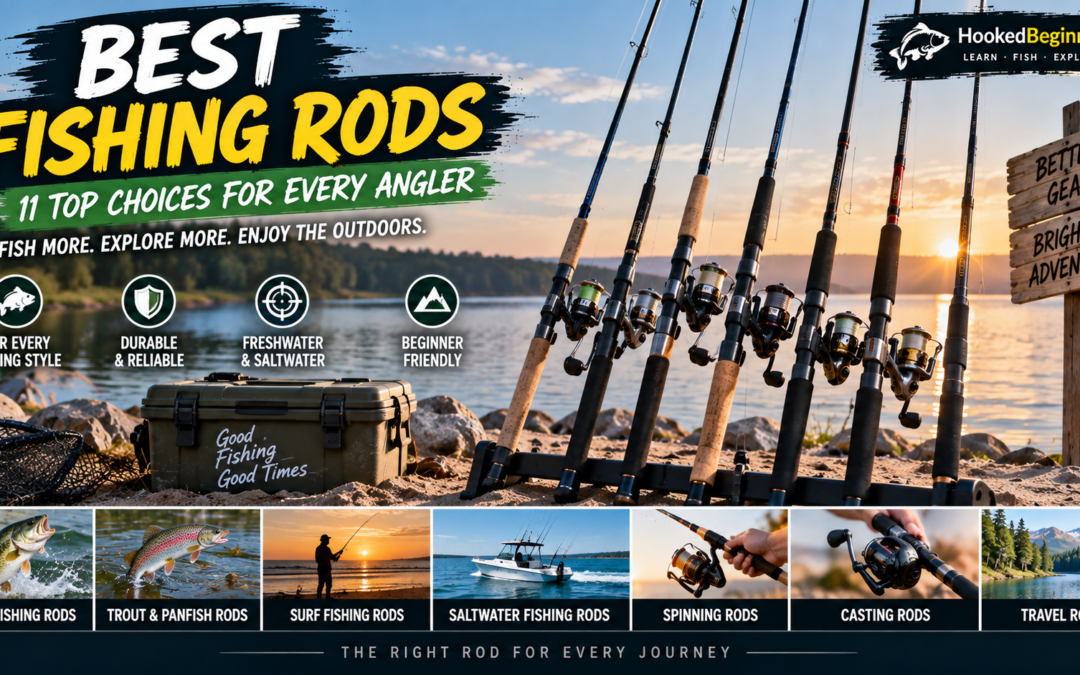
Best Fishing Rods: 11 Top Choices for Every Angler
Choosing among the best fishing rods is not simply about buying the most expensive rod or choosing a famous brand. The right fishing rod depends on where you fish, what species you target, what line and lures you use, and how you prefer to fish. A lightweight rod that feels perfect for trout may be completely unsuitable for heavy surf fishing or large catfish.
This guide explains how to compare fishing rods by type, length, power, action, construction, and intended use. It also explains the difference between spinning and casting rods, how to match a rod with a reel, and what beginners should look for before buying. For additional background on rod selection, Take Me Fishing's fishing rod guide also emphasizes matching the rod to your fishing location, bait, lure weight, and target species.
Rather than looking for one universal winner, use the information below to identify the rod that best matches your own fishing situation.
What Are the Best Fishing Rods?
The best fishing rods are rods that match the demands of a particular fishing situation while remaining comfortable and practical for the angler. There is no single rod that performs perfectly for every technique, species, lure weight, and environment.
A good rod needs to balance strength and flexibility. A powerful rod may be better for heavier lures and stronger fish, while a lighter rod can provide greater sensitivity when targeting smaller species. Rod length also changes how the rod casts and handles fish. Longer rods can help with casting distance, while shorter rods can offer greater control in tight areas.
Rod material matters too. Fiberglass is generally known for durability and flexibility, while graphite is lighter and more sensitive. Composite rods combine characteristics of both materials. These differences are discussed in detail by Take Me Fishing.
The most useful way to think about a fishing rod is as part of a complete system. The rod, reel, line, lure, hook, and fishing technique should all work together.
Why Choosing the Right Fishing Rod Matters
The correct rod affects much more than casting. It influences lure presentation, sensitivity, hook setting, fighting fish, and overall comfort during a fishing trip.
A poorly matched rod can make fishing unnecessarily difficult. A rod that is too light for the target species may struggle under heavy pressure. A rod that is unnecessarily heavy may reduce sensitivity and become tiring during repeated casting. A rod that is too short may reduce casting distance in open water, while an overly long rod can be difficult to manage around vegetation, docks, boats, and confined spaces.
The correct rod can also improve how naturally a lure moves through the water. Fast-action rods, for example, generally transmit movement and contact through the upper portion of the blank, while slower actions bend farther down the blank.
Before buying, always consider the species you are targeting, the fishing environment, the lures or baits you intend to use, and the line rating recommended for the rod.
11 Main Types of Fishing Rods to Consider
1. Spinning Rods
Spinning rods are among the most versatile options for freshwater and light saltwater fishing. They pair with spinning reels and are especially useful for anglers who fish with lighter lures and bait.
They are commonly recommended for beginners because the spinning setup is relatively straightforward to cast and control. A spinning rod can be useful for species such as bass, trout, panfish, perch, and a range of other freshwater fish.
Explore our spinning fishing rods guide for additional information.
2. Casting Rods
Casting rods are designed to work with baitcasting or other casting-style reels. They are frequently used when anglers need greater control over heavier lures, artificial baits, and specific casting techniques.
These rods can be especially useful for anglers who fish for bass and other species using heavier presentations. They normally require more practice than a basic spinning setup, but experienced anglers can achieve precise lure placement and strong fish control.
See our guide to casting rods for a deeper comparison.
3. Ultralight Rods
Ultralight rods are built for smaller lures, lighter line, and smaller target species. They can make panfish, crappie, trout, and other smaller fish considerably more exciting to catch.
Because these rods are light and flexible, they are not intended for situations requiring significant lifting power. Always check the manufacturer's recommended lure and line ranges before using an ultralight rod.
4. Medium-Light Rods
Medium-light rods occupy a useful middle ground for anglers who want sensitivity without moving into heavier tackle. They can be useful for a wide range of freshwater applications where relatively light lures and line are used.
This category can work well for anglers targeting trout, walleye, perch, smaller bass, and similar species, although the correct choice depends on the actual lure and line requirements.
5. Medium-Power Rods
Medium-power rods are one of the most versatile categories for general fishing. They provide more backbone than light tackle while remaining manageable for many common freshwater techniques.
A medium-power spinning setup can be a practical starting point for anglers who want one rod for several species. For beginners who do not yet know exactly which fishing techniques they will pursue, a medium setup can offer useful versatility.
6. Medium-Heavy Rods
Medium-heavy rods provide more lifting power and are often selected for larger lures, heavier line, and stronger fish. They are common in bass fishing and other applications where anglers need additional hook-setting and fish-fighting strength.
These rods are especially useful when fishing cover, vegetation, docks, timber, or other situations where a fish must be controlled quickly after the strike.
7. Heavy-Power Rods
Heavy rods are built for demanding applications. They are often used with larger lures, heavier terminal tackle, and stronger lines.
Heavy-power rods can be useful for large catfish, heavy bass presentations, predator fishing, offshore applications, and other situations where greater backbone is required. They should be matched carefully with an appropriate reel and line.
8. Surf Fishing Rods
Surf fishing requires specialized considerations because anglers may need long casts from shore and sufficient power to handle larger fish and heavier rigs.
Longer surf rods can provide additional casting distance, while the correct power and action depend on the target species, surf conditions, bait, lure weight, and line. Take Me Fishing's saltwater rod guide explains that rod length, power, action, line rating, and lure weight should all be considered when choosing saltwater equipment.
9. Saltwater Fishing Rods
Saltwater fishing places additional demands on fishing equipment. The rod must be appropriate for the target species and technique, while the complete setup should be designed to handle the environment and the intended line and lure weights.
For anglers fishing from shore, boats, piers, or inshore environments, the correct rod can differ considerably. A light inshore rod is not the same tool as a heavy offshore rod.
Read our saltwater fishing rods guide for more information.
10. Travel and Multi-Piece Rods
Travel rods are designed for portability. Multi-piece construction allows a longer fishing rod to be broken down into shorter sections for transport.
These rods can be useful for anglers who travel frequently, hike to fishing locations, or need a rod that fits inside luggage or a vehicle. The trade-off is that the angler must properly assemble and inspect each section before fishing.
See our guide to travel fishing rods.
11. Specialized Species Rods
Some fishing situations benefit from rods designed specifically around a species or technique. Examples include trout rods, catfish rods, salmon rods, steelhead rods, walleye rods, trolling rods, and swimbait rods.
Specialized rods can provide more targeted performance because their length, power, action, handle design, and lure range are developed around a particular application.
Our site also covers catfish rods, trout fishing rods, salmon rods, and walleye rods.
Best Fishing Rods Comparison Table
| Rod Type | Best For | Main Advantage | Typical Consideration |
|---|---|---|---|
| Spinning | Beginners and general fishing | Easy-to-use versatile setup | Match the reel and line correctly |
| Casting | Heavier lures and precise casting | Control and power | Requires more casting practice |
| Ultralight | Panfish and small trout | Sensitivity and light tackle | Limited lifting power |
| Medium-Light | Light to moderate freshwater fishing | Balance of sensitivity and strength | Not intended for heavy applications |
| Medium | General-purpose freshwater fishing | Versatility | May not suit very large fish |
| Medium-Heavy | Bass and heavier presentations | Additional backbone | Less suitable for very light lures |
| Heavy | Large fish and heavy tackle | High lifting power | Heavier overall setup |
| Surf | Shore-based saltwater fishing | Long casting potential | Length can be cumbersome |
| Saltwater | Inshore and offshore fishing | Designed around demanding saltwater applications | Choose based on species and technique |
| Travel | Portable fishing | Easy transportation | Requires careful assembly |
| Specialized | Specific species or techniques | Purpose-built performance | Less versatile outside its intended use |
How to Choose the Best Fishing Rod
Once you understand the major rod types, narrow your choice using the following characteristics.
Rod Length
Rod length affects casting distance, leverage, lure control, and maneuverability. Short rods are generally easier to control in confined spaces, while longer rods can provide additional casting range and leverage.
For example, an angler fishing a small stream surrounded by trees may prefer a shorter rod because there is less room to cast. Someone fishing open shoreline may benefit from additional length.
Take Me Fishing explains that shorter rods can provide leverage and control, while longer rods can help with casting distance. Read the complete rod-selection guide.
Rod Power
Power describes the amount of force required to bend the rod. Common categories include ultralight, light, medium-light, medium, medium-heavy, heavy, and extra-heavy.
Do not confuse power with action. Power is about the rod's overall strength and resistance to bending, while action describes where the rod bends along the blank.
For a deeper explanation, see our fishing rod power guide.
Rod Action
Action describes how quickly and where a rod bends. Fast-action rods generally bend closer to the tip, while moderate and slow actions bend farther down the blank.
Action affects lure presentation, sensitivity, hook-setting feel, and how the rod absorbs pressure during a fight.
Read our fishing rod action guide for more detail.
Rod Material
Fiberglass and graphite are two common fishing rod materials. Fiberglass is generally more flexible and durable, while graphite is lighter and typically more sensitive.
There are also composite designs that combine materials. Neither material is automatically better for every angler. The appropriate choice depends on the fishing technique and the balance between sensitivity, durability, weight, and flexibility that you need.
Line Rating
Always check the rod's recommended line range. The correct line rating helps ensure that your setup is being used within its intended design parameters.
Do not select a rod solely by its power label. Look at its full specifications, including recommended line weight and lure weight.
Lure and Bait Weight
Lure weight is another critical specification. The rod should be appropriate for the weight of the lures or rigs you plan to cast.
A rod designed for very light lures may not be suitable for heavy plugs or large sinkers. Likewise, an extremely powerful rod may not load effectively with very light lures.
Choosing the Best Fishing Rod for Beginners
Beginners should generally prioritize simplicity, versatility, comfort, and appropriate specifications rather than buying the most specialized rod available.
A spinning setup is often a practical starting point because it can handle a broad range of lighter freshwater applications and is relatively straightforward to learn. Take Me Fishing similarly describes spinning rods as useful general-purpose and beginner options, particularly for lighter baits and lures.
A beginner should pay attention to:
- Rod length
- Rod power
- Rod action
- Recommended line range
- Recommended lure range
- Reel compatibility
- Target species
- Fishing location
For additional beginner information, read our fishing rod buying guide.
Best Fishing Rods for Freshwater Fishing
Freshwater fishing covers many different environments, from small streams and ponds to large lakes and rivers. That means the ideal rod depends heavily on the species and technique.
A lighter setup may be appropriate for panfish and small trout. Medium setups can provide more versatility for general freshwater applications, while medium-heavy and heavy rods may be appropriate for larger fish or techniques involving heavier lures.
Our freshwater fishing rod content should always be considered alongside the exact fishing situation. Rod selection should not be based on species name alone because lure weight, line strength, cover, water conditions, and technique also matter.
Best Fishing Rods for Bass
Bass anglers use a wide range of tackle, so there is no single bass rod that works for every presentation. Spinning rods can be useful for lighter lures and finesse techniques, while casting rods are frequently chosen for heavier artificial presentations.
The best choice depends on lure weight, cover, line type, casting style, and the particular bass technique being used.
For anglers building a broader bass setup, our guides on rod power and rod action can help explain the specifications before choosing a model.
Best Fishing Rods for Trout and Panfish
Smaller species can be excellent candidates for light or ultralight tackle. A lighter rod provides greater sensitivity and makes smaller fish more engaging to fight.
Trout, crappie, bluegill, perch, and other panfish can often be targeted with light tackle, but the correct setup depends on whether you are fishing with bait, small spinners, jigs, floats, or other presentations.
Our guides to trout fishing rods and panfish rods can be used alongside the specifications discussed here.
Best Fishing Rods for Saltwater Fishing
Saltwater anglers need to consider the species, fishing location, technique, lure or bait weight, and environmental conditions before choosing a rod.
Inshore fishing can call for relatively manageable spinning tackle, while surf and offshore fishing may require substantially heavier equipment. Rod length and power become particularly important when casting from shore or handling larger fish.
For saltwater applications, review the manufacturer's recommended line and lure ratings carefully. Take Me Fishing notes that saltwater rod selection should account for length, power, action, line rating, and lure weight. See their saltwater rod and reel guide.
Materials and Setup: Building a Complete Fishing Rod System
A fishing rod works as part of a complete system. The reel, line, lure, hook, leader, and technique should all fit within the rod's intended specifications.
For a spinning setup, begin with the rod and then choose a reel that comfortably matches its recommended line range. A properly balanced rod-and-reel combination can improve comfort and handling over a full day of fishing.
Take Me Fishing's discussion of rod-and-reel balance emphasizes matching the reel to the rod rather than simply choosing a reel by size alone. Read more about balancing a fishing rod.
For anglers starting from scratch, a rod-and-reel combo can simplify the process because the components are already designed to work together. However, experienced anglers may prefer selecting each component separately to fine-tune the setup.
Common Fishing Rod Buying Mistakes
Choosing by Price Alone
Higher price does not automatically mean a rod is appropriate for your fishing style. A premium rod designed for a specialized technique may perform worse for you than a less expensive rod that is correctly matched to your needs.
Ignoring Power and Action
Two rods can be the same length but behave very differently because of their power and action. Always inspect both specifications.
Buying the Wrong Length
Consider where you actually fish. A long rod may help on an open shoreline but become awkward around trees, brush, docks, or small boats.
Using the Wrong Lure Range
Do not regularly cast lures outside the recommended range. The rod is engineered around a particular loading range.
Ignoring the Reel
A rod should not be selected independently of the reel. Balance, line capacity, weight, and compatibility all matter.
Buying a Specialized Rod Too Early
New anglers often benefit from learning with a versatile setup before investing heavily in highly specialized equipment.
Fishing Rod Buying Checklist
Before buying a rod, run through this checklist:
- What species am I targeting?
- Where will I fish?
- Will I fish from shore, a boat, or both?
- What lures or baits will I use?
- What line strength do I need?
- What rod length suits the environment?
- What power is appropriate?
- What action suits my technique?
- Do I need a spinning or casting rod?
- Does the reel properly match the rod?
- Will the rod be comfortable to carry and use?
Checking these specifications before buying can prevent many common tackle mistakes.
Fishing Rod Examples to Compare
The following products are examples already available on HookedBeginner and can be examined alongside the specifications in this guide:
- St. Croix Premier 2025 Spinning Rods
- Shimano Clarus E Spinning Rods
- St. Croix Triumph Spinning Rods
- G. Loomis IMX-PRO Steelhead Rods
- Torrent Casting Rod
- Carbon R1 Casting Rod
Use product specifications rather than the product name alone when deciding whether a particular rod fits your target species and technique.
Related Fishing Rod Guides
Choosing the right rod often requires understanding several specifications together. Continue learning with these related HookedBeginner guides:
- Fishing Rod Length — understand how length influences casting and control.
- Fishing Rod Power Guide — compare light through heavy rod power.
- Fishing Rod Action Guide — understand fast, moderate, and slow actions.
- Types of Fishing Rods — compare the major rod categories.
- Fishing Rod Buying Guide — work through the buying process in more detail.
- Fishing Reel Buying Guide — match a reel to your chosen rod.
Frequently Asked Questions About the Best Fishing Rods
What is the best fishing rod for a beginner?
For many beginners, a versatile spinning rod is a practical starting point because spinning tackle can handle a broad range of lighter freshwater fishing applications. The ideal choice still depends on the species, lure weight, fishing location, and line you intend to use.
What length fishing rod should I buy?
Choose the length according to your fishing environment and technique. Longer rods can help with casting distance, while shorter rods can provide greater control in confined areas. Your preferred lure and target species should also influence the decision.
Is a spinning rod better than a casting rod?
Neither is universally better. Spinning rods are often easier for beginners and work well with lighter lures and bait. Casting rods can provide strong control for heavier artificial lures and specific techniques. The better option depends on how you fish.
What is the difference between rod power and action?
Power refers to how much force is required to bend the rod, while action describes where the rod bends along its blank. Both specifications influence how a rod behaves.
Are expensive fishing rods worth it?
An expensive rod may offer advantages such as lower weight, increased sensitivity, specialized construction, or premium components, but the value depends on your fishing needs. A properly matched rod is more useful than simply choosing the most expensive model.
Are graphite rods better than fiberglass rods?
Graphite rods are generally lighter and more sensitive, while fiberglass rods tend to be more flexible and durable. Neither material is ideal for every fishing technique.
What fishing rod should I use for saltwater?
Choose the rod according to whether you are fishing inshore, from the surf, offshore, or using another saltwater technique. Target species, lure weight, line strength, rod power, action, and length should all be considered.
Should I buy a rod and reel combo?
A combo can be convenient for beginners because the rod and reel are already paired. Anglers who understand their equipment may prefer buying components separately to create a more specialized setup.
Final Thoughts
The best fishing rods are not necessarily the most expensive rods or the rods with the most features. The right choice is the rod that matches your target species, fishing location, lure or bait, line, technique, and personal comfort.
Start with the fundamentals: determine what you are fishing for, where you will fish, and what you will cast. Then compare rod type, length, power, action, material, line rating, and lure rating.
For beginners, a versatile spinning setup can be an excellent place to start. As your fishing experience develops, you can add specialized rods for bass, trout, surf fishing, saltwater fishing, catfish, trolling, or other techniques.
Most importantly, do not choose a rod in isolation. Match the rod with the reel, line, lure, and fishing conditions. That approach will help you build a setup that feels balanced, performs properly, and suits the type of fishing you actually enjoy.
For additional guidance, continue with our fishing rod buying guide, rod power guide, and rod action guide.
Trackbacks/Pingbacks