
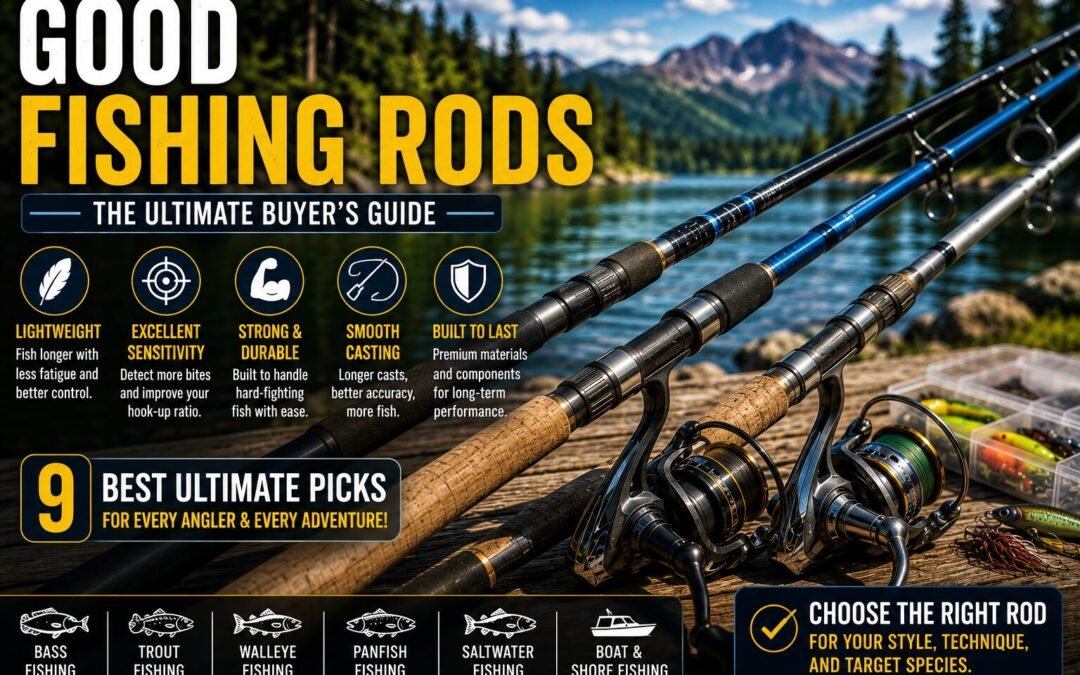
Good Fishing Rods: 7 Key Features for Better Fishing
Finding good fishing rods is not about choosing the most expensive model or buying whatever has the highest number of features. A good fishing rod is one that matches the way you fish, the species you target, the lures or bait you use, and the environment where you fish.
A rod that works well for trout in a narrow stream may not be suitable for heavy bass techniques, catfish, surf fishing, or large saltwater species. Rod length, power, action, material, lure rating, line rating, handle design, and reel compatibility all influence how a rod performs.
This guide explains what makes a fishing rod good, how to compare different rod types, what specifications matter most, and how to choose a rod for beginners, freshwater fishing, bass, trout, panfish, and other common situations. It also explains common buying mistakes and how to evaluate a rod before spending your money.
What Makes Good Fishing Rods?
Good fishing rods are rods that provide the combination of characteristics needed for a particular fishing application. The ideal rod should feel appropriate in your hands while also providing suitable strength, sensitivity, casting performance, and control.
There is no single specification that determines whether a rod is good. A rod can have excellent sensitivity but be unsuitable for heavy fish. Another rod may have tremendous strength but be unnecessarily heavy for lightweight fishing.
A useful rod should therefore be judged in context.
For example, a light spinning rod can be an excellent choice for trout and panfish but a poor choice for heavy bass fishing around dense vegetation. A medium-heavy casting rod may be useful for bass but unnecessarily powerful for small stream trout.
Before purchasing, identify the fishing situation first and then choose the rod specifications that match it. Take Me Fishing's fishing rod guide also explains why anglers should consider rod length, power, action, line, and lure requirements together.
Why Good Fishing Rods Matter
Your rod is the connection between you and the fish. It controls the lure or bait, helps you detect bites, sets the hook, and absorbs pressure while you fight a fish.
A poorly matched rod can make each of these tasks more difficult.
A rod that is too heavy may reduce sensitivity when using light presentations. A rod that is too light may lack the backbone needed for a larger fish. A rod that is too short may limit casting distance, while an unnecessarily long rod can be awkward in a confined fishing area.
Good equipment also helps reduce fatigue. When a rod and reel feel balanced, repeated casting becomes more comfortable. This matters especially when fishing for several hours.
The goal is not to find a rod that is perfect in every category. The goal is to find a rod whose characteristics make sense for the type of fishing you actually do.
7 Important Features of Good Fishing Rods
1. Appropriate Rod Length
Length is one of the first specifications to consider. Fishing rods are available in many lengths, with shorter and longer designs serving different purposes.
Longer rods can help increase casting distance and provide additional leverage. They can be useful when fishing open shorelines, large lakes, or other environments where there is plenty of room for a casting motion.
Shorter rods can provide greater control and maneuverability. They are often useful around docks, vegetation, tight river banks, small streams, and other areas where a long rod can become awkward.
Do not choose a rod based on length alone. Consider your fishing environment and the technique you plan to use.
Our fishing rod length guide provides more information on this specification.
2. The Right Rod Power
Rod power describes how much force is needed to bend the rod. Common categories include ultralight, light, medium-light, medium, medium-heavy, and heavy.
A light rod is designed for lighter tackle and smaller fish, while heavier powers provide additional backbone for larger fish, stronger line, heavier lures, and more demanding applications.
Power should always be considered alongside the manufacturer's line and lure ratings.
For example, two rods may both be seven feet long, but one may be medium-light while another is medium-heavy. They can feel completely different when casting and fighting fish.
Learn more with our fishing rod power guide.
3. The Correct Rod Action
Rod action describes where the rod begins to bend under load and how quickly the blank responds.
Fast-action rods generally bend closer to the tip, while moderate actions allow the bend to move farther down the blank. Slower actions can load more deeply into the blank.
Action can influence lure control, sensitivity, casting feel, and how the rod behaves when fighting fish.
For example, an angler who needs a quick response from the upper section of the rod may prefer a fast-action design, while another angler may prefer the smoother loading behavior of a moderate action.
Read our fishing rod action guide for a more detailed explanation.
4. Suitable Rod Material
Rod material affects weight, sensitivity, flexibility, and durability.
Graphite
Graphite rods are commonly valued for being lightweight and sensitive. They can be useful for anglers who need to detect subtle contact with the lure or bait.
Fiberglass
Fiberglass rods are generally more flexible and forgiving. They can be useful when durability and a softer loading characteristic matter.
Composite Construction
Composite rods combine characteristics of different materials. Their actual performance depends on the specific construction rather than the word “composite” alone.
When comparing rods, look at how the material contributes to the intended application rather than assuming one material is automatically better.
5. Appropriate Lure Rating
The lure rating tells you the range of lure weights the manufacturer expects the rod to handle.
This specification is particularly important because the rod needs to load properly during a cast. If the lure is too light, the rod may not load effectively. If the lure is too heavy, you may be asking the rod to perform outside its intended range.
Always compare the lure weights you actually use with the manufacturer's recommendations before buying.
6. Appropriate Line Rating
Line rating provides another important indication of the rod's intended use.
A rod designed for light line is fundamentally different from one intended for heavy line and powerful fish. Line rating should be considered together with rod power, target species, lure weight, and fishing environment.
When buying a rod, do not focus on power alone. Review the complete specification label.
7. Comfortable Handle and Balanced Setup
A good rod should also feel comfortable when held and cast repeatedly.
The handle material, grip shape, length, and reel-seat design can affect comfort. A rod may have excellent technical specifications but still feel awkward if the handle does not suit your hands or fishing technique.
Balance matters too. The rod and reel should work together as a complete setup. An oversized reel on a light rod can make the outfit feel heavy, while an undersized reel may not provide sufficient line capacity for the intended application.
Take Me Fishing also discusses the importance of matching rod and reel characteristics rather than treating the two pieces of equipment as completely separate.
Types of Good Fishing Rods
Spinning Rods
Spinning rods are among the most versatile options for freshwater fishing and many light saltwater applications. They are paired with spinning reels and work well with a broad selection of bait and artificial lures.
They are especially practical for beginners because the basic casting technique is relatively straightforward.
See our spinning fishing rods guide.
Casting Rods
Casting rods are designed to pair with baitcasting and other casting reels. They are commonly used when anglers want strong lure control, heavier lure capability, or precise placement around cover.
Bass anglers frequently use casting rods for techniques involving heavier lures and stronger line.
Read our casting rods guide for more information.
Ultralight Rods
Ultralight rods are designed around small lures and light line. They are commonly used for trout, crappie, bluegill, perch, and other smaller freshwater species.
The lighter setup can improve sensitivity and make smaller fish more enjoyable to catch.
Medium-Light Rods
Medium-light rods provide more strength than ultralight equipment while maintaining a relatively light and responsive feel.
They can be useful for trout, walleye, finesse bass techniques, perch, and similar light to moderate applications.
Medium Rods
Medium-power rods are among the most versatile options for general-purpose freshwater fishing.
They can handle a variety of lures and species when the manufacturer's line and lure ratings match the tackle being used.
Medium-Heavy Rods
Medium-heavy rods provide additional backbone and are often used for bass fishing, larger lures, and applications where fish need to be controlled around cover.
They are useful when a lighter rod would lack sufficient strength.
Heavy Rods
Heavy-power rods are built for demanding applications. They may be appropriate for large catfish, heavy bass techniques, predator fishing, or other situations requiring substantial lifting power.
Good Fishing Rods Comparison Table
| Rod Type | Typical Application | Main Strength | Important Consideration |
|---|---|---|---|
| Spinning | General freshwater and light tackle | Versatility | Match the spinning reel and line |
| Casting | Bass and heavier lure techniques | Control and power | Requires a suitable casting reel |
| Ultralight | Trout and panfish | Sensitivity | Limited heavy-tackle capability |
| Medium-Light | Light freshwater applications | Balance of sensitivity and strength | Check lure rating |
| Medium | General-purpose fishing | Versatility | Not intended for every heavy application |
| Medium-Heavy | Bass and heavy cover | Backbone | Less suitable for very light presentations |
| Heavy | Large fish and heavy tackle | Lifting power | Heavier and less sensitive for light fishing |
How to Choose Good Fishing Rods
Start With Your Fishing Environment
Think about where you spend most of your time fishing.
Small streams, large rivers, ponds, lakes, piers, boats, and surf environments all create different requirements.
A long rod may be useful on an open shoreline, while a shorter rod can be easier to handle under trees or around tight banks.
Identify the Main Species
The species you target should influence the rod's power, action, length, and line rating.
Small panfish, trout, and perch can be targeted with much lighter tackle than catfish, heavy bass presentations, or large predator fish.
Think about the species you target most often rather than choosing equipment solely around the possibility of catching a much larger fish.
Match the Lure or Bait
Choose the rod around the actual lures and rigs you use.
If your fishing relies on very light lures, a heavy rod may not load properly. If you use heavy jigs, large plugs, or other substantial presentations, a very light rod may not be appropriate.
Match the Reel
The reel should complement the rod.
Consider reel size, weight, line capacity, drag requirements, and the overall balance of the setup.
For beginners, a rod-and-reel combo can simplify this process because the two pieces are already paired.
Consider Your Skill Level
Beginners usually benefit from equipment that is versatile and easy to use.
Experienced anglers may prefer more specialized rods because they understand the techniques they use and can take advantage of differences in action, power, length, and construction.
Good Fishing Rods for Beginners
Beginners do not need to own a large collection of rods immediately.
A versatile spinning rod can be a practical starting point because it can cover a variety of common freshwater situations and is relatively easy to learn.
A medium or medium-light setup may suit many general applications when the line and lure ratings are appropriate.
Beginners should pay attention to:
- Rod length
- Power
- Action
- Lure rating
- Line rating
- Reel compatibility
- Target species
- Fishing environment
Our fishing rod buying guide provides additional help with these specifications.
Good Fishing Rods for Freshwater
Freshwater fishing covers many species and environments, so versatility is often valuable.
A medium or medium-light spinning setup can cover a broad range of situations. Lighter rods can be used for trout and panfish, while medium-heavy and heavy setups can be chosen for larger fish or heavier presentations.
The key is matching the complete setup to the environment and target species.
Explore our fishing rods section for additional information.
Good Fishing Rods for Bass
Bass fishing involves a wide variety of techniques.
A medium spinning rod can be useful for lighter presentations, while a medium-heavy casting rod can provide additional control with heavier lures and stronger line.
Fishing around vegetation, docks, timber, and heavy cover can require more backbone because the angler may need to control the fish quickly after the strike.
Rod power and action should therefore be considered together rather than selecting a rod simply because it is marketed for bass.
Good Fishing Rods for Trout
Trout fishing commonly involves lighter tackle.
Light and ultralight rods can provide the sensitivity and flexibility needed for small lures, spinners, jigs, and bait.
Rod length should reflect the environment. Narrow streams may favor a shorter rod for maneuverability, while open rivers and lakes can allow longer rods.
See our trout fishing rods guide for more information.
Good Fishing Rods for Panfish
Panfish are excellent targets for light and ultralight equipment.
Because these species are generally smaller, a light setup can provide a more enjoyable fight while allowing anglers to fish small lures and light line.
Our panfish rod guide provides additional information.
Good Fishing Rods for Catfish
Catfish rods need to be selected according to the species, size of fish, bait, sinker weight, and fishing environment.
Some catfish applications can be handled with moderate tackle, while larger fish can require considerably more power.
Consider the total weight of your bait and rig before deciding on rod power.
See our catfish rod guide for more details.
Good Fishing Rods for Saltwater
Saltwater fishing can require stronger equipment and more attention to environmental conditions.
Inshore, surf, and offshore applications are not identical. The appropriate rod depends on target species, lure weight, line strength, fishing location, and technique.
For saltwater-specific guidance, see Take Me Fishing's saltwater rods and reels information.
Rod Material and Construction
Construction affects how a fishing rod feels and performs.
Graphite is commonly chosen for light weight and sensitivity. Fiberglass is generally valued for flexibility and durability. Composite construction attempts to combine characteristics of different materials.
When comparing rods, avoid choosing based solely on material names. Look at the complete design and determine whether it fits your technique.
Spinning Rod vs. Casting Rod
| Feature | Spinning Rod | Casting Rod |
|---|---|---|
| Typical reel | Spinning reel | Baitcasting or casting reel |
| Beginner use | Common starting option | Usually requires more practice |
| Lighter lures | Highly suitable | Technique-dependent |
| Heavier applications | Available in stronger powers | Common choice |
| General versatility | High | High for experienced anglers |
The correct choice depends on how you fish. Spinning rods can be especially practical for beginners and lighter tackle, while casting rods can offer strong control for heavier techniques.
Common Mistakes When Buying Fishing Rods
Buying the Most Expensive Rod
Price does not automatically determine suitability. A premium rod designed for a specialized technique may be less useful to you than a moderately priced rod that matches your fishing style.
Choosing Only by Brand
Brand reputation can help narrow options, but the individual model's length, power, action, lure range, and line rating are more relevant to the actual application.
Ignoring Lure Weight
Always check whether the rod is appropriate for the weight of the lures you intend to cast.
Ignoring Line Rating
The line rating helps define the type of tackle the rod was designed to handle.
Using the Wrong Power
Very light rods should not be selected for heavy applications simply because they feel comfortable. Likewise, heavy rods can be unnecessarily cumbersome for small species.
Forgetting the Reel
The rod should be considered as part of a complete fishing system. A mismatched reel can reduce balance and comfort.
Good Fishing Rods Buying Checklist
| Specification | What to Ask |
|---|---|
| Length | Will it suit my fishing environment? |
| Power | Is it strong enough for my target fish and tackle? |
| Action | Does the bend suit my technique? |
| Lure rating | Does it match the lures I use? |
| Line rating | Does it match my intended line? |
| Material | Does the construction suit my priorities? |
| Reel compatibility | Will the complete setup feel balanced? |
| Handle | Is it comfortable for repeated casting? |
| Target species | Is it appropriate for the fish I pursue? |
| Environment | Will it be practical where I fish? |
Fishing Rod Examples on HookedBeginner
Once you know the specifications you need, you can compare actual fishing rods in the HookedBeginner catalog.
- St. Croix Premier 2025 Spinning Rods
- Shimano Clarus E Spinning Rods
- St. Croix Triumph Spinning Rods
- G. Loomis IMX-PRO Steelhead Rods
- Torrent Casting Rod
- Carbon R1 Casting Rod
Always review the current specifications for the exact model before purchasing, including length, power, action, lure weight, line rating, and intended use.
Related Fishing Rod Guides
Continue your research with these related HookedBeginner resources:
- Best Fishing Rods
- Best Fishing Poles
- Affordable Fishing Rods
- Budget Fishing Pole
- Budget-Friendly Fishing Rod
- Best Rated Fishing Rod
- Best Fishing Rod Brands
- Fishing Rod Buying Guide
Frequently Asked Questions About Good Fishing Rods
What makes a good fishing rod?
A good fishing rod matches the target species, fishing environment, lure or bait, line, and technique while providing appropriate length, power, action, sensitivity, and comfort.
What is a good fishing rod for beginners?
A versatile spinning rod is a practical starting point for many beginners because it can handle a broad range of common freshwater applications and is relatively easy to learn.
What fishing rod length is best?
There is no universal length. Longer rods can help with casting distance, while shorter rods can offer better control in tight areas. The correct length depends on the environment and technique.
What is rod power?
Rod power describes how much force is required to bend the rod. Light powers are suited to lighter tackle, while heavy powers are designed for stronger applications.
What is rod action?
Rod action describes where the blank bends when loaded. Fast actions generally bend closer to the tip, while moderate and slower actions bend farther down the blank.
Are expensive fishing rods better?
Higher-priced rods can offer advantages such as reduced weight, increased sensitivity, premium components, or specialized construction. However, a more expensive rod is not automatically more suitable for your particular fishing application.
Are graphite fishing rods good?
Graphite rods are commonly valued for their low weight and sensitivity. They can be useful for techniques where detecting subtle contact with the lure or bait is important.
Are fiberglass rods good?
Fiberglass rods are generally flexible and durable. They can be useful when a more forgiving rod is desirable.
Should I buy a spinning rod or casting rod?
Choose according to the fishing techniques you plan to use. Spinning rods are often practical for beginners and lighter tackle, while casting rods are commonly used for heavier lures and techniques requiring additional control.
Can one good fishing rod handle multiple species?
Yes. A versatile rod can handle several species when their tackle requirements overlap. General-purpose medium or medium-light setups can be useful for many freshwater situations.
Final Thoughts
The best way to identify good fishing rods is to stop looking for one universal specification and start matching the rod to your actual fishing.
Consider where you fish, what species you target, what lures or bait you use, and what line you intend to fish. Then evaluate length, power, action, material, lure rating, line rating, reel compatibility, and comfort.
A versatile spinning rod can be a practical starting point for beginners. As your experience grows, you may discover that a specialized rod for bass, trout, catfish, saltwater, surf fishing, or another technique gives you better control for that particular application.
Price and brand can help narrow the market, but the specifications should ultimately determine whether a rod fits your needs.
For more help choosing your next setup, continue with our Fishing Rod Buying Guide, Fishing Rod Power Guide, and Fishing Rod Action Guide.