
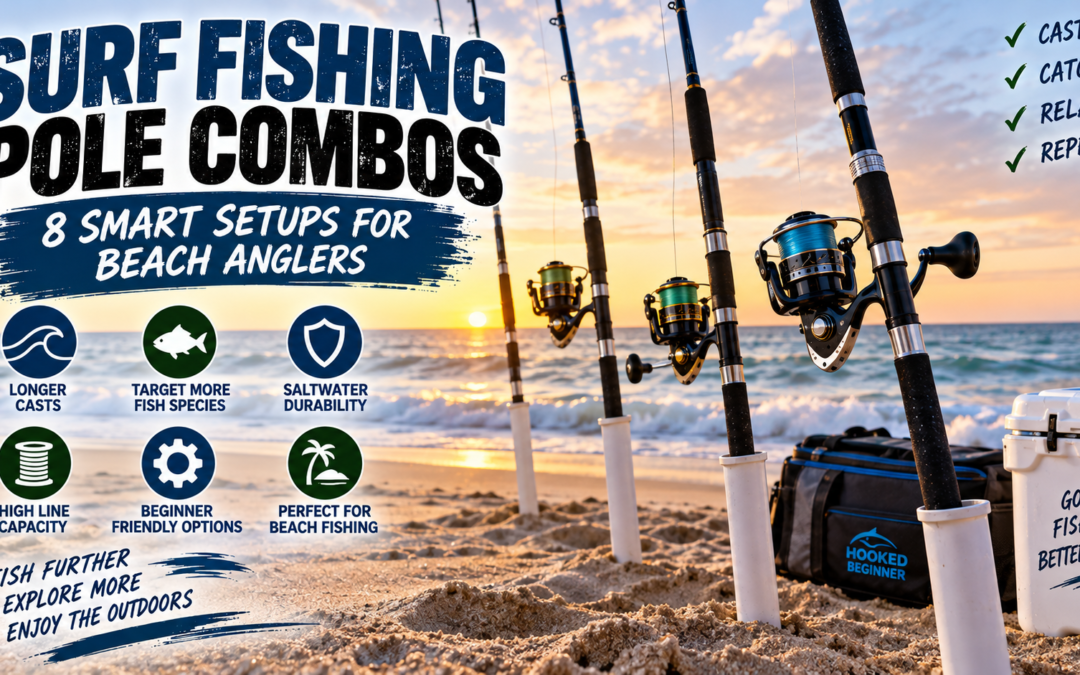
Surf Fishing Pole Combos: 8 Smart Setups for Beach Anglers
Choosing the right surf fishing pole combos can make beach fishing much easier, especially when you need enough casting distance, line capacity, power, and saltwater durability in one setup. A surf combo pairs a fishing rod with a reel so the two pieces work together rather than leaving you to match every component separately.
Surf fishing creates different equipment demands from fishing a small pond or protected lake. You may need to cast beyond breaking waves, handle heavier sinkers, work with larger baits, and deal with salt spray, sand, wind, and strong fish. The correct combination therefore depends on where you fish, what you target, how far you need to cast, and the weight of the terminal tackle.
Take Me Fishing notes that surf anglers should consider target species, the distance needed to reach the breaker zone, and the weights being cast when selecting a surf rod and reel. Its current saltwater rod-and-reel guidance also emphasizes rod length, power, action, line rating, and construction. Read the surf fishing rod and reel selection guide and the saltwater rods and reels guide.
This guide breaks down 8 surf fishing pole combos for different beach-fishing needs, then explains how to compare rod length, power, action, reel size, line capacity, construction, casting weight, and overall balance before buying.
What Are Surf Fishing Pole Combos?
Surf fishing pole combos are matched rod-and-reel packages designed or marketed for fishing from beaches, shorelines, jetties, and other coastal locations. The rod provides casting length and backbone while the reel supplies line capacity, drag, retrieve, and the mechanical system needed to handle a fish.
The word "combo" matters because the rod and reel are selected as a pair. Instead of buying a 10- or 12-foot rod and then guessing which reel size will balance it, a combo can reduce some of the matching work.
That does not mean every surf combo is equally suitable for every situation. A light beach setup for smaller species can be very different from a heavy setup used for large baits, strong current, or powerful fish.
Before choosing your outfit, it helps to understand the fundamentals of fishing rods. The Hooked Beginner fishing rods guide provides broader information about rod types, while the fishing rod length guide covers how length affects casting and control.
Why Surf Fishing Pole Combos Matter
1. Rod and Reel Balance
A surf rod and reel should feel like a single setup rather than two unrelated pieces of equipment. A reel that is too small may look neat but lack sufficient line capacity or balance, while an unnecessarily large reel can add weight and make long casting sessions tiring.
2. Casting Distance
Surf fishing often involves placing bait or lures at a particular distance from shore. Rod length, action, casting weight, technique, and line all influence how efficiently the setup casts.
Longer rods can provide leverage and help with casting distance, although longer is not automatically better. The best length is the one that fits your casting ability, fishing location, and target species.
3. Line Capacity
A surf reel needs enough line for the style of fishing you plan to do. Long casts already remove line from the spool, and a strong fish can take substantially more.
Reel capacity should therefore be considered alongside line diameter and breaking strength rather than treated as an isolated number.
4. Saltwater Durability
Saltwater, spray, sand, and moisture are hard on fishing equipment. A good surf setup should be selected with the environment in mind, and it should be maintained properly after use.
Take Me Fishing specifically recommends considering saltwater reel construction because surf fishing exposes equipment to spray and sand. See its surf fishing equipment guidance.
5. Casting Weight Compatibility
One of the most important specifications on a surf rod is its recommended lure or casting-weight range. A rod designed for light presentations should not be pushed beyond its stated rating simply because a heavier sinker seems useful.
Matching the rod to the actual weight you intend to cast is more important than choosing a rod simply because it is labeled "surf."
8 Surf Fishing Pole Combos to Consider
1. Medium-Heavy Spinning Surf Combo
A medium-heavy spinning outfit is a practical category for anglers who want a balance of casting power, manageable weight, and broad use. It can suit a variety of beach applications where moderate-to-heavier tackle is required without moving immediately into the largest surf equipment.
This type of setup can be useful for anglers targeting species such as striped bass, redfish, snook, drum, smaller sharks, and other coastal fish where tackle requirements overlap. The actual suitability depends on local regulations, species size, bait, and the rod's published ratings.
A medium-heavy setup is also relatively approachable for anglers transitioning from freshwater equipment into surf fishing.
2. Long-Cast 10-Foot Surf Combo
A 10-foot surf combo can provide a useful compromise between casting leverage and overall handling. It is long enough for many beach applications while remaining more manageable than some of the longest surf rods.
This category makes sense for anglers who regularly need additional casting reach but still want a setup that is reasonably convenient to transport and use.
Pay close attention to the rod's casting-weight range because two 10-foot rods can be designed for substantially different applications.
3. 11-Foot Surf Spinning Combo
An 11-foot surf spinning combo offers additional length for anglers who prioritize casting distance and leverage. This can be useful on broad beaches where you need to reach beyond shallow nearshore water.
However, an 11-foot rod also requires more room and can feel noticeably different from a standard freshwater setup. Beginners should consider both the rod's physical weight and the effort required to cast it repeatedly.
4. 12-Foot Heavy Surf Combo
A 12-foot combo can be appropriate when maximum casting leverage and heavier tackle are major priorities. Take Me Fishing notes that 10- to 12-foot rods are a common range for general surf fishing and describes a beginner surf setup around that size range when paired with an appropriately sized saltwater spinning reel. Review the full guide.
Longer rods are not automatically the right answer for every angler. If your fishing style involves frequent repositioning, steep terrain, crowded beaches, or shorter casts, a slightly shorter rod may be easier to use.
5. Beginner Surf Spinning Combo
A beginner-friendly spinning combo is designed around simplicity. The goal is to make the rod and reel easy enough to learn without immediately requiring highly specialized techniques.
A moderate-length spinning rod with a reel large enough for the intended line and casting weight can provide a practical starting point.
Beginners should prioritize correct specifications over flashy features. A balanced setup that fits the fishing environment is generally more useful than an oversized outfit chosen solely because it looks powerful.
6. Long-Distance Beach Combo
Long-distance surf fishing pole combos are built around casting efficiency. Rod length, action, guide design, spool dimensions, line choice, and casting weight can all contribute to how well the setup performs.
These combos are useful for open beaches where fish regularly hold beyond the first line of breakers or where conditions make longer casts advantageous.
Distance should still be treated as one part of the equation. Accuracy, safe casting technique, line control, and the ability to handle a fish once hooked are equally important.
7. Heavy-Duty Saltwater Combo
A heavy-duty saltwater combo is intended for stronger fish, larger baits, heavier sinkers, or tougher conditions. The reel generally needs more robust gearing, drag capability, and line capacity than a light beach setup.
This category is better suited to anglers who already know the species and terminal tackle they are targeting. Buying the heaviest available equipment without a specific need can make the outfit unnecessarily tiring.
8. Travel-Friendly Surf Combo
A travel-friendly surf combo focuses on transportation as well as fishing performance. Two-piece or travel-oriented rods can be easier to transport in vehicles and luggage than very long one-piece surf rods.
The trade-off is that portability may affect overall rod length, section design, or convenience. Compare the packed length against how you actually travel before making a decision.
Surf Fishing Pole Combos Comparison
| Combo Type | Main Strength | Typical Use | What to Watch |
|---|---|---|---|
| Medium-heavy spinning | Balanced power and versatility | General beach fishing | Match lure and line ratings |
| 10-foot long-cast | Good reach with manageable length | Open beaches | Casting-weight range |
| 11-foot spinning | Added leverage | Longer casts | Overall weight |
| 12-foot heavy surf | Maximum leverage in this group | Heavy rigs and long casts | Transport and fatigue |
| Beginner spinning | Simplicity | New surf anglers | Do not oversize the outfit |
| Long-distance | Casting efficiency | Deep water beyond breakers | Technique and accuracy |
| Heavy-duty saltwater | Strength and capacity | Larger fish and heavier tackle | Weight and balance |
| Travel-friendly | Portability | Road and air travel | Packed length |
How to Choose the Right Surf Fishing Pole Combos
1. Start With Your Target Fish
The species you plan to target should influence almost every other decision. A setup for smaller coastal fish can be significantly different from one built around large rays, sharks, drum, striped bass, or other powerful species.
Research local species and regulations before buying. In the United States, NOAA Fisheries notes that saltwater size and possession limits can vary by species, season, and jurisdiction, and state rules can differ from federal rules. Review current regional saltwater fishing regulations and resources.
2. Choose Rod Length
Rod length is one of the most visible differences between surf equipment and many freshwater setups.
A shorter surf rod can be easier to handle and may provide better control in certain locations. A longer rod can help provide leverage and reach when longer casts are needed.
Our fishing rod length guide is useful when comparing these characteristics.
3. Match Rod Power
Power describes how much force the rod is designed to handle. Light, medium, medium-heavy, and heavy rods are not interchangeable simply because they are all labeled as surf rods.
Use the rod's actual ratings and the type of fish, bait, sinker, and line involved to determine the appropriate power.
For more detail, see the fishing rod power guide.
4. Consider Rod Action
Action refers to where the rod bends along its blank. Faster action generally produces a quicker, more concentrated bend, while moderate actions distribute the bend farther down the rod.
Surf anglers should consider how the action interacts with the casting style, lure or bait, and hook-setting requirements.
The fishing rod action guide explains this in more detail.
5. Choose Reel Size
Reel size needs to match the rod, line, casting needs, and target species. Larger surf reels typically provide greater line capacity, but they also add weight.
Take Me Fishing's surf-fishing guidance identifies 4500- to 6500-size saltwater spinning reels as a general beginner range for a 10- to 12-foot medium-heavy surf rod, while stressing that equipment should be matched to the actual fishing application. See the source guidance.
6. Check Line Capacity
Do not choose a reel based on its number alone. Check the manufacturer's stated capacity for the specific line diameter and type you intend to use.
Long surf casts consume line quickly, and a hooked fish can remove much more. Sufficient capacity gives you a greater margin for those situations.
7. Check the Casting-Weight Range
This specification is critical. If you expect to cast heavy sinkers and bait, the rod should be rated for the weight you intend to use.
Never assume that a longer or heavier-looking rod can automatically handle more weight. Follow the manufacturer's stated rating.
8. Evaluate Saltwater Construction
Surf equipment should be selected with salt exposure in mind. Consider the reel's corrosion resistance, sealing, drag system, frame construction, and maintenance requirements.
The rod also needs appropriate guides, reel-seat construction, and materials for the intended environment.
9. Think About Weight
Surf fishing can involve repeated casts over several hours. Equipment that feels acceptable for ten casts can become tiring after a hundred.
A lighter setup is not automatically better, but you should balance power against the amount of time you expect to hold, cast, and reposition the outfit.
10. Consider Your Skill Level
More powerful tackle can require more controlled casting technique. Beginners should avoid buying specialized heavy equipment simply because it appears more capable.
The best starting setup is one that fits the actual fishing you will do and that you can control comfortably.
Choosing Surf Fishing Pole Combos for Different Use Cases
For Beginners
Beginners should usually prioritize simplicity and versatility. A balanced spinning combo with understandable specifications is easier to learn than a highly specialized outfit.
Start with the fish, beach, line, and casting weight you actually expect to use. Then select the rod and reel around those requirements.
For Long Beach Casts
When distance is important, rod length, action, casting weight, and line choice become particularly relevant. A longer rod can provide useful leverage, but casting technique still determines how effectively that potential is used.
The goal is not simply to buy the longest rod. It is to build a setup you can load and cast efficiently while maintaining control.
For Heavy Bait
Heavy bait applications require a rod rated for the weight being cast and a reel with sufficient capacity and drag capability for the target species.
Do not use a lighter rod simply because it feels more comfortable. The casting rating should come first.
For Smaller Coastal Species
A lighter surf setup can improve comfort when heavy equipment is unnecessary. Smaller species often do not require the same line capacity, rod power, or sinker weight as larger surf targets.
This can produce a more enjoyable setup for anglers who fish close to shore and do not need extreme casting distance.
For Jetty and Rocky Shorelines
Jetty fishing introduces additional considerations because footing, obstacles, current, and nearby structure can make rod control more important.
Choose equipment that gives you enough lifting power for the target fish while remaining manageable in the specific fishing environment.
For Saltwater Travel
Traveling with surf gear adds another variable: packed size. A two-piece or travel surf rod can simplify transportation, especially when vehicle space is limited.
Protect the guides, blank, reel, and connections during transport and rinse the equipment after saltwater use.
Materials and Setup for Surf Fishing Pole Combos
Rod Materials
Modern saltwater rods are commonly produced from graphite, fiberglass, or combinations of materials. Take Me Fishing notes that graphite tends to be stiffer and more sensitive, while fiberglass tends to be tougher and more powerful. See its saltwater rod and reel guide.
The choice depends on the balance of sensitivity, durability, weight, flexibility, and the style of fishing involved.
Spinning Reels
Spinning reels are common in surf fishing because they are relatively straightforward to cast and can accommodate long-distance beach fishing techniques.
Look at spool capacity, drag, gearing, corrosion resistance, and the manufacturer's intended saltwater use.
Monofilament, Braid, and Leader Systems
Your reel should be selected with your intended line in mind. Monofilament, braid, and leader systems each have different characteristics.
Braid can provide high strength for its diameter, while monofilament can offer stretch and straightforward handling. The leader system should reflect the species, structure, bait, and water conditions.
Sinkers and Terminal Tackle
Surf fishing often requires sinkers heavy enough to hold position in moving water. The weight must remain within the rod's stated casting range.
Match the sinker style to the bottom, current, waves, and fishing method rather than simply using the heaviest option available.
Hooks and Regulations
Local rules may specify permitted hooks, bait, minimum sizes, seasons, or other requirements. NOAA Fisheries emphasizes that anglers should check current regulations for the species and area they are fishing. Check current NOAA recreational saltwater information.
Common Surf Fishing Pole Combo Mistakes
Choosing the Longest Rod Automatically
Length can help with reach, but it also increases weight, transport difficulty, and casting demands. Choose the length that fits your actual fishing conditions.
Ignoring Casting Weight
A surf rod can be long and powerful without being designed for every heavy sinker. Always check the manufacturer's weight range.
Using an Undersized Reel
An undersized reel can limit line capacity and create an awkward balance on a long surf rod.
Buying an Oversized Setup
More power and capacity are not always useful. Oversized tackle can become tiring and may reduce sensitivity and enjoyment when targeting smaller fish.
Ignoring Corrosion
Saltwater damage does not stop when you leave the beach. Salt residue can remain on reels, guides, handles, and hardware if equipment is not cleaned correctly.
Not Practicing Your Cast
A high-powered surf rod does not automatically produce long casts. Casting mechanics matter, and beginners benefit from learning how their rod loads before adding more weight or power.
Focusing Only on the Reel
A large reel cannot compensate for a poorly matched rod. Rod length, power, action, line rating, casting weight, and balance all need to work together.
Ignoring Local Fishing Rules
Saltwater rules can change by species, location, season, and jurisdiction. Check the current regulations before fishing rather than relying on an old guide or memory.
Surf Fishing Pole Combos Buying Checklist
| Check | What to Look For |
|---|---|
| Target species | Match the outfit to the fish you intend to target |
| Rod length | Balance casting distance, control, and portability |
| Rod power | Match power to fish, bait, line, and casting needs |
| Rod action | Choose an action appropriate for casting and presentation |
| Casting weight | Stay within the manufacturer's stated range |
| Reel size | Match the reel to the rod and intended line |
| Line capacity | Ensure enough capacity for long casts and strong fish |
| Drag | Choose a drag system suited to your target species |
| Saltwater construction | Look for appropriate corrosion resistance and maintenance requirements |
| Overall weight | Consider how the combo feels after repeated casts |
| Portability | Check rod sections and packed length if traveling |
| Local regulations | Verify current size, season, gear, and possession requirements |
Related Fishing Guides
Building an effective surf setup is easier when you understand how each component works. Continue with these Hooked Beginner guides:
- Fishing Rods Guide — Review common rod types and applications.
- Fishing Rod Buying Guide — Compare the specifications that matter before buying.
- Fishing Rod Length Guide — Understand how rod length changes casting and control.
- Fishing Rod Power Guide — Match rod power to fish and tackle.
- Fishing Rod Action Guide — Learn how action affects rod behavior.
- Fishing Reel Buying Guide — Compare reel size, capacity, drag, and other important specifications.
- Fishing Reel Size Guide — Understand how reel sizing relates to your setup.
Relevant Hooked Beginner Products
Hooked Beginner's catalog also includes saltwater-oriented and rod-and-reel equipment that can be useful when comparing components. Always verify the current product specifications and intended application before ordering.
Piscifun Nautix Saltwater Reel
Spinning Rod and Reel Combo Category
Frequently Asked Questions
What size rod is best for surf fishing?
There is no universal best size. Many general surf setups fall around the 10- to 12-foot range, but the appropriate length depends on casting distance, target species, casting weight, beach conditions, and angler ability. Take Me Fishing's surf-fishing guidance discusses 10- to 12-foot rods as a common beginner range. Read the source guide.
What reel size is good for surf fishing?
Reel size depends on the rod, line, target fish, and casting needs. Take Me Fishing gives a general 4500- to 6500-size saltwater spinning reel range for a 10- to 12-foot beginner surf setup, but the manufacturer's specifications and your intended fishing should determine the final match.
Are surf fishing pole combos good for beginners?
They can be a practical starting point because the rod and reel are already matched as a package. Beginners should still verify the rod length, power, action, casting-weight range, reel size, and intended saltwater use.
Can I use a freshwater reel for surf fishing?
Some freshwater equipment may physically function in saltwater, but it may not be designed for repeated exposure to salt and sand. A reel intended for saltwater use is generally easier to justify when surf fishing is a regular activity.
Is a 10-foot surf rod enough?
A 10-foot rod can be enough for many beach-fishing situations. Whether it provides sufficient casting distance depends on your casting technique, rod action, casting weight, line, wind, beach structure, and the location of the fish.
Is a 12-foot surf rod better for long casts?
A 12-foot rod can provide additional leverage and may help with longer casts, but only when the angler can efficiently load and control it. A longer rod is not automatically more effective for every person or fishing situation.
What line should I use on a surf fishing combo?
Line choice depends on target species, structure, casting style, and the rod and reel specifications. Common choices include monofilament and braid, often combined with an appropriate leader system.
What sinker weight should I use for surf fishing?
Use a sinker that holds bottom under your conditions while staying within the rod's recommended casting-weight range. Current, waves, bottom type, bait, and fishing method all influence the appropriate choice.
Should I choose spinning or conventional surf equipment?
Both systems can be effective. Spinning equipment is often easier for many beginners to learn, while conventional setups can offer different casting and line-management characteristics. Choose based on your experience, technique, and target application.
How do I protect a surf fishing combo from saltwater?
Follow the reel and rod manufacturer's cleaning recommendations, remove salt and debris after fishing, keep the equipment dry during storage, and inspect guides, reel components, drag systems, and connections regularly.
Do surf fishing pole combos need to be rinsed after every trip?
Regular cleaning is important after saltwater exposure. The exact method should follow the manufacturer's instructions because aggressive spraying or improper lubrication can introduce problems instead of preventing them.
Do surf anglers need to check fishing regulations?
Yes. Regulations can specify seasons, size limits, possession limits, gear restrictions, licenses, and species-specific requirements. NOAA Fisheries advises anglers to check current rules for the area and species being targeted. Regulations outside the United States will be governed by local authorities.
Final Thoughts
The right surf fishing pole combos are not chosen simply by picking the longest rod or the biggest reel. A successful setup begins with the fish you plan to target, the beach or shoreline where you will fish, the distance you need to cast, and the weight of the tackle you will throw.
For many anglers, a balanced spinning combo provides a straightforward place to start. From there, rod length, power, action, reel size, line capacity, casting weight, construction, and overall comfort should determine the specific setup.
Remember that surf fishing can put more stress on gear than many freshwater situations. Salt, sand, wind, heavier rigs, and long casts all make equipment selection and maintenance important.
Use the buying checklist above, compare the published specifications, and choose equipment you can comfortably cast and control. The best surf fishing pole combos are the ones that match your actual fishing conditions rather than simply having the largest numbers on the label.
Before heading to the beach, also verify the current local fishing regulations and conservation requirements. NOAA Fisheries recommends checking current rules because saltwater regulations can vary by species, location, season, and jurisdiction. Review current recreational saltwater fishing information.